
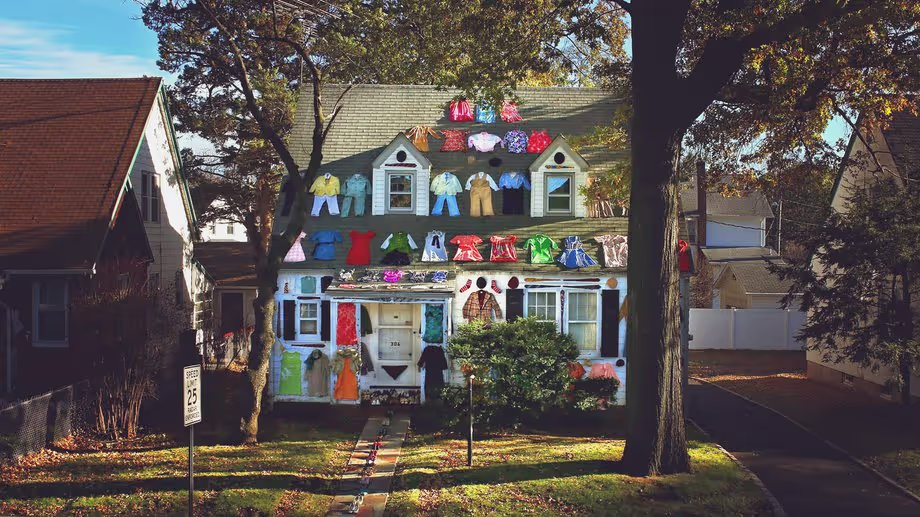
306 Hollywood Delve Deeper Reading List
Cooper, Anderson and Gloria Vanderbilt.The Rainbow Comes and Goes.Harper, 2016.
Anderson Cooper was busy with his career as a journalist when his mother, Gloria Vanderbilt, suffered her first serious illness at the age of ninety-one. After that experience, he decided to spend more quality time with her. This book follows a year-long conversation between mother and son discussing family history, personal tragedies and triumphs.
Heti, Sheila, Heidi Julavits and Leanne Shapton.Women in Clothes.Blue Rider Press, 2014.
A conversation among hundreds of women of all nationalities— famous, anonymous, religious, secular, married, single, young, old—on the subject of clothing, and how the garments we put on every day define and shape our lives.
Knisley, Lucy.Displacement: A Travelogue.Fantagraphics Books, 2015.
Displacementis Lucy Knisley’s graphic memoir of her experiences traveling with her aging grandparents on a cruise. Knisley explores her frustrations and fears while taking care of her grandparents and coming to terms with their mortality. The graphic novel looks at her family history, using her grandfather’s WWII memoir as a guide.
Lightman, Alan.Screening Room: A Memoir of the South.Pantheon Books, 2015.
Alan Lightman's grandfather, M.A. Lightman, was the family's undisputed patriarch. It was his movie theater empire that catapulted the Lightmans, a Hungarian Jewish immigrant family, to prominence in the South; his triumphs both galvanized and paralyzed his descendants. In this evocative personal history, the author chronicles his return to Memphis and the stifling home he was so eager to flee forty years earlier. As aging uncles and aunts retell old stories, Alan finds himself reconsidering long-held beliefs about his larger-than-life grandfather and his quiet, inscrutable father.
Shapiro, Bill and Naomi Wax.What We Keep: 150 People Share the One Object that Brings Them Joy, Magic, and Meaning.Running Press Adult, 2018.
Best-selling author and former editor-in-chief of LIFE magazine, Bill Shapiro shares the stories of 150 objects that are each deeply personal to their owners. The interviews range from renowned authors to everyday individuals. The stories are paired with photographs of the object and the interviewee.

Minding the Gap: Discussion Guide
Minding the Gap started as a series of interviews on a road trip and snowballed into a confrontational saga of everything I couldn’t make sense of as a child.
I was 8 years old when my single mother took a job in Rockford, Illinois, a crumbling factory city two hours west of Chicago. She remarried a physically and mentally abusive man, had a child with him and then remained with him for 17 years. Because of his explosive, often unpredictable violence, I perceived the world as lacking causality: you could do the right thing or the wrong thing, but either way things might not go well for you. After I started skateboarding at age 13, through many bruises, broken bones and hard-earned tricks, I gradually regained a sense of control over my pain. Most importantly, I found myself much happier with a group of outcasts in the streets than at home. We spent countless hours together, making our own version of a family.
In my late teens and early twenties, I was struck by loss. I’d permanently escaped my home to move to Chicago, and I wanted to know why so many of my peers were falling prey to drug addictions, jail sentences or worse. I was still filming skate videos for fun—driving solo around the country and couch-surfing with other skateboarding friends I’d met over the years. Eventually I began interviewing skateboarders: What does skateboarding feel like? Who do you love more, your mom or your dad? Who taught you the feeling of hate? These conversations often turned into impromptu therapy sessions, intimate spaces for catharsis and realizations.
I discovered a pattern of absent, distant and abusive father-figures—something that affected mental health, relationships and parenting styles. A little more than one year into the project, I returned to Rockford, where I sat with a charming, goofy 16-year-old named Keire in his mother’s attic and asked him about his father. He’d never talked about their relationship before and was fidgeting with the sleeves of his sweater. When he told me about his abusive father, I felt my chest tighten with anxiety. “Did you cry?” I asked. “Wouldn’t you?” he shot back. “I did cry,” I said. We sat in silence, neither of us daring to attempt a joke.
For the next four years, I returned to Rockford to continue following Keire, as well as the ad-hoc leader of the Rockford skateboarding community, a charismatic 23-year-old named Zack who was about to become a father himself. After partnering with Kartemquin Films, I wanted to explore the connected themes of skateboarding and violence in the home through a character-driven approach. I took on a more cinema vérité style, drawing inspiration from the films that resonated with me in my adolescence: Gummo, Waking Life, Kids, Slacker—stories that captivated me with their representations of growing up in a chaotic, uncertain world. I could relate to them, and through them I could also find hope.
As I began assembling rough cuts and holding feedback screenings, people were surprised at how close I was to the themes and community of the film. With their encouragement, I began participating in the film more. À la Sherman’s March, the cameraperson was cast as a character. But then everything changed when (spoiler alert) the mother of Zack’s child told me Zack had been battering her. The heart of the film, which had been exploring how skateboarders deal with masculinity and child abuse, suddenly became much more murky with immediate and personal ramifications; I was forced to become an active participant in the story, eventually interviewing my estranged mother and half-brother about my stepfather and revisiting old footage to find a way to tell my own story.
People are often surprised that I didn’t know Keire and only briefly knew Zack growing up but that we were still able to have candid and vulnerable moments with each other when I came back to Rockford. In the course of making the film, I realized that Zack, Keire and I were all harboring toxic experiences buried under the weight of years of societal and personal repression, and we all chose our own ways of dealing with that pressure. The film has given me a sense of clarity about myself and shown me that, while there’s no one-size-fits-all solution, some ways of coping aren’t sustainable.
What’s clear from doing this project is that violence and its sprawling web of effects are perpetuated in large part because these issues remain behind closed doors, both literally and figuratively. My hope is that the characters who open doors in Minding the Gap will inspire young people struggling with something similar—inspire them to see that they can survive their situations, live to tell their stories and create lives of causality for themselves.
— Bing Liu, Director
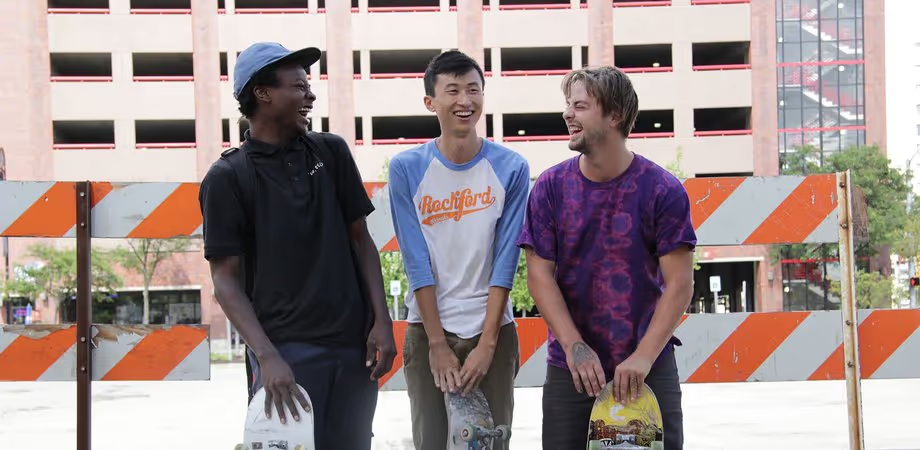
Minding the Gap: Educator Resource
Minding the Gap is a coming of age film by Bing Liu. Starting in high school, Bing begins to make skate videos. What starts as a hobby ends up as a profound exploration of issues that is likely to resonate deeply with students.
The diverse group of participants in the film – Bing, Keire, Zack, and Nina – see and feel the often jarring challenges of life in a small, declining Rust Belt city. Collectively, they experience family violence, substance abuse, economic insecurity, racism, and teen pregnancy, along with the typical struggles of identity formation as teens become adults. To cope, they skate — regulating the speed at which they move through life, attacking obstacles and flipping over platforms, sometimes unsuccessfully. The risks they take are sometimes rewarded and sometimes the source of pain. But they persevere.
Minding the Gap Delve Deeper Reading List
Thompson, Neal.Kickflip Boys: A Memoir of Freedom, Rebellion, and the Chaos of Fatherhood. Ecco, 2018.
What makes a good father, and what makes one a failure? Does less-is-more parenting inspire independence and strength, or does it encourage defiance and trouble? Kickflip Boys is the story of a father’s struggle to understand his willful skateboarder sons, challengers of authority and convention, to accept his role as a vulnerable “skate dad,” and to confront his fears that the boys are destined for an unconventional and potentially fraught future.
Cumming, Alan.Not My Father's Son: A Memoir. Dey Street Books, 2014.
When television producers approached Alan Cumming to appear on a popular celebrity genealogy show, he hoped to solve the mystery of his maternal grandfather's disappearance that had long cast a shadow over his family. But this was not the only mystery laid before Alan. Alan grew up in the grip of a man who held his family hostage, someone who meted out violence with a frightening ease, who waged a silent war with himself that sometimes spilled over onto everyone around him.
McClelland, Edward.Nothin' But Blue Skies: The Heyday, Hard Times, and Hopes of America's Industrial Heartland. Bloomsbury Press, 2013.
Nothin' but Blue Skies tells the story of how the country's industrial heartland grew, boomed, bottomed, and hopes to be reborn. Through a propulsive blend of storytelling and reportage, celebrated writer Edward McClelland delivers the rise, fall, and revival of the Rust Belt and its people.
Hooks, Bell.All About Love: New Visions.HarperCollins, 2000.
As bell hooks uses her incisive mind and razor-sharp pen to explore the question “What is love?” her answers strike at both the mind and heart. In thirteen concise chapters, hooks examines her own search for emotional connection and society’s failure to provide a model for learning to love. Razing the cultural paradigm that the ideal love is infused with sex and desire, she provides a new path to love that is sacred, redemptive, and healing for individuals and for a nation.
Coates, Ta-Nehisi.Between the World and Me.Penguin Random House, 2015.
In a profound work that pivots from the biggest questions about American history and ideals to the most intimate concerns of a father for his son, Ta-Nehisi Coates offers a powerful new framework for understanding our nation’s history and current crisis. Americans have built an empire on the idea of “race,” a falsehood that damages us all but falls most heavily on the bodies of black women and men—bodies exploited through slavery and segregation, and, today, threatened, locked up, and murdered out of all proportion. What is it like to inhabit a black body and find a way to live within it? And how can we all honestly reckon with this fraught history and free ourselves from its burden?
Novak, Brandon and Joe Frantz.Dreamseller: An Addiction Memoir.Citadel, 2009.
At seven, Brandon was a skateboard prodigy. By the time he was fourteen, he was living the dream. Discovered by skate legends Bucky Lasek and Tony Hawk. Touring the U.S. with the elite Powell-Peralta team. Signing autographs and appearing in films and magazines. Brandon had it all. Then he got hooked on heroin. Soon the up-and-coming star was living a down-and-out life in a garage, begging for change, and hustling to score his next fix. He stole from his family and friends. He pushed the fantasy that everything was okay, that he was going to rehab, getting help, and getting better. But it was all a lie. This is the story of an addict—a dreamseller who stopped believing the lies he was selling and started believing in himself.
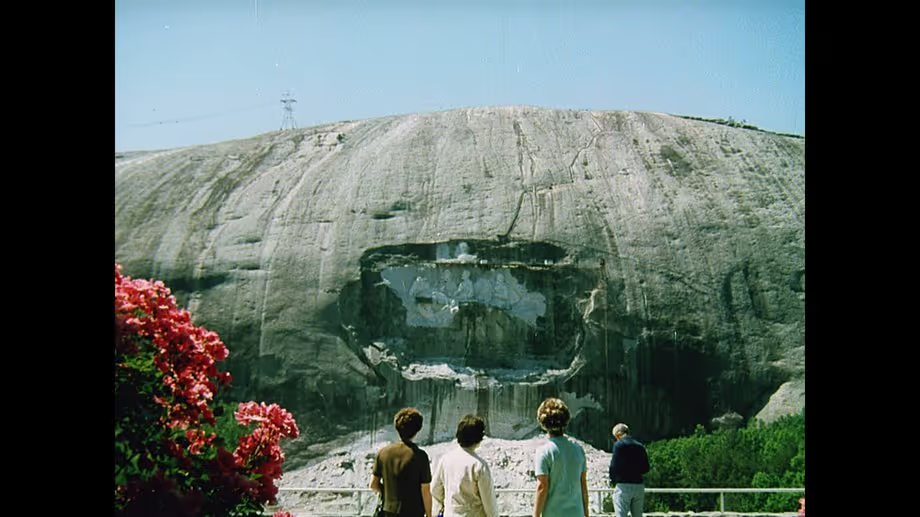
Stone Mountain and Historical Memory: Who Defines the Past?
Some 300 million years ago, an eruption of magma produced the massive granite rock that is known today as Stone Mountain in Georgia. Humans first stepped foot on this remarkable landmark around 4,000 B.C.E. and have continued to gather at its summit for more than six millennia. In 1915, one such gathering took place that would alter Stone Mountain in the eyes of Georgians and the world.
At midnight on November 25, 1915, a dozen white supremacists climbed to the top of Stone Mountain and burned a cross, inspired by the D.W. Griffith’s propaganda film The Birth of a Nation. This marked the revival of the Ku Klux Klan, a violent terror group that grew to a membership of more than 4 million in 10 years, and cemented Stone Mountain’s link with that group. The brothers who owned the mountain, the 85 year-old president of the Atlanta United Daughters of the Confederacy and the Klan-sympathizing sculptor Gutzon Borglum (who would go on to carve Mount Rushmore) then launched their plan to etch three Confederate generals into the mountain’s façade. In 1972 the carving was completed, transforming Stone Mountain into the world’s largest Confederate memorial and celebration of American white supremacy.
“Stone Mountain allows for a full century’s worth of reckoning with the motivations and politics behind these celebrations of the Confederacy and the Lost Cause narrative,” says Sierra Pettengill, director of the film, Graven Image. “In my film, a voiceover from a 1972 Stone Mountain promotional film says, ‘Remember how it used to be? It’s still that way for you to enjoy at Stone Mountain Park.’ I want this film to make us remember how it actually used to be.”
Recent conflicts over resurgent white nationalism and its links to Confederate monuments in public spaces have prompted conversations about the role of history in our national identity. These debates are an opportunity to critically examine our historical memory and to reevaluate our cultural symbols, like monuments, as our nation’s values and priorities evolve.
In this lesson, students use the short film Graven Image to explore the meaning and function of monuments, analyze the role collective historical memory plays in shaping our identities, and engage with monuments in their own communities to better understand the power dynamics that shape public spaces.

Media Literacy Questions for Analyzing POV Films
Because everyone interprets media through the lens of his or her own experience, media literacy analysis is about rich readings rather than specific “right” answers.
These suggested questions are starting points for that type of analysis. They are designed for diverse films and audiences; choose the ones that best meet the needs of your situation. To encourage deeper readings, try using follow-up questions such as, “How do you know?”; “How could you find out?”; “What evidence from the film backs up your answer?”; “What else do you notice?”; or “What else do you want to know?”
Based on NAMLE’s Core Principles of Media Literacy Education in the United States, April 2007 –www.NAMLE.NET/core-principles– Adapted by Faith Rogow, Ph.D.

The Poverty to Prison Pipeline
Across racially segregated St. Louis County, Missouri, thousands of people have been routinely sent to jail because they cannot pay local court fines and fees. The vast majority of those fined are poor and black. In Ferguson and the surrounding municipalities, where police shooting victim Michael Brown was killed, a practice with historical antecedents has become systematic: jailing the impoverished when they are unable to pay fines and fees. In A Debtors’ Prison, Samantha Jenkins and Meredith Walker recount their unfolding court cases in St. Louis County, describing the matrix of controls that has incarcerated them repeatedly for being poor.
Through the stories in A Debtors’ Prison, students will understand how aggressive policing, court fees and monetary sentencing have created a cycle of debt and incarceration in poor communities across the United States. They will compare the circumstances in Missouri municipal courts to the policies and procedures of their local juvenile justice systems and write persuasive essays in the form of letters to their local representatives.
Dark Money Delve Deeper Reading List
Mayer, Jane.Dark Money: The Hidden History of the Billionaires Behind the Rise of the Radical Right. Doubleday, 2016.
Why is America living in an age of profound and widening economic inequality? Why have even modest attempts to address climate change been defeated again and again? Why do hedge-fund billionaires pay a far lower tax rate than middle-class workers? In a riveting and indelible feat of reporting, Jane Mayer illuminates the history of an elite cadre of plutocrats—headed by the Kochs, the Scaifes, the Olins, and the Bradleys—who have bankrolled a systematic plan to fundamentally alter the American political system.
Teachout, Zephyr.Corruption in America: From Benjamin Franklin’s Snuff Box to Citizens United. Harvard University Press, 2014.
In 2010, one of the most consequential Court decisions in American political history gave wealthy corporations the right to spend unlimited money to influence elections. Justice Anthony Kennedy’s majority opinion treated corruption as nothing more than explicit bribery, a narrow conception later echoed by Chief Justice Roberts in deciding McCutcheon v. FEC in 2014. With unlimited spending transforming American politics for the worse, warns Zephyr Teachout, Citizens Unitedand McCutcheon were not just bad law but bad history.
Collins, Ronald K.L. When Money Speaks: The McCutcheon Decision, Campaign Finance Laws, and the First Amendment.Top Five Books, 2014.
On April 2, 2014, the U.S. Supreme Court struck down aggregate limits on how much money individuals could contribute to political candidates, parties, and committees. The McCutcheon v. FECdecision fundamentally changes how people (and corporations, thanks to Citizens United) can fund campaigns, opening the floodgates for millions of dollars in new spending, which had been curtailed by campaign finance laws going back to the early 1970s. When Money Speaks is the definitive—and the first—book to explain and dissect the Supreme Court’s controversial ruling in McCutcheon, including analysis of the tumultuous history of campaign finance law in the U.S. and the new legal and political repercussions likely to be felt from the Court’s decision.
Mutch, Robert E.Campaign Finance Reform: What Everybody Needs to Know.Oxford University Press, 2016.
In 2015, well over half of the money contributed to the presidential race came from roughly 350 families. The 100 biggest donors gave as much as 2 million small donors combined. Can we still say we live in a democracy if a few hundred rich families provide a disproportionate shares of campaign funds? Congress and the courts are divided on that question, with conservatives saying yes and liberals saying no. The debate is about the most fundamental of political questions: how we define democracy and how we want our democracy to work.
Shapiro, Bruce. Shaking the Foundations: 200 Years of Investigative Journalism in America. Thunder’s Mouth Press/Nation Books, 2003.
Great investigative journalism is present-tense literature: part detective story, part hellraising. This is the first anthology of its kind, bringing together outstanding (and often otherwise unavailable) practitioners of the muckraking tradition, from the Revolutionary era to the present day. Ranging from mainstream figures like Woodward and Bernstein to legendary iconoclasts such as I. F. Stone and Ida B. Wells-Barnett, the dispatches in this collection combine the thrill of the chase after facts with a burning sense of outrage.
Smith, Bradley A. Unfree Speech: The Folly of Campaign Finance Reform. Princeton University Press, 2001.
At a time when campaign finance reform is widely viewed as synonymous with cleaning up Washington and promoting political equality, Bradley Smith, a nationally recognized expert on campaign finance reform, argues that all restriction on campaign giving should be eliminated. In Unfree Speech, he presents a bold, convincing argument for the repeal of laws that regulate political spending and contributions, contending that they violate the right to free speech and ultimately diminish citizens’ power.
Broder, David S. Democracy Derailed: Initiative Campaigns and the Power of Money. Harcourt, 2000.
A new form of government is sweeping across America: the initiative process, available in half the states and hundreds of cities. Where once most state laws were passed by legislatures, now voters decide directly on such explosive issues as drugs, affirmative action, casino gambling, assisted suicide, and human rights. Ostensibly driven by public opinion, the initiative process is, in reality, manipulated by moneyed interests, often funded by out-of-state millionaires pursuing their own agendas. In this highly controversial book David Broder tells how this revolution came about.
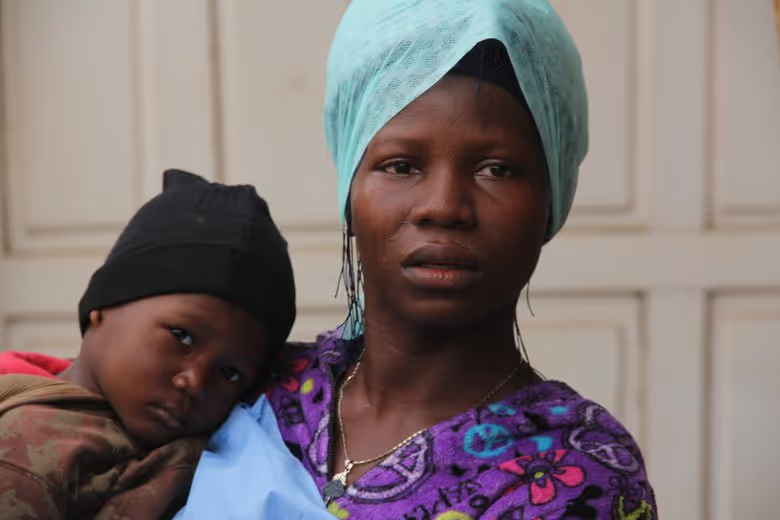
Survivors Delve Deeper Reading List
Quammen, David.Ebola: The Natural and Human History of a Deadly Virus. W.W. Norton & Company, 2014.
In 1976 a deadly virus emerged from the Congo forest. As swiftly as it came, it disappeared, leaving no trace. Over the four decades since, Ebola has emerged sporadically, each time to devastating effect. It can kill up to 90 percent of its victims. In between these outbreaks, it is untraceable, hiding deep in the jungle. The search is on to find Ebola’s elusive host animal. And until we find it, Ebola will continue to strike. Acclaimed science writer and explorer David Quammen first came near the virus while he was traveling in the jungles of Gabon, accompanied by local men whose village had been devastated by a recent outbreak. Here he tells the story of Ebola—its past, present, and its unknowable future.
Hatch, Steven.Inferno: A Doctor’s Ebola Story.St. Martin's Press, 2017.
Dr. Steven Hatch, an infectious disease specialist, first came to Liberia in November 2013 to work at a hospital in Monrovia. Six months later, several of the physicians he had served with were dead or unable to work, and Ebola had become a world health emergency. Inferno is his account of the epidemic that nearly consumed a nation, as well as its deeper origins.
Shah, Sonia.Pandemic: Tracking Contagions, from Cholera to Ebola and Beyond.Sarah Crichton Books, 2016.
Pandemicinterweaves history, original reportage, and personal narrative to explore the origins of contagions, drawing parallels between cholera, one of history’s most deadly and disruptive pandemic-causing pathogens, and the new diseases that stalk humankind today. To reveal how a new pandemic might develop, Sonia Shah tracks each stage of cholera’s dramatic journey, from its emergence in the South Asian hinterlands as a harmless microbe to its rapid dispersal across the nineteenth-century world, all the way to its latest beachhead in Haiti. Along the way she reports on the pathogens now following in cholera’s footsteps, from the MRSA bacterium that besieges her own family to the never-before-seen killers coming out of China’s wet markets, the surgical wards of New Delhi, and the suburban backyards of the East Coast.
Oldstone, Michael B. A.Viruses, Plagues, and History: Past, Present, and Future.Oxford, UK: Oxford University Press, 2010.
The story of viruses and humanity is a story of fear and ignorance, of grief and heartbreak, and of great bravery and sacrifice. Michael Oldstone tells all these stories as he illuminates the history of the devastating diseases that have tormented humanity, focusing mostly on the most famous viruses. Oldstone begins with smallpox, polio, and measles. Nearly 300 million people were killed by smallpox in this century alone and the author presents a vivid account of the long campaign to eradicate this lethal killer. Oldstone then describes the fascinating viruses that have captured headlines in more recent years: Ebola, Hantavirus, mad cow disease (a frightening illness made worse by government mishandling and secrecy), and, of course, AIDS.
Forna, Aminatta.The Devil That Danced on the Water. Atlantic Monthly Press, 2002.
Mohamed Forna was a man of impeccable integrity and enchanting charisma. As Sierra Leone faced its future as a fledgling democracy, he was a new star in the political firmament, a man who had been one of the first black students to come to Britain after the war. He stole the heart of Aminatta’s mother, to the dismay of her Presbyterian parents, and returned with her to Sierra Leone. But as Aminatta Forna shows with compelling clarity, the old Africa was torn apart by new ways of Western parliamentary democracy, which gave birth only to dictatorships and corruption of hitherto undreamed-of magnitude.
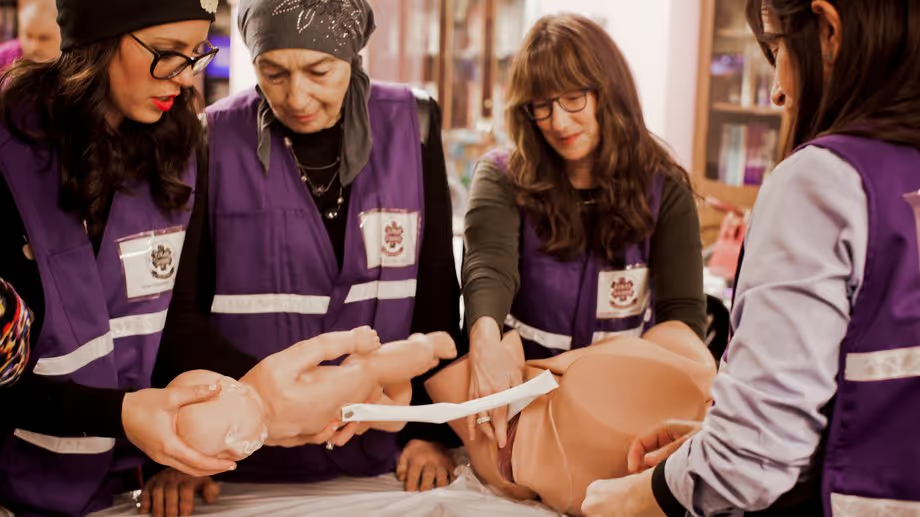
93Queen Delve Deeper Reading List
Berwin, Mel, Jennifer Sartori and Judith Rosenbaum.Making our Wilderness Bloom: 350 Years of Extraordinary Jewish Women in America.Jewish Women’s Archive, 2004.
Making Our Wilderness Bloom celebrates 350 years of extraordinary Jewish women with biographies, historical context, primary source interviews and photographs. One segment of the book introduces Jewish women who save lives through medicine and health. This represents the Jewish value of pikuach nefesh—“saving a life”—where the preservation of life overrides all other religious considerations.
Biale, David et al.Hasidism: A New History: Princeton University Press, 2017.
This is the first comprehensive history of the pietistic movement that shaped modern Judaism. The book's unique blend of intellectual, religious, and social history offers perspectives on the movement's leaders as well as its followers, and demonstrates that, far from being a throwback to the Middle Ages, Hasidism is a product of modernity that forged its identity as a radical alternative to the secular world.
Fader, Ayala.Mitzvah Girls: Bringing up the Next Generation of Hasidic Jews in Brooklyn.Princeton University Press, 2009.
Mitzvah Girls is the first book about bringing up Hasidic Jewish girls in North America, providing an in-depth look into a closed community. Ayala Fader examines language, gender, and the body from infancy to adulthood, showing how Hasidic girls in Brooklyn become women responsible for rearing the next generation of nonliberal Jewish believers. To uncover how girls learn the practices of Hasidic Judaism, Fader looks beyond the synagogue to everyday talk in the context of homes, classrooms, and city streets.
Levine, Stephanie Wellen.Mystics, Mavericks, and Merrymakers: An Intimate Journey among Hasidic Girls.New York University Press, 2003.
Mystics, Mavericks, and Merrymakers includes over thirty exclusive interviews with young Hasidic women transitioning from their teenage years to adulthood. While some of the girls are rebels, others strive for higher education and successful careers while remaining rooted in their faith community. The author lived in Crown Heights, Brooklyn for a year in the Orthodox Jewish Lubavitch community.
Stern, Jane.Ambulance Girl: How I Saved Myself by Becoming an EMT.Crown Publishing Group, 2003.
Jane Stern began her second career as an emergency medical technician late in life. For years, she had battled panic attacks, depression, and hypochondria. While her plane was grounded at the Minneapolis airport for 6 hours, she was able to help a young man experiencing a health crisis. This small but satisfying act of helping someone else led her to EMT training. Stern shares her on-the-job experiences which often included emotional and physical challenges. Through all of her hard work, Jane eventually becomes the first woman officer of her department.
Zipora, Malka.Rather Laugh Than Cry: Stories from a Hassidic Household.Montreal, Canada: Véhicule Press, 2007.
Rather Laugh than Cry is a glimpse into the daily life of a contemporary Hassidic woman living in a large urban setting. Malka Zipora is the pseudonym of a Montreal Hassidic woman who has raised a family of twelve children who now range in age between nine and thirty years old. Zipora has taken the unusual step of drawing back the curtain on her life as a Hassidic woman, and what she tells us about her everyday life gives us a very human view into a world that seems very much apart from the mainstream.
Berger, Joseph. The Pious Ones: The World of Hasidim and Their Battles with America. HarperCollins, 2014.
As the population of ultra-Orthodox Jews in the United States increases to astonishing proportions, veteran New York Timesjournalist Joseph Berger takes us inside the notoriously insular world of the Hasidim to explore their origins, beliefs, and struggles— and the social and political implications of their expanding presence in America.
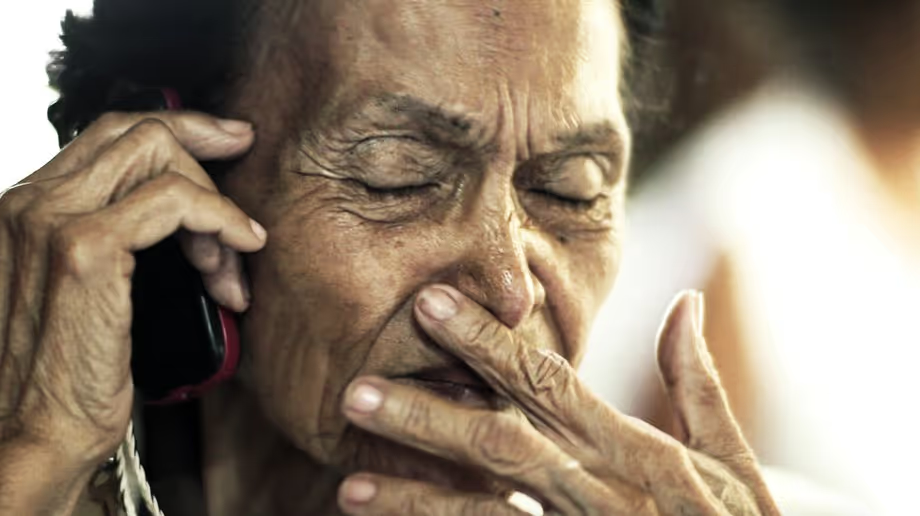
The Apology Delve Deeper Reading List
Qiu, Pei Pei.Chinese Comfort Women: Testimonies from Imperial Japan’s Sex Slaves. Oxford University Press, 2014.
Accountability and redress for Imperial Japan's wartime "comfort women" have provoked international debate in the past two decades. Yet there has been a dearth of first-hand accounts available in English from the women abducted and enslaved by the Japanese military in Mainland China -- the major theatre of the Asia-Pacific War. Chinese Comfort Women features the personal stories of the survivors of this devastating system of sexual enslavement. Offering insight into the conditions of these women's lives prior to and after the war, it points to the social, cultural, and political environments that prolonged their suffering.
Soh, Chunghee Sarah.The Comfort Women: Sexual Violence and Postcolonial Memory in Korea and Japan. University of Chicago Press, 2008.
In an era marked by atrocities perpetrated on a grand scale, the tragedy of the so-called comfort women—mostly Korean women forced into prostitution by the Japanese army—endures as one of the darkest events of World War II. These women have usually been labeled victims of a war crime, a simplistic view that makes it easy to pin blame on the policies of imperial Japan and therefore easier to consign the episode to a war-torn past. In this revelatory study, C. Sarah Soh provocatively disputes this master narrative. Soh reveals that the forces of Japanese colonialism and Korean patriarchy together shaped the fate of Korean comfort women—a double bind made strikingly apparent in the cases of women cast into sexual slavery after fleeing abuse at home.
Yoshimi, Yoshiaki.Comfort Women: Sexual Slavery in the Japanese Military During WWII. Columbia University Press, 2000.
Available for the first time in English, this is the definitive account of the practice of sexual slavery the Japanese military perpetrated during World War II by the researcher principally responsible for exposing the Japanese government's responsibility for these atrocities. The large scale imprisonment and rape of thousands of women, who were euphemistically called "comfort women" by the Japanese military, first seized public attention in 1991 when three Korean women filed suit in a Toyko District Court stating that they had been forced into sexual servitude and demanding compensation.
Henson, Maria Rosa.Comfort Woman: a Filipina’s Story of Prostitution and Slavery by the Japanese Military. Rowman & Littlefield Publishers, 1995.
In April 1943, 15-year-old Maria Rosa Henson was taken by Japanese soldiers occupying the Philippines and forced into prostitution as a comfort woman. In this autobiography, Rosa recalls her childhood as the illegitimate daughter of a wealthy landowner, her work for Huk guerrillas, her wartime ordeal, and her marriage to a rebel leader who left her to raise their children alone.
O’Herne, Jan Ruff.Fifty Years of Silence. Sydney: Penguin Random House Australia, 2011.
Jan Ruff O'Herne's idyllic childhood in Dutch colonial Indonesia ended when the Japanese invaded Java in 1942. She was interned in Ambarawa Prison Camp along with her mother and two younger sisters. In February 1944, when Jan was just twenty-one years old, she was taken from the camp and forced into sexual slavery in a military brothel. Jan was repeatedly beaten and raped for a period of three months, after which she was returned to prison camp with threats that her family would be killed if she revealed the truth about the atrocities inflicted upon her. For fifty years, Jan told no one what had happened to her, but in 1992, after seeing Korean war rape victims making appeals for justice on television, she decided to speak out and support them.
Hicks, George L.The Comfort Women: Japan’s Brutal Regime of Enforced Prostitution During the Second World War. W.W. Norton & Co., 1995.
Over 100,000 women across Asia were victims of enforced prostitution by the Japanese Imperial Forces during World War II. Until as recently as 1993 the Japanese government continued to deny this shameful aspect of its wartime history. George Hicks's book is the only history in English regarding this terrible enslavement of women

Student Engagement through Participatory Budgeting
Across New York City, a bold experiment in participatory democracy is underway. Since 2012, the city council has steadily increased investment in a process called Participatory Budgeting, by which community members help decide how to spend part of a public budget. Through an eight-month process, neighbors come together and work with their government to propose, debate and ultimately vote on budget decisions that affect their lives.
This process, developed in Brazil in 1989, now takes place in 1,500 cities worldwide. In each location, PB brings together diverse communities to grapple with big questions at the center of urban development, while creating an opportunity for community members to transform the way they see their neighborhood, their neighbors and themselves.
Public Money delves into New York City’s PB process, the largest in the U.S., involving more than 100,000 people deciding how to spend over $35 million each year. Following the process over one year in Brooklyn’s Sunset Park—a multicultural neighborhood undergoing gentrification—this quietly observed, verité documentary asks, what happens when community members come together to discuss and decide what development should look like in their neighborhood?
Through the film Public Money, students will be introduced to the Participatory Budgeting (PB) model and how this has process provided the residents of Sunset Park, Brooklyn with a voice in local government. Students will then translate the PB process to their own school and develop an Action Plan and Budget proposal that will address an issue in their community. Students will summarize and present their proposals to students and school administration in the form of an Elevator Pitch.