
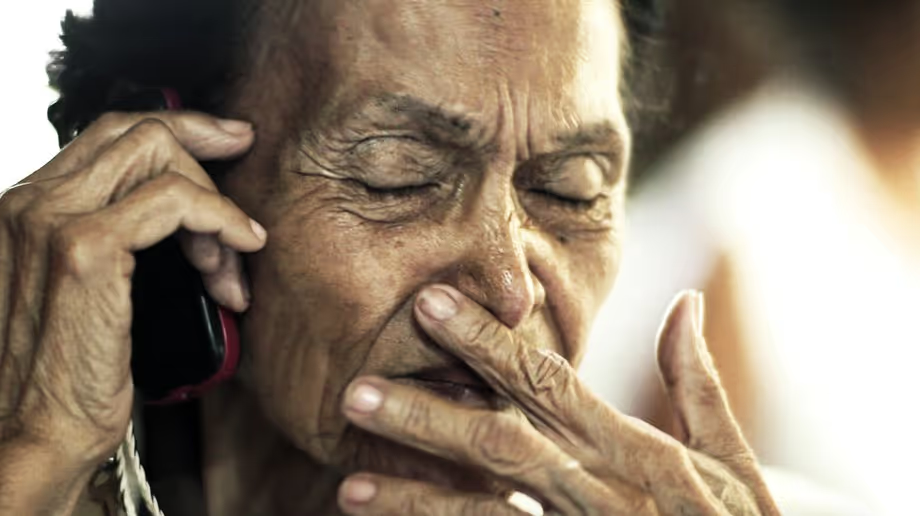
Listening and Responding to Women’s Stories from War
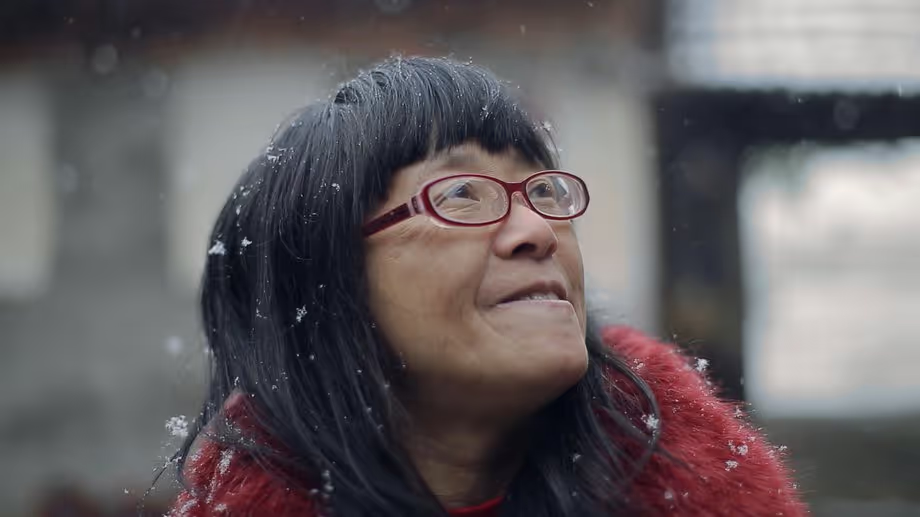
In this lesson students will learn the history of an often-overlooked part of World War II - the girls and women forced into military sexual slavery under the occupation of the Japanese army. In The Apology, three of the surviving women, nicknamed “the Grandmas,” Adela Barroquillo from the Philippines, Cao Hei Mao from China and Gil Won-Ok from South Korea, relate their experiences as young girls during the war and reflect on the scars this violence left on their entire lives.
Sexual violence and rape during war is not unique to World War II, nor are women and girls the only victims. Governments and the military use rape as a weapon of war to dehumanize and humiliate populations, exert their power and damage communities for generations.
For over 70 years these women, euphemistically called “comfort women,” have carried the weight of shame, trauma and fear of rejection. Many did not speak about what they had experienced. They were sometimes pressured into silence by their communities, who regarded the women as shameful or even blamed them for what occurred. It has taken decades for their stories to emerge, but as Director Tiffany Hsiung of The Apologysays, “They still need us to listen and respond.” Learning to listen deeply to and acknowledge the stories of survivors is a form of justice. This lesson uses first-hand testimonies to understand the consequences of war through the eyes of women who are sharing their stories as an act of healing, a form of resistance and an attempt at historical reconciliation.
Note to Educators:The Apologyis a documentary film about women’s experience of sexual violence and rape during war. While the focus on the lesson revolves around what we can learn from their stories and how it can inspire change, students are asked to be active listeners as the women share traumatic memories. Setting the historical and emotional context for this lesson and creating a safe space within your classroom to discuss this topic is critical. It is expected that this lesson would be integrated only within courses where students have been prepared to encounter this history and have the maturity with which to share and process the information.
In the Resource section of this lesson you will find several recommended organizations and materials to use as you prepare to approach this topic with students.
The Apology: Discussion Guide
In 2009, a trip to Asia would change my life forever. That’s when I first met “the grandmothers.” Prior to that trip I knew very little about the atrocities that occurred during World War II in Asia—specifically, the institutionalized sexual slavery system that held captive more than 200,000 girls and young women. When I asked the elders in my family to tell me stories about the past, what it was like during the war, they would shake their heads slowly and somberly say, “没有什么好说的, 不好听 (Mei yoa shimo hao shio de bu hao tin)” which means, “There’s nothing good to say, nothing good to hear.” And that was the end of my history lesson.
As a “CBC” (Canadian Born Chinese), I often felt conflicted culturally. The North American approach is to speak out against injustice, while the Chinese way of dealing with hardship is to “吃苦 (chi ku)” which literally translates to “swallow the bitterness.” And of course, one must always “save face” to preserve pride and honor. I was first confronted with this dilemma at 8 years old, after being sexually assaulted at home by a so-called family friend. I was paralyzed by the choices I could make, but either way, I felt that my world had already been shattered. I chose the temporary comfort and safety of keeping silent and, like the women of generations before me, I just learned to swallow the bitterness.
Fast-forward 17 years, when I would meet the remarkable women in my film The Apology. History refers to them as “comfort women”—a term used by the Imperial Japanese Army to describe the girls and women they forced into sexual slavery. But to me, they are the grandmothers. What started off as a journey to uncover this dark history of human atrocities soon turned into an exploration of perseverance.
When Korean survivor Kim Hak-sun first spoke out publicly in 1991, nearly five decades after the end of World War II, she set off a domino effect. Other women in their respective countries started to speak out, too, and the world would hear testimony after testimony from hundreds of women describing unimaginable crimes against them with the hope that justice would soon follow. Twenty-seven years later, their fight still continues.
After the first few years of spending time with Grandma Cao in China, Grandma Gil in Korea and Grandma Adela in the Philippines, it was clear that there was more to this chapter in history, more than just the sexual slavery, more to these women that people weren’t seeing. I came to learn about their lives after the war and how they survived. The grandmothers had incredible resilience, made tremendous sacrifices and ultimately displayed the true power of the human spirit.
Over the course of six years, each of the communities that we filmed demonstrated the importance of camaraderie. Knowing that you aren’t alone and that you will be supported after disclosing your past can make the difference between speaking out versus living the rest of your life in silence and carrying the burden and pain of what you experienced as a victim. Society has perpetuated a culture of shame that has resulted in decades, or even lifetimes of silence for survivors of sexual violence.
These days the Me Too and Time’s Up movements are sparking a global dialogue that de-stigmatizes and reframes what it means to be a victim of sexual violence. The grandmothers have taught me that although my past does not define me, the journey to come to terms with my past makes me who I am today. Discovering why I wanted to make this film was extremely difficult, because I thought it was a story I wanted to tell, when, in fact, it became a story I always needed to tell. It’s a story for the 8-year-old girl within me that struggled to tell her own family about the abuse. It’s a story for all the courageous grandmothers who survived months and years of sexual slavery. It’s a story for all the survivors who never had the space to be known outside the ugly crimes committed against them. It’s a story that brings to light the millions of untold stories of sexual violence that continue to go unheard.
Tiffany Hsiung
Director, The Apology
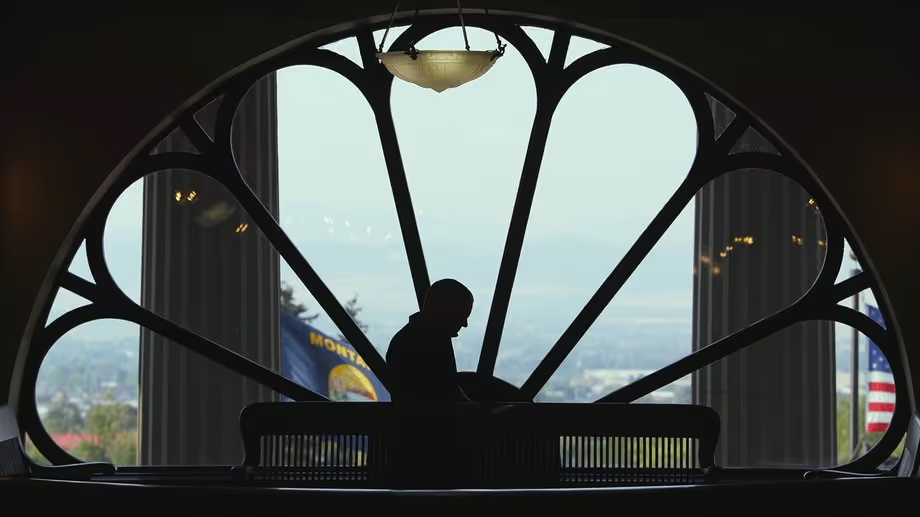
Media Literacy for Elections
In this lesson, students will examine a case study about how corporate donations to American political campaigns influence elections. Students will use film clips from the documentary Dark Money to learn how donations where the donor is undisclosed are used to finance political campaigns and how investigative journalism revealed the harm of this type of political spending in Montana. Students will increase their critical media analysis skills, their knowledge of campaign finance and their understanding of why an informed citizenry is necessary to a strong democracy. Students will apply what they learn to an election in their own community and gain a deeper understanding of how campaigns are funded and how money may influence elected representatives in local, state or federal office.
Note to Educators:Dark Moneyis an accessible yet complex story of campaign finance and corruption that touches on many critical issues, from the First Amendment to the Citizens United decision. This lesson focuses on strengthening media literacy to increase understanding of free and fair elections. See the Extensions/Adaptations section for resources related to other key issues raised by the film.
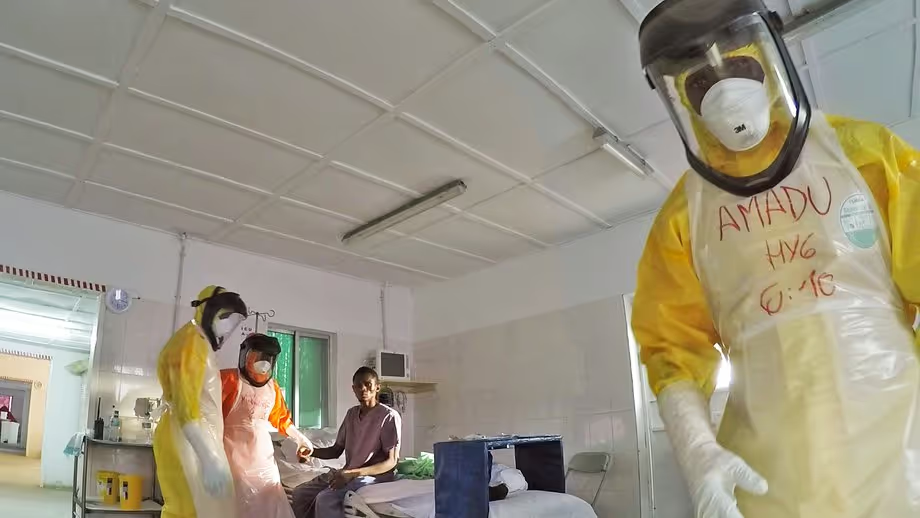
Nature of an Epidemic
In this lesson students will explore key concepts in public health, such as the definitions of “epidemic” and “intervention” and criteria for national and international emergencies. Using the film Survivors,students will learn about the science of the Ebola virus, including the symptoms of the disease and how it is spread. Finally, the class will examine local, national and international responses to the 2014-2016 Ebola epidemic in Sierra Leone and neighboring countries, and what those responses revealed about strengths and gaps in global public health policy.
Through the eyes of Sierra Leonean filmmaker Arthur Pratt, Survivors presents an intimate portrait of Sierra Leone during the Ebola outbreak, exposing the complexity of the epidemic and the sociopolitical turmoil that lies in its wake. Survivorsreveals the bureaucratic missteps that took place during one of the most acute public health crises of the modern era, as well as remarkable stories of individual bravery and the deep humanity of those caught in the middle of this unfolding crisis.
Note to Teachers:The film clips from Survivorsportray very sick and dying patients, as well as people grieving for loved ones killed by the disease. This content may be upsetting to some students.
POV offers a lending library of DVDs that you can borrow anytime during the school year—FOR FREE! Get started by joining the POV Community Network. Survivorsis a co-production of American Documentary | POV and ITVS.
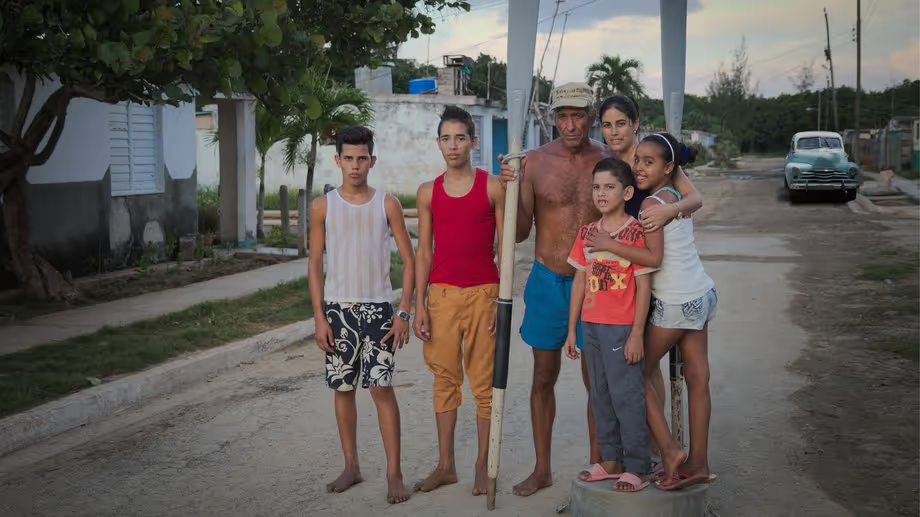
Humanizing Immigrant Stories
Debates over U.S. immigration policy, and the xenophobia that often accompanies such debates, are once again center stage. Policy debates are often dominated by statistics and stereotypes, both of which can dehumanize those under examination. This lesson brings the personal stories of migrants back into the debate. As a springboard for discussion, it uses clips from Voices of the Sea, a film about a Cuban family divided on whether or not to emigrate. After researching the history or current situation in a nation from which people have emigrated to the U.S. in large numbers, students will write an imagined dialogue between family members considering whether to make the journey. In the process, they'll consider what motivates people to leave their homes or stay.
Cultural Competence and Cultural Humility in Cross-Cultural Exchange
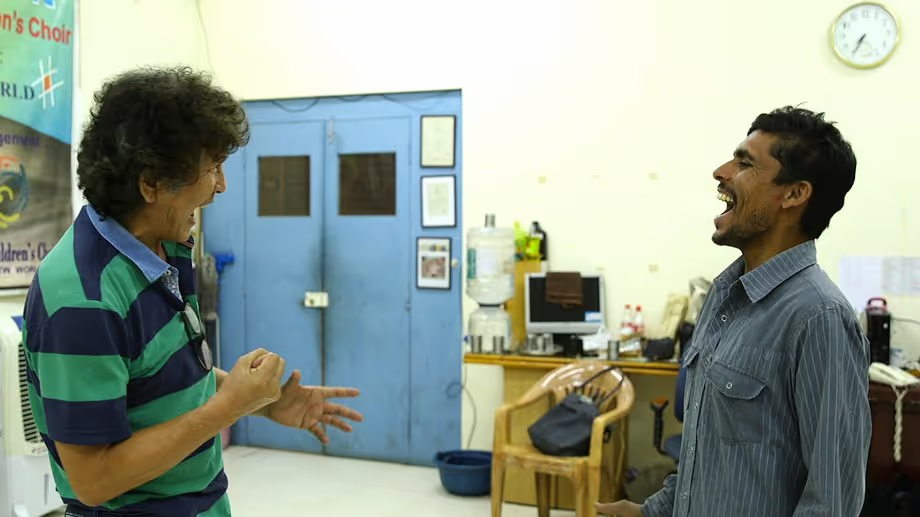
After he retired from his career in opera, Jae-chang Kim relocated to the Indian city of Pune where he started the Banana Children's Choir for children living in the city's slums. Affectionately nicknamed Angry Bird by his students, Jae-chang Kim is not attempting to train his youth choir members to work as professional musicians; instead he wants to introduce them to the world beyond Pune through music and performance. But the children's parents, who are struggling in the economic margins, wonder if the time spent at choir practice could be better used studying and helping to earn money for the family.
The film Singing with Angry Bird follows Jae-chang Kim for a year as he attempts to involve the parents in the choir by inviting them to rehearse for and perform in a joint concert with their kids. As the project intersects with the choir families' daily challenges, Angry Bird and the singers must collaborate to find new strategies to make space for the singing they love while respecting the demanding economic and cultural responsibilities of Pune's community.
Through the following lesson for Singing with Angry Bird, students will understand the significance of cultural competence in cultural exchange projects like the Banana Children's Choir and assess its benefits and limitations. They will also explore the related concept of cultural humility and consider how they would integrate these approaches into theoretical cultural exchange projects of their own.
Comparing Written and Visual Poetry
Students are typically exposed to historical or current events by reading expository or narrative texts written by journalists, historians or textbook authors. This lesson adds poetry, and the new dimensions of image and emotion that poetry evokes, to that list.
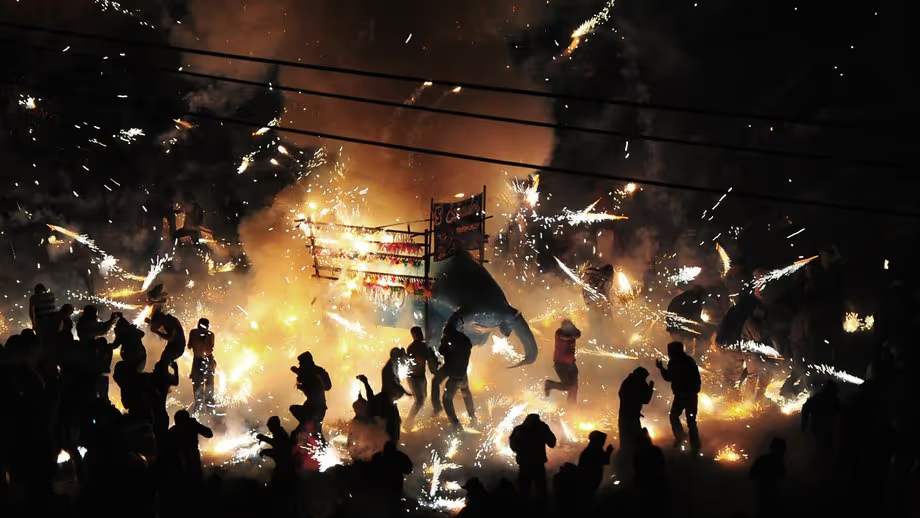
After reading a standard description of Mexico's National Pyrotechnic Festival and viewing clips from Brimstone & Glory, a documentary/visual poem about the event, students will write poems to describe the festival's main attractions. Because the event takes place in Mexico, this is an excellent lesson for multilingual classes or classes with Spanish speakers who are learning English.
Solar Sailing
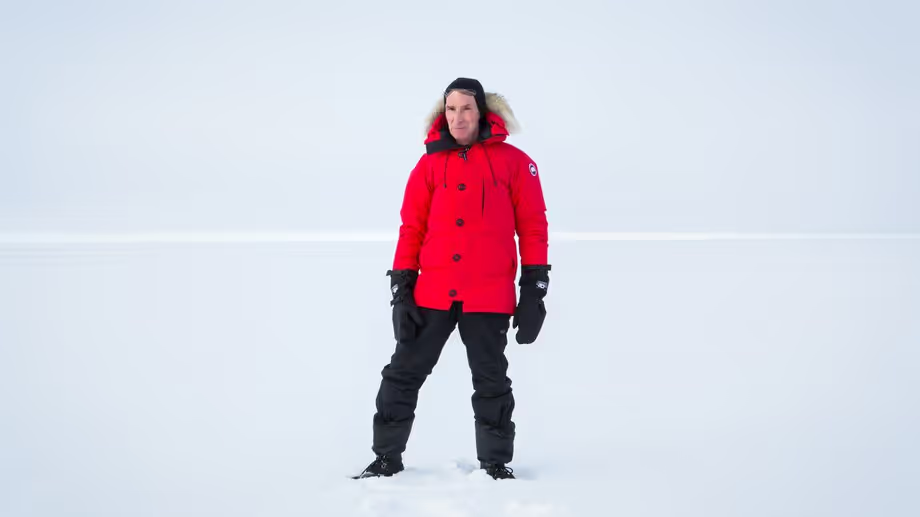
Bill Nye is a man on a mission: to grow appreciation and excitement for scientific thinking across the world. The former star of the popular kids show Bill Nye the Science Guy is now advocating for the importance of science, research and discovery in public life. With intimate and exclusive access-as well as plenty of wonder and whimsy-this behind-the-scenes portrait of Nye follows him as he takes off his Science Guy lab coat and takes on those who deny climate change, evolution and a science-based world view. Directed by David Alvarado and Jason Sussberg, the film features Bill Nye, Neil deGrasse Tyson, Ann Druyan and many others.
As CEO of the Planetary Society, Bill Nye leads the largest nonprofit organization dedicated to educating about space exploration. In this lesson, students will explore one of the promising innovations of space exploration, solar sail technology. Students will learn how solar sailing works, who is involved, how the technology has been tested and where it is headed in the future.
Voices of the Sea: Delve Deeper Reading List
Bardach, Ann Louise. Without Fidel: A Death Foretold in Miami, Havana and Washington. Scribner, 2014.
Since 1959, Fidel Castro has been the supreme leader of Cuba, deftly checkmating his foes, both from within and abroad; confronting eleven American presidents; and outfoxing dozens of assassination attempts, vanquished only by collapsing health. As night descends on Castro's extraordinary fifty-year reign, Miami, Havana, and Washington are abuzz with anxious questions: What led to the lightning-bolt purge of key Cuban officials in March 2009? Who will be Raúl's heir? Will the U.S. embargo end? Bardach offers profound and surprising answers to these questions as she meticulously chronicles Castro's protracted farewell and assesses his transformative impact on the world stage and the complex legacy that will long outlive him.
Eire, Carlos M.N. Waiting for Snow in Havana: Confessions of a Cuban Boy. Free Press, 2003.
Waiting for Snow in Havana is both an exorcism and an ode to a paradise lost. For the Cuba of Carlos’s youth—with its lizards and turquoise seas and sun-drenched siestas—becomes an island of condemnation once a cigar-smoking guerrilla named Fidel Castro ousts President Batista on January 1, 1959. Suddenly the music in the streets sounds like gunfire. Christmas is made illegal, political dissent leads to imprisonment, and too many of Carlos’s friends are leaving Cuba for a place as far away and unthinkable as the United States. Carlos will end up there, too, and fulfill his mother’s dreams by becoming a modern American man—even if his soul remains in the country he left behind.
Gott, Richard. Cuba: A New History. Yale University Press, 2004.
In this concise and up-to-date book, British journalist Richard Gott casts a fresh eye on the history of the Caribbean island from its pre-Columbian origins to the present day. He provides a European perspective on a country that is perhaps too frequently seen solely from the American point of view. The author emphasizes such little-known aspects of Cuba’s history as its tradition of racism and violence, its black rebellions, the survival of its Indian peoples, and the lasting influence of Spain. The book also offers an original look at aspects of the Revolution, including Castro’s relationship with the Soviet Union, military exploits in Africa, and his attempts to promote revolution in Latin America and among American blacks.
Machado, Eduardo. Tastes Like Cuba: An Exile’s Hunger for Home. London: Penguin, 2009.
Born into a well-to-do family in Cuba in 1953, Eduardo Machado saw firsthand the effects of the rising Castro regime. When he and his brother were sent to the United States on one of the Peter Pan flights of 1961, they did not know if they would ever see their parents or their home again. From his experience living in exile in Los Angeles to becoming an actor, director, playwright and professor in New York, Machado explores what it means to say good-bye to the only home one’s ever known, and what it means to be a Latino in America today.
Murphy, Dervla. The Island that Dared. Eland, 2010.
Take a three-generation family holiday in Cuba in the company of Dervla Murphy, her daughter and three young granddaughters and you have a Swallows-and-Amazons-like adventure in the Caribbean as they trek into the hills and along the coast as a family, camping out on empty beaches beneath the stars and relishing the ubiquitous Cuban hospitality. But this is no more than the joyful start of a fully-fledged quest to understand the unique society created by the Cuban Revolution. For Dervla returns alone to explore the mountains, coastal swamps and decaying cities, investigating the experience of modern Cuba with her particular, candid curiosity.
Perez Jr., Louisa A. On Becoming Cuban: Identity, Nationality and Culture. University of North Carolina Press, 2008
Using an enormous range of Cuban and U.S. sources—from archival records and oral interviews to popular magazines, novels, and motion pictures—Pérez reveals a powerful web of everyday, bilateral connections between the United States and Cuba and shows how U.S. cultural forms had a critical influence on the development of Cubans' sense of themselves as a people and as a nation. He also articulates the cultural context for the revolution that erupted in Cuba in 1959. In the middle of the twentieth century, Pérez argues, when economic hard times and political crises combined to make Cubans painfully aware that their American-influenced expectations of prosperity and modernity would not be realized, the stage was set for revolution.
Before and After: Asking Questions about Going to War
American middle and secondary students typically study a dozen or more wars, from ancient Greek and Roman military campaigns to the armed conflicts that shaped modern Europe and the United States. Despite these opportunities, few are asked to examine the decision-making process behind the choice to wage war. This lesson fills that gap.
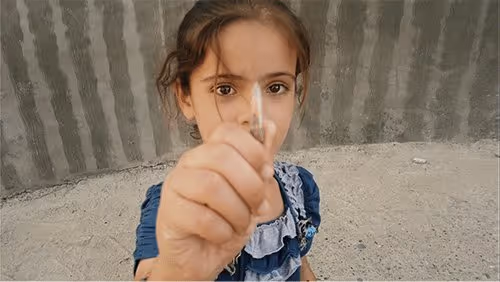
Using clips from the documentary film Nowhere to Hide, which provides a portrait of civilian life in a volatile Iraqi province following the U.S. troop withdrawal in 2011, the lesson asks students to consider the questions they want their political representatives to ask before authorizing military action. As they think about their roles as citizens who elect representatives with the power to authorize force under the War Powers Act, they'll also look at concepts that permeated news coverage of the Iraq War, including "nation building" and "preemptive war," as well as "pacifism."
Stereotypes, Cerebral Palsy and Poetry
In this multidisciplinary lesson, students examine stereotypes about people with physical disabilities. Using clips from Still Tomorrow, a documentary about Chinese poet Yu Xiuhua, who has cerebral palsy, students will gain awareness of the clues they use to judge people. To better understand Yu's condition, they'll conduct research about cerebral palsy and write an "advice blog" addressing stereotypes about people with disabilities. As part of that research, students will consider how they choose what to click on when they do online searches.

Developing Informed Opinions in the World of "Likes"
In this climate of instantaneous thumbs up and thumbs down, students can easily lose sight of the difference between spontaneous judgments and informed opinion. This lesson lets students experience the distinction. After viewing clips from the film The War to Be Her, a profile of Pakistani athlete Maria Toorpakai, who beat the odds under Taliban rule to become an international squash champion, students will be guided through several steps of discussion, question generation and research. They'll compare their initial reactions to the film with their conclusions at the end of the lesson.
Because Toorpakai's story involves the Taliban, Islam (often misrepresented in U.S. media) and a female athlete (subject to gender stereotypes), students will be wading through "hot button" issues. Outside of class, discussions of such issues often devolve into unproductive Twitter wars or worse. Their goal will be to arrive at well-informed opinions about whether or not the Taliban is completely responsible for Toorpakai's challenges.