
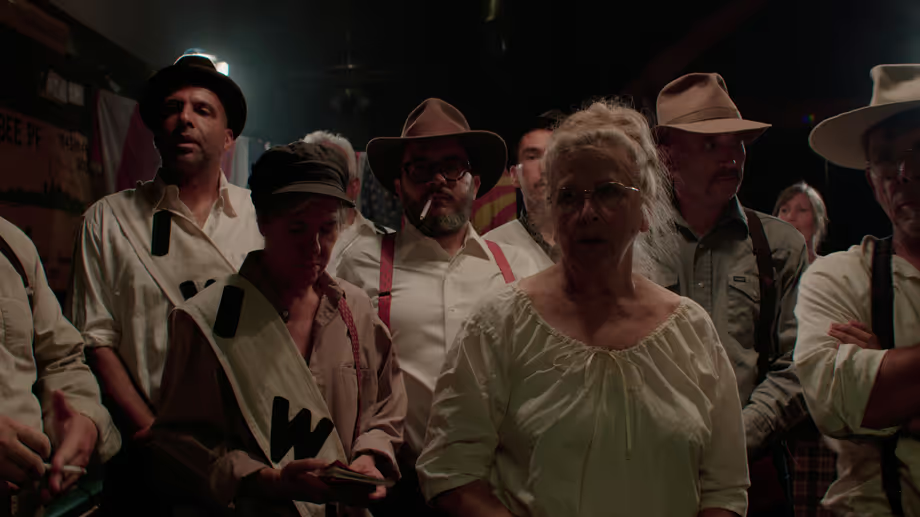
Bisbee '17 Delve Deeper Reading List
Buhle, Paul and Nicole Schulman. Wobblies!: A Graphic History of the Industrial Workers of the World.Verso, 2005.
The stories of the hard-rock miners' shooting wars, young Elizabeth Gurly Flynn (the "Rebel Girl" of contemporary sheet music), the first sit-down strikes and Free Speech fights, Emma Goldman and the struggle for birth control access, the Pageant for Paterson orchestrated in Madison Square Garden, bohemian radicals John Reed and Louise Bryant, field-hand revolts and lumber workers' strikes, wartime witch hunts, government prosecutions and mob lynching, Mexican-American uprisings in Baja, and Mexican peasant revolts led by Wobblies, hilarious and sentimental songs created and later revived—all are here, and much, much more.
Carter, Bill. Boom, Bust, Boom: A Story about Copper, the Metal that Runs the World.Scribner Book Company, 2012.
Starting in his own backyard in the old mining town of Bisbee, Arizona—where he discovers that the dirt in his garden contains double the acceptable level of arsenic—Bill Carter follows the story of copper to the controversial Grasberg copper mine in Indonesia; to the “ring” at the London Metal Exchange, where a select group of traders buy and sell enormous amounts of the metal; and to an Alaskan salmon run threatened by mining. Boom, Bust, Boom is a highly readable account—part social history, part mining-town exploration, and part environmental investigation. Page by page, Carter blends the personal and the international in a narrative that helps us understand the paradoxical relationship we have with a substance whose necessity to civilization costs the environment and the people who mine it dearly.
Dray, Philip. There is Power in a Union: The Epic Story of Labor in America.Doubleday, 2010.
From the nineteenth-century textile mills of Lowell, Massachusetts, to the triumph of unions in the twentieth century and their waning influence today, the contest between labor and capital for the American bounty has shaped our national experience. In this stirring new history, Philip Dray shows us the vital accomplishments of organized labor and illuminates its central role in our social, political, economic, and cultural evolution. His epic, character-driven narrative not only restores to our collective memory the indelible story of American labor, it also demonstrates the importance of the fight for fairness and economic democracy, and why that effort remains so urgent today.
Grandin, Greg. The End of the Myth: From the Frontier to the Border Wall in the Mind of America. Metropolitan Books, 2019.
Ever since this nation’s inception, the idea of an open and ever-expanding frontier has been central to American identity. Symbolizing a future of endless promise, it was the foundation of the United States’ belief in itself as an exceptional nation—democratic, individualistic, forward-looking. Today, though, America has a new symbol: the border wall. In The End of the Myth, acclaimed historian Greg Grandin explores the meaning of the frontier throughout the full sweep of U.S. history—from the American Revolution to the War of 1898, the New Deal to the election of 2016. For centuries, he shows, America’s constant expansion—fighting wars and opening markets—served as a “gate of escape,” helping to deflect domestic political and economic conflicts outward.
Slotkin, Richard. Gunfighter Nation: The Myth of the Frontier in Twentieth-Century America.University of Oklahoma Press, 1998.
Slotkin examines an impressive array of sources—fiction, Hollywood westerns, and the writings of Hollywood figures and Washington leaders—to show how the racialist theory of Anglo-Saxon ascendance and superiority (embodied in Theodore Roosevelt’s The Winning of the West), rather than Frederick Jackson Turner’s thesis of the closing of the frontier, exerted the most influence in popular culture and government policy making in the twentieth century. He argues that Roosevelt’s view of the frontier myth provided the justification for most of America’s expansionist policies, from Roosevelt’s own Rough Riders to Kennedy’s counterinsurgency and Johnson’s war in Vietnam.
Benton-Cohen, Katherine. Borderline Americans: Racial Division and Labor War in the Arizona Borderlands. Harvard University Press, 2009.
“Are you an American, or are you not?” This was the question Harry Wheeler, sheriff of Cochise County, Arizona, used to choose his targets in one of the most remarkable vigilante actions ever carried out on U.S. soil. And this is the question at the heart of Katherine Benton-Cohen’s provocative history, which ties that seemingly remote corner of the country to one of America’s central concerns: the historical creation of racial boundaries. It was in Cochise County that the Earps and Clantons fought, Geronimo surrendered, and Wheeler led the infamous Bisbee Deportation, and it is where private militias patrol for undocumented migrants today. These dramatic events animate the rich story of the Arizona borderlands, where people of nearly every nationality—drawn by “free” land or by jobs in the copper mines—grappled with questions of race and national identity.
Murolo, Priscilla and A. B. Chitty. From the Folks Who Brought You the Weekend: A Short, Illustrated History of Labor in the United States. New Press, 2001.
From the Folks Who Brought You the Weekend surveys the historic efforts and sacrifices that working people have made to win the rights we take for granted today: basic health and safety standards in the workplace, fair on-the-job treatment for men and women, the minimum wage, and even the weekend itself. With dramatic cartoon narratives by internationally-acclaimed artist Joe Sacco, this book brings labor history to life.
Punke, Michael. Fire and Brimstone: The North Butte Mine Disaster of 1917. Hachette Books, 2006.
While the disaster is compelling in its own right, Fire and Brimstone also tells a far broader story striking in its contemporary relevance. Butte, Montana, on the eve of the North Butte disaster, was a volatile jumble of antiwar protest, an abusive corporate master, seething labor unrest, divisive ethnic tension, and radicalism both left and right. It was a powder keg lacking only a spark, and the mine fire would ignite strikes, murder, ethnic and political witch hunts, occupation by federal troops, and ultimately a battle over presidential power.
Watson, Bruce. Bread and Roses: Mills, Migrants, and the Struggle for the American Dream.Viking Books, 2005.
On January 12, 1912, an army of textile workers stormed out of the mills in Lawrence, Massachusetts, commencing what has since become known as the "Bread and Roses" strike. Based on newspaper accounts, magazine reportage, and oral histories, Watson reconstructs a Dickensian drama involving thousands of parading strikers from fifty-one nations, unforgettable acts of cruelty, and even a protracted murder trial that tested the boundaries of free speech. A rousing look at a seminal and overlooked chapter of the past, Bread and Roses is indispensable reading.
Byrkit, James W. Forging the Copper Collar: Arizona's Labor-Management War of 1901–1921. The University of Arizona Press, 2016.
While the Bisbee Deportation was the most notorious of many vigilante actions of its day, it was more than the climax of a labor-management war—it was the point at which Arizona donned the copper collar. That such an event could occur, James Byrkit contends, was not attributable so much to the marshaling of public sentiment against the I.W.W. as to the outright manipulation of the state's political and social climate by Eastern business interests. In Forging the Copper Collar, Byrkit paints a vivid picture of Arizona in the early part of this century. He demonstrates how isolated mining communities were no more than mercantilistic colonies controlled by Eastern power, and how that power wielded control over all the Arizona's affairs—holding back unionism, creating a self-serving tax structure, and summarily expelling dissidents.
Jones, Reece.Violent Borders: Refugees and the Right to Move.Verso, 2017.
In Violent Borders, Jones crosses the migrant trails of the world, documenting the billions of dollars spent on border security projects and the dire consequences for countless millions. While the poor are restricted by the lottery of birth to slum dwellings in the ailing decolonized world, the wealthy travel without constraint, exploiting pools of cheap labor and lax environmental regulations. With the growth of borders and resource enclosures, the deaths of migrants in search of a better life are intimately connected to climate change, environmental degradation, and the growth of global wealth inequality.
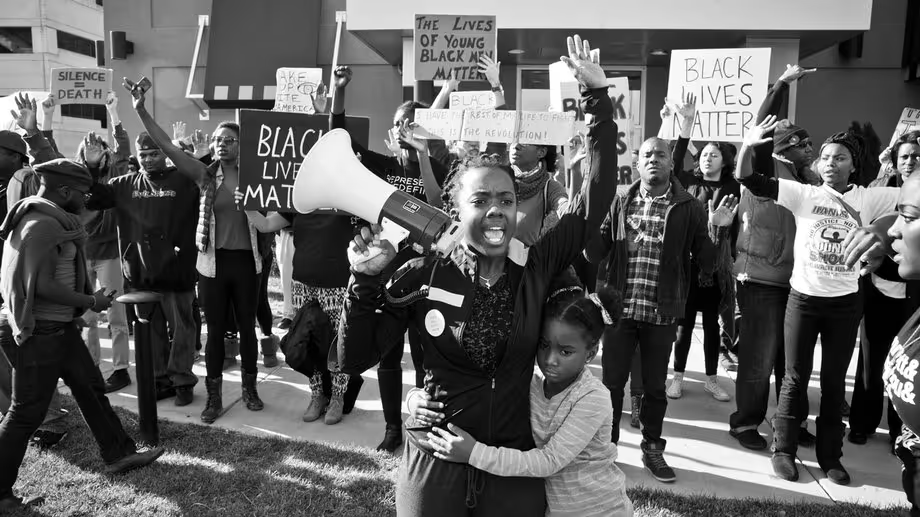
Whose Streets? Lesson Plan
"Resist and participate in democracy! That is your right and it cannot be taken away from you.” This quote from Whose Streets?, a documentary film by Sabaah Folayan and Damon Davis, responds to the systemic oppression at work around the world against people of color. This lesson provides a framework for critical analysis of current and historic race relations in America through the lens of the 2014 shooting of Michael Brown, Jr., a young unarmed black man, by white police officer Darren Wilson in Ferguson, Missouri.
In this lesson, students conduct a Socratic seminar in preparation for creating a plan of action to submit to local bodies of government with suggestions for improving relations between police departments and the people in the communities that they protect and addressing other disparities in our country’s criminal justice system. This plan of action is malleable and will be adjusted depending upon grade level and specific issues in your school community. The structured conversation of the Socratic seminar will help students generate questions and proposed solutions for their written plans of action.
A Note From the Directors, Sabaah Folayan and Damon Davis
We made this film as an act of recognition. The people who took to the streets following the death of Michael Brown Jr. were mothers, fathers, teachers, students and everything in between. Through the chaos and political talk, the humanity of the situation got lost. Whose Streets?is meant to remind all of us that freedom comes with a responsibility, and that sometimes participation in democracy means taking risks, including the risk of being misunderstood. They called Dr. King a troublemaker. They called Ferguson protestors “thugs.” There will always be those who fear change. Our belief is that the act of protest, whether that be rallying in the streets or telling the truth in the classroom, is our best hope in the fight for a world that is just, fair, and safe for our children. If you have decided to take on the challenge of using this film as a teaching tool, we thank you for your courageous leadership.
A Note From Curriculum Writer Vivett Dukes
Teaching is a form of social activism. It is deeply embedded in my philosophy of pedagogy that all of us, regardless of our content of expertise or station in life are, at our cores, facilitators of change. At our best, our classrooms are labs where societal problems great and small are analyzed, reconstructed and moved closer to being solved by the students entrusted daily in our care. That is why I wrote this Whose Streets?lesson plan—to bring to the forefront the deeper implications about what the shooting of Michael Brown, Jr. and the reverberation of the protests that ensued as a result of his murder in 2014 mean today for us—all of us. You see, what you have before you is not just a lesson plan. It is a call to action. It is a charge to be not just the proverbial but the literal change that you want to see in the world. Through the posing of poignant yet challenging essential questions and structured, researched responses, it is the sincere hope that students and educators who engage in the activities of this lesson will move beyond their roles as momentary passive classroom participants to become lifelong informed and civically engaged community citizens. From one educator to another who is in this fight right alongside you, I thank you sincerely for adding Whose Streets? to your teaching repertoire. Together we win.
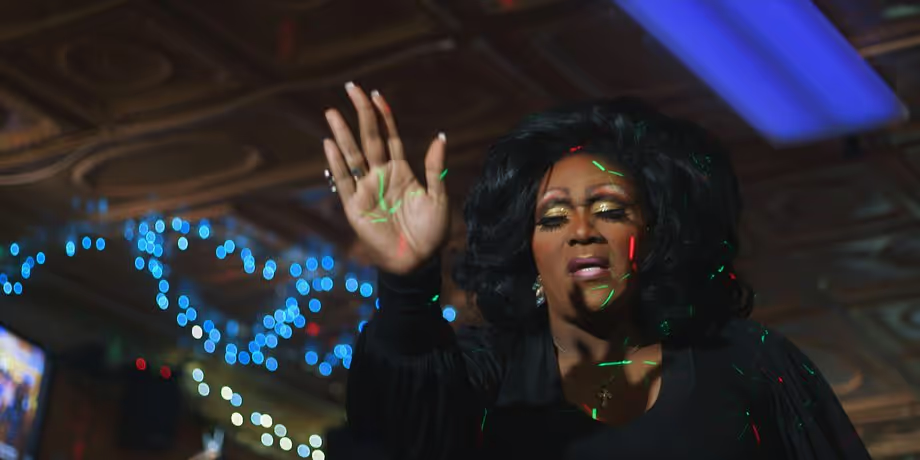
The Gospel of Eureka Delve Deeper Reading List
Ray, Douglas, ed. The Queer South: LGBTQ Writers on the American South. Sibling Rivalry Press, 2014.
This anthology, dreamed up and edited by Douglas Ray, features poetry and prose that sings of and explores the queer experience of the American South. From hilarious to heartbreaking, anxious to angry, religious to reluctant, contemplative to celebratory, this anthology expands our ideas of what it means to be queer and what it means to represent the land south of the Mason-Dixon.
Thompson, Brock. The Un-Natural State. University of Arkansas Press, 2010.
The Un-Natural State is a one-of-a-kind study of gay and lesbian life in Arkansas in the twentieth century, a deft weaving together of Arkansas history, dozens of oral histories, and Brock Thompson's own story. Thompson analyzes the meaning of rural drag shows, including a compelling description of a 1930s seasonal beauty pageant in Wilson, Arkansas, where white men in drag shared the stage with other white men in blackface, a suggestive mingling that went to the core of both racial transgression and sexual disobedience. These small town entertainments put on in churches and schools emerged decades later in gay bars across the state as a lucrative business practice and a larger means of community expression, while in the same period the state's sodomy law was rewritten to condemn sexual acts between those of the same sex in language similar to what was once used to denounce interracial sex.
New York Public Library, Edmund White and Jason Baumann, eds. The Stonewall Reader Paperback. Penguin Random House, 2019.
June 28, 2019 marks the fiftieth anniversary of the Stonewall uprising, which is considered the most significant event in the gay liberation movement, and the catalyst for the modern fight for LGBTQ rights in the United States. Drawing from the New York Public Library's archives, The Stonewall Reader is a collection of first accounts, diaries, periodic literature, and articles from LGBTQ magazines and newspapers that documented both the years leading up to and the years following the riots. Most importantly the anthology spotlights both iconic activists who were pivotal in the movement, such as Sylvia Rivera, co-founder of Street Transvestites Action Revolutionaries (STAR), as well as forgotten figures like Ernestine Eckstein, one of the few out, African American, lesbian activists in the 1960s.
Evans, Rachel Held. Searching for Sunday. Nelson Books, 2015.
Like millions of her millennial peers, Rachel Held Evans didn’t want to go to church anymore. The hypocrisy, the politics, the gargantuan building budgets, the scandals—church culture seemed so far removed from Jesus. Yet, despite her cynicism and misgivings, something kept drawing her back to Church. And so she sets out on a journey to understand Church and to find her place in it. Centered around seven sacraments, Evans’s quest takes readers through a liturgical year with stories about baptism, communion, confirmation, confession, marriage, vocation, and death that are funny, heartbreaking, and sharply honest.
Cantorna, Amber. Unashamed: A Coming-Out Guide for LGBTQ Christians. Westminster John Knox Press, 2019.
In this handy guide, LGBTQ people of faith will find personal and practical advice for the coming-out process. Unashamed tackles such topics as internalized homophobia, re-establishing your worth as a child of God, finding an affirming faith community, and deciding when and how to come out. In her accessible and compassionate style, Cantorna equips LGBTQ Christians for the coming-out process, helps them create communities that will support and love them during the journey, and offers a bridge to re-establish their relationship with God.
Howard, John. Men Like That: A Southern Queer History. University of Chicago Press, 1999.
We don’t usually associate thriving queer culture with rural America, but John Howard’s unparalleled history of queer life in the South persuasively debunks the myth that same-sex desires can’t find expression outside the big city. In fact, this book shows that the nominally conservative institutions of small-town life—home, church, school, and workplace—were the very sites where queer sexuality flourished. As Howard recounts the life stories of the ordinary and the famous, often in their own words, he also locates the material traces of queer sexuality in the landscape: from the farmhouse to the church social, from sports facilities to roadside rest areas.
Decaro, Frank. Drag: Combing Through the Big Wigs of Show Business.Rizzoli, 2019.
Drag is a multimedia collection of interviews, commentaries and photos on drag history and culture, featuring contributions from some of the most influential drag artists of our time from around the globe, including Bianca del Rio, Miss Coco Peru, Hedda Lettuce, Lypsinka, and Varla Jean Merman. Illustrated with more than 100 photos, many never-before-seen images from performers’ personal collections, and a timeline of drag “herstory.”
Sontag, Susan. Notes on Camp. Penguin Modern, 2018. (Originally published 1964.)
'The ultimate Camp statement: it's good because it's awful.' These two classic essays were the first works of criticism to break down the boundaries between 'high' and 'low' culture, and made Susan Sontag a literary sensation.
Naidoo, Jamie Campbell. Rainbow Family Collections: Selecting and Using Children’s Books with Lesbian, Gay, Bisexual, Transgender, and Queer Content. Libraries Unlimited, 2012.
Research shows that an estimated 2 million children are being raised in lesbian, gay, bisexual, and transgender (LGBT) families in the United States; that the number of same-sex couples adopting children is at an all-time high; and that lesbian, gay, bisexual, transgender, and queer/questioning (LGBTQ) couples raising children live in 96 percent of all counties in the United States. Today's educators and youth librarians therefore need guidance in choosing, evaluating, and selecting high-quality children's books with LGBTQ content. As one of the only highly praised resources on this important topic, this thoughtfully compiled book examines and suggests picture books and chapter books presenting LGBTQ content to children under the age of 12.
Harker, Jaime.The Lesbian South: Southern Feminists, the Women in Print Movement, and the Queer Literary Canon. The University of North Carolina Press, 2018.
In this book, Jaime Harker uncovers a largely forgotten literary renaissance in southern letters. Anchored by a constellation of southern women, the Women in Print movement grew from the queer union of women’s liberation, civil rights activism, gay liberation, and print culture. Broadly influential from the 1970s through the 1990s, the Women in Print movement created a network of writers, publishers, bookstores, and readers that fostered a remarkable array of literature. With the freedom that the Women in Print movement inspired, southern lesbian feminists remade southernness as a site of intersectional radicalism, transgressive sexuality, and liberatory space.
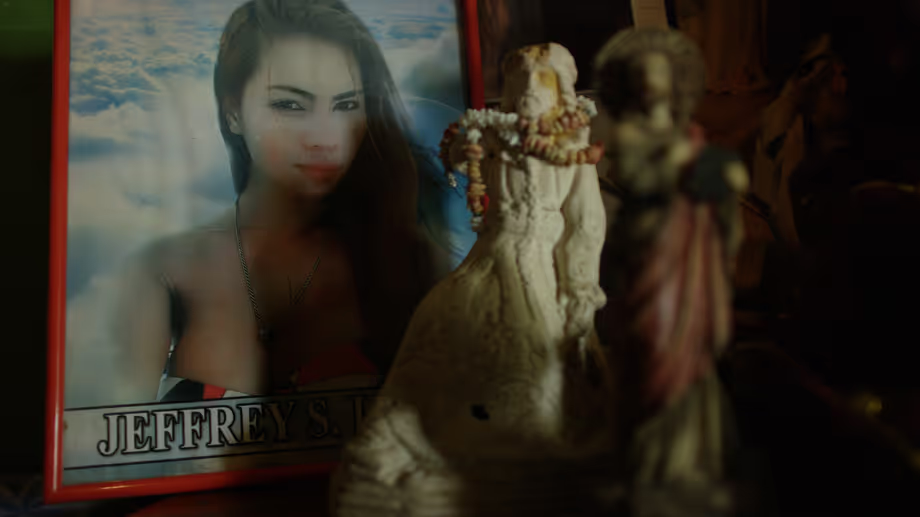
When the Political Becomes Personal: U.S. Imperialism in the Philippines
The United States has a history of imperialism that was intended to increase military reach, expand U.S. markets, identify and exploit cheap labor and resources and spread American culture and ideals. The policy and ideology of imperialism have led to devastating results for the economies and cultures of colonized nations around the world, including the Philippines. Inherent to a doctrine of imperialism is a suppression of indigenous cultures and, according to historian Kristin Hoganson, author of Fighting for American Manhood: How Gender Politics Provoked the Spanish-American and Philippine-American Wars, a gender-based exercise of power.
In the documentary film Call Her Ganda we see how the legacy of U.S. imperialism persists in the form of ongoing U.S. military presence in the Philippines and legal protections afforded to U.S. military personnel who commit crimes on Filipino soil. Call Her Ganda reveals the injustices and imbalance of power inherent in this legacy and how it leads to violence against the Filipino population in general and, in the case of Jennifer Laude, the historical erasure and degradation of transgender identity and the inability of the Filipino people to fight for their right to punish violent crimes committed against them on their own shores.
In this lesson students will study how the history of the U.S. military presence in the Philippines has an impact on families like the Laudes and how the murder of Jennifer “Ganda” Laude reveals the tragic intersection of imperialism, gender, transphobia and violence.
If students are unfamiliar with the disproportionate rates of violence against transgender individuals in the U.S. and around the world, it may be instructive to share this information:
"Every day millions of transgender people in all regions experience rejection, stigmatization, harassment and physical violence because they do not conform with prevailing gender norms. Such violence may be physical (including murder, beatings, kidnappings, rape and sexual assault) or psychological (including threats, coercion and arbitrary deprivations of liberty)."
— 2013 United Nations Development Programme Discussion Paper on Transgender Health and Human Rights
Trans Murder Monitoring Map, a project of transrespect.org, monitors murders of transgender people by country throughout the world.
Important Note to Educators
Call Her Ganda includes violence and sexual assault that can be difficult to watch and talk about. Bringing these elements into a classroom conversation requires establishing an environment where students have been prepared in advance and exhibit the maturity to share and process this information.
To prepare for this lesson:
● Watch all the film clips suggested for this lesson prior to screening them in your classroom.
● Review the Resources of this lesson and familiarize yourself with the recommended organizations and materials.
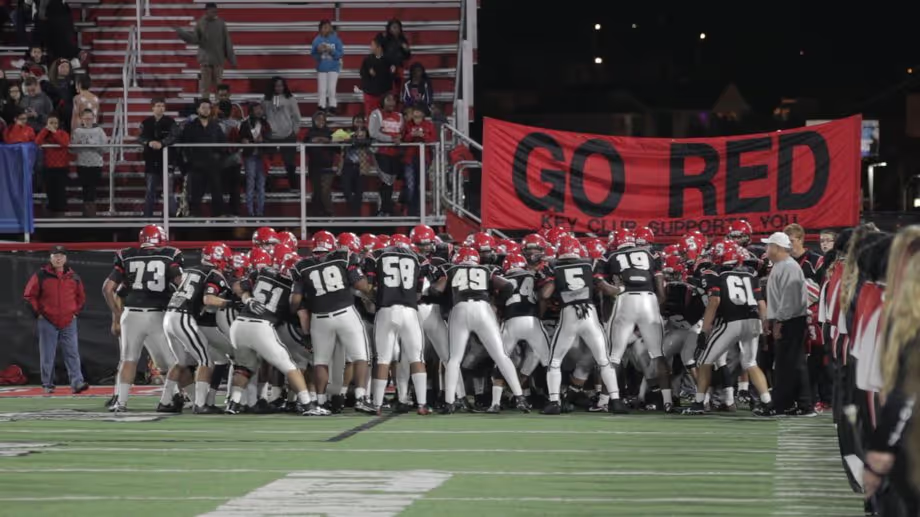
Roll Red Roll: Discussion Guide
The Roll Red Roll Discussion Guide includes a director's statement, helpful information about addressing consent and sexual assault, prompts for discussion and a list of action steps and resources. This guide is an invitation to dialogue. It is based on a belief in the power of human connection, designed for people who want to use Roll Red Roll to engage family, friends, classmates, colleagues and communities. In contrast to initiatives that foster debates in which participants try to convince others that they are right, this document envisions conversations undertaken in a spirit of openness in which people try to understand one another and expand their thinking by sharing viewpoints and listening actively.
Download the discussion guide for Roll Red Roll (PDF).
Call Her Ganda: Delve Deeper Reading List
Tobia, Jacob. Sissy: A Coming-of-Gender Story. G.P. Putnam’s Sons, 2019.
From the moment a doctor in Raleigh, North Carolina, put “male” on Jacob Tobia’s birth certificate, everything went wrong. Alongside “male” came many other, far less neutral words: words that carried expectations about who Jacob was and who Jacob should be, words like “masculine” and “aggressive” and “cargo shorts” and “SPORTS!” Naturally sensitive, playful, creative, and glitter-obsessed, as a child Jacob was given the label “sissy.” In the two decades that followed, “sissy” joined forces with “gay,” “trans,” “nonbinary,” and “too-queer-to-function” to become a source of pride and, today, a rallying cry for a much-needed gender revolution. Through revisiting their childhood and calling out the stereotypes that each of us have faced, Jacob invites us to rethink what we know about gender and offers a bold blueprint for a healed world–one free from gender-based trauma and bursting with trans-inclusive feminism.
Boylan, Jennifer Finney.She’s Not There: A Life in Two Genders.Broadway Books, 2013.
When she changed genders, she changed the world. It was the groundbreaking publication of She’s Not There in 2003 that jump-started the transgender revolution. By turns hilarious and deeply moving, Boylan—a cast member on I Am Cait; an advisor to the television series Transparent, and a contributing opinion writer for the New York Times—explores the territory that lies between men and women, examines changing friendships, and rejoices in the redeeming power of love and family.
Immerwahr, Daniel. How to Hide an Empire: A History of the Greater United States. Farrar, Straus and Giroux, 2019.
We are familiar with maps that outline all fifty states. And we are also familiar with the idea that the United States is an “empire,” exercising power around the world. But what about the actual territories—the islands, atolls, and archipelagos—this country has governed and inhabited? In How to Hide an Empire, Daniel Immerwahr tells the fascinating story of the United States outside the United States. In crackling, fast-paced prose, he reveals forgotten episodes that cast American history in a new light.
Kinzer, Stephen. Overthrow: America's Century of Regime Change from Hawaii to Iraq. Times Books, 2007.
"Regime change" did not begin with the administration of George W. Bush, but has been an integral part of U.S. foreign policy for more than one hundred years. Starting with the overthrow of the Hawaiian monarchy in 1893 and continuing through the Spanish-American War and the Cold War and into our own time, the United States has not hesitated to overthrow governments that stood in the way of its political and economic goals. The invasion of Iraq in 2003 is the latest, though perhaps not the last, example of the dangers inherent in these operations. In Overthrow, Stephen Kinzer tells the stories of the audacious politicians, spies, military commanders, and business executives who took it upon themselves to depose monarchs, presidents, and prime ministers. He also shows that the U.S. government has often pursued these operations without understanding the countries involved; as a result, many of them have had disastrous long-term consequences.
Kinzer, Stephen.The True Flag: Theodore Roosevelt, Mark Twain, and the Birth of American Empire. Henry Holt & Co., 2017.
How should the United States act in the world? Americans cannot decide. Sometimes we burn with righteous anger, launching foreign wars and deposing governments. Then we retreat—until the cycle begins again. No matter how often we debate this question, none of what we say is original. Every argument is a pale shadow of the first and greatest debate, which erupted more than a century ago. Its themes resurface every time Americans argue whether to intervene in a foreign country. Revealing a piece of forgotten history, Stephen Kinzer transports us to the dawn of the twentieth century, when the United States first found itself with the chance to dominate faraway lands. That prospect thrilled some Americans. It horrified others. Their debate gripped the nation.
Gosset, Reina, and Eric A. Stanley, eds.Trap Door: Trans Cultural Production and the Politics of Visibility (Critical Anthologies in Art and Culture).MIT Press, 2017.
The increasing representation of trans identity throughout art and popular culture in recent years has been nothing if not paradoxical. Trans visibility is touted as a sign of a liberal society, but it has coincided with a political moment marked both by heightened violence against trans people (especially trans women of color) and by the suppression of trans rights under civil law. Trap Door grapples with these contradictions. The essays, conversations, and dossiers gathered here delve into themes as wide-ranging yet interconnected as beauty, performativity, activism, and police brutality. Collectively, they attest to how trans people are frequently offered "doors"—entrances to visibility and recognition—that are actually "traps," accommodating trans bodies and communities only insofar as they cooperate with dominant norms.
Karnow, Stanley.In Our Image: America’s Empire in the Philippines. Ballentine Books, 2016.
Stanley Karnow won the Pulitzer Prize for this account of America’s imperial experience in the Philippines. In a swiftly paced, brilliantly vivid narrative, Karnow focuses on the relationship that has existed between the two nations since the United States acquired the country from Spain in 1898, examining how we have sought to remake the Philippines “in our image,” an experiment marked from the outset by blundering, ignorance, and mutual misunderstanding.
Foster, John Bellamy.Naked Imperialism: the U.S. Pursuit of Global Dominance. Monthly Review Press, 2006.
During the Cold War years, mainstream commentators were quick to dismiss the idea that the United States was an imperialist power. Even when U.S. interventions led to the overthrow of popular governments, as in Iran, Guatemala, or the Congo, or wholesale war, as in Vietnam, this fiction remained intact. During the 1990s and especially since September 11, 2001, however, it has crumbled. Today, the need for American empire is openly proclaimed and defended by mainstream analysts and commentators. John Bellamy Foster’s Naked Imperialismexamines this important transformation in U.S. global policy and ideology, showing the political and economic roots of the new militarism and its consequences both in the global and local context.
Talusan, Grace. The Body Papers: A Memoir. Restless Books, 2019.
Born in the Philippines, young Grace Talusan moves with her family to a New England suburb in the 1970s. At school, she confronts racism as one of the few kids with a brown face. At home, the confusion is worse: her grandfather’s nightly visits to her room leave her hurt and terrified, and she learns to build a protective wall of silence that maps onto the larger silence practiced by her Catholic Filipino family. Talusan learns as a teenager that her family’s legal status in the country has always hung by a thread—for a time, they were “illegal.” Family, she’s told, must be put first.
Velasco Shaw, Angel and Luis. H. Francia.Vestiges of War: The Philippine-American War and the Aftermath of an Imperial Dream 1899-1999. NYU Press, 2002.
U.S. intervention in the Philippines began with the little-known 1899 Philippine-American War. Using the war as its departure point in analyzing U.S.—Philippine relations, Vestiges of War retrieves this willfully forgotten event and places it where it properly belongs—as the catalyst that led to increasing U.S. interventionism and expansionism in the Asia Pacific region. This seminal, multidisciplinary anthology examines the official American nationalist story of "benevolent assimilation" and fraternal tutelage in its half century of colonial occupation of the Philippines.
Mendoza, S. Lily and Strobel, Leny Mendoza.Back from the Crocodile's Belly: Philippine Babaylan Studies and the Struggle for Indigenous Memory. Center for Babaylan Studies, 2013.
Back from the Crocodile’s Belly is a celebration of the beauty, richness, and diversity of indigenous ways of being as revealed in the critical studies and creative performances of living native traditions in the Philippines and in the United States diaspora. Through the use of primary and secondary research, the re-reading of historical and cultural archives, and the articulation of silenced stories, the book seeks to open up space for an alternative discourse on indigenous knowledge that does not merely reproduce progressivist and social evolutionary paradigms that invariably position the Indigenous Subject as “primitive,” “barbaric,” and nothing more than a “quaint relic of the past.”
Benedicto, Bobby.Under Bright Lights: Gay Manila and the Global Scene. University of Minnesota Press, 2014.
Bobby Benedicto draws on ethnographic research and employs affective, first-person storytelling techniques to capture the visceral experience of Manila, painting a remarkably counterintuitive portrait of gay spaces in postcolonial cities. He argues that Filipino gay men’s pursuit of an elusive global gay modernity sustains the very class, gender, and racial hierarchies that structure urban life in the Philippines.
Johnson, Mark. Beauty and Power: Transgendering and Cultural Transformation in the Southern Philippines. London, UK: Berg Publishers, 1997.
This compelling study of gender and sexual diversity in the Southern Philippines addresses general questions about the relationship between the making of gender and sexualities, the politics of national and ethnic identities and processes of cultural transformation in a world of contract labourers and transnational consumers.
Manalansan, Martin F.Global Divas: Filipino Gay Men in the Diaspora. Duke University Press, 2003.
A vivid ethnography of the global and transnational dimensions of gay identity as lived by Filipino immigrants in New York City, Global Divas challenges beliefs about the progressive development of a gay world and the eventual assimilation of all queer folks into gay modernity. Insisting that gay identity is not teleological but fraught with fissures, Martin Manalansan IV describes how Filipino gay immigrants, like many queers of color, are creating alternative paths to queer modernity and citizenship.
Call Her Ganda: Discussion Guide
In December of 2014, I was fortunate enough to be invited by film auteur and scholar Nick Deocampo to travel to Manila to screen my previous two documentary features (Trinidad and BeforeYou Know It) for the QC Pink LGBTQ+ Film Festival. Having only visited my parents’ homeland as a child, I was excited to return to the Philippines and to forge my own connections to the country and its local queer communities. When I arrived, I discovered a country struck with grief, outraged over the death of Jennifer Laude, a trans woman from Olongapo who was found murdered in a motel room. A U.S. marine was the leading suspect, but police authorities were unable to detain him, as he was protected by a Visiting Forces Agreement that gives the U.S. enormous latitude with cases concerning military personnel. While serving on a panel about LGBTQ rights at the festival, I met Attorney Virginia Suarez who was representing the Laude family. She told us about the case and shared a clip of Jennifer’s mother, “Nanay” (tagalog for “mother”), who spoke with raw passion, demanding justice for the death of her child. During the panel, someone suggested that a documentary about Jennifer needed to be made, and all eyes turned to me.
For years I’ve made work recognized in LGBTQ film circles, and somewhere along the way people started overlooking my Filipino heritage. Being both queer and Filipino-American shapes who I am and how I experience the world, and it’s important to me to honor my intersectionality by presenting stories from both communities. I’ve always wanted to make a film set in the Philippines, and having the opportunity to tell the story of Jennifer Laude and those who worked tirelessly to seek justice for her death not only spoke to me as a queer person of color, but also as a Filipino-American. This film integrates all aspects of my identity and I’m extremely thankful for being given this opportunity to tell an important story for so many people, including myself.
Inspired by my first encounters with Nanay and attorney Virgie Suarez, I initially intended just to follow them for my documentary. I was riveted by Nanay when she spoke of her daughter and about seeking justice for her death, and Virgie impressed me with her sharp legal skills, which matched her passion for cultural and policy change. However, after becoming aware of investigative reporter Meredith Talusan, it became clear to me that following Meredith would parallel my own investigative journey. Meredith would not only be able to ask the larger questions, but she’d be able to view the unfolding events from a unique perspective--having been born in the Philippines yet currently living in the U.S., and also being transgender. Meredith would be the perfect narrator to contextualize the cultural differences between the Philippines and the U.S. and to pinpoint the relevance and historical importance of the unfolding events.
Call Her Ganda is a protest against the extreme violence and discrimination that trans women face around the globe. It is a tribute to the 3.4 million Filipinos living in the U.S. and diaspora. And, it is a lesson for a global audience largely ignorant of the legacy of U.S. imperialism in my country of origin. As a Filipino American growing up in the U.S., where my history and identity have remained largely invisible, I am well aware of the devastating lack of knowledge about my homeland and its colonization. Relegated to the footnotes and margins of the history books, the Philippines has been unduly overlooked and vastly misunderstood. In making this film, I seek to educate the wider public, while also furthering my own knowledge of my cultural heritage.
— PJ Raval, Director, Call Her Ganda
The Gospel of Eureka: Discussion Guide
Cinema, like theater, can heighten our belief or make us believe the unbelievable. It can also disrupt and deconstruct our belief. Without condescension we hope to show that what is crass, campy, or even profane in the eyes of one group is sacred and full of communal significance in the eyes of another. We consider this project a continuation of the cinematic exploration of the links between class, commerce and American ritual that is central to our work. In an era when fundamentalism in both faith and politics rules the national stage, we hope to present a drama that explores the complex nature of belief and the fluid nature of faith but also provides personal windows into the issues and problems facing America as a whole.
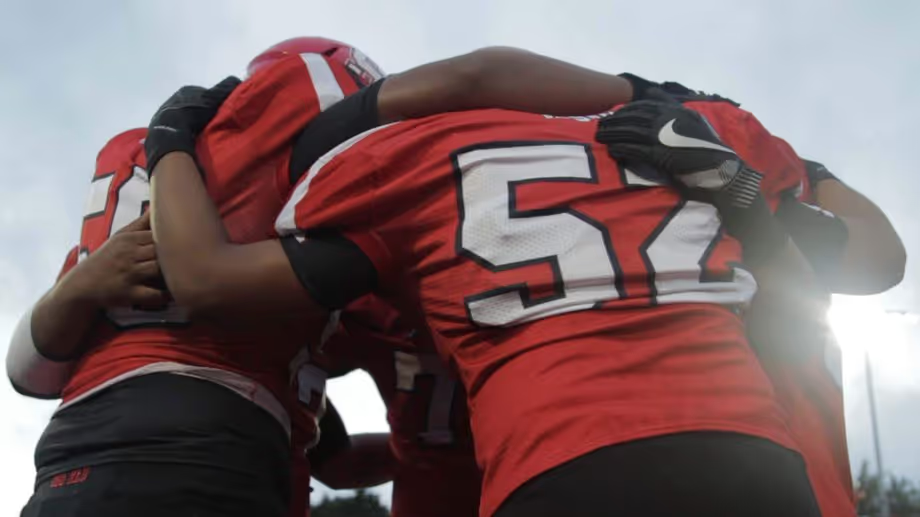
Transforming a Culture of Silence: Preventing Sexual Violence and Rape
When you witness an injustice, remaining silent or acting as a bystander is an active choice that is an impediment to justice. Speaking out and taking action are the counterpoints. The modern Civil Rights Movement would not have had the impact it did without thousands of individuals who spoke out and acted nonviolently to gain equal treatment under the law. More recently, the #MeToo movement’s power stems from individuals choosing to name and hold accountable those who perpetrate sexual harassment and violence. In both examples, the key factor in overcoming oppression and exploitation is breaking silence in the face of injustice.
In this lesson students will have the opportunity to examine the consequences of remaining silent specifically in relation to sexual violence and rape. Classrooms will watch curated segments from the acclaimed documentary Roll Red Roll, analyze in small groups a variety of perspectives involved in the case and identify moments when silence could have been broken. Students will then look at individuals who did intervene as model upstanders and reflect by writing proactive and prosocial steps they can each take to prevent, intervene, inform others and work toward ending sexual violence and rape culture.
Important Note to Educators
Roll Red Roll is a film about a sexual assault that occurred and can be difficult to watch and talk about, regardless of whether you or someone you know has been affected by violence. The film and lesson also include explicit language. Bringing these elements into a classroom conversation and sharing and processing this information requires a strong culture of respect and trust.
To prepare yourself and your students for this lesson:
● Read through the Discussion Guide for Roll Red Roll and consider integrating the Key Themes for Discussion and the related questions from the discussion guide into this POV lesson.
● Watch all the film clips suggested for this lesson prior to screening them in your classroom.
● Review the Resources section of this lesson and familiarize yourself with the recommended organizations and materials from the Discussion Guide for Roll Red Roll.
● Refer to and/or print and distribute the Important Terminology sheet at the end of this lesson and use it as a reference for yourself and your students. These terms and definitions can provide language for the class to use when discussing the film and the topics covered.
This lesson also offers two days of engagement, depending upon the grade level and preparedness of your students.
➔ Lesson: Students will view Clips 1 through 3, discuss a variety of perspectives and complete a reflective writing exercise.
➔ Extended Learning: Students will view Clips 4 and 5, discuss the choice of complicity by many peers and critically examine how technology added to the violation by bringing the crime to the “public square” of social media. If incorporating day two film segments, please pay particular attention to who is in your classroom.
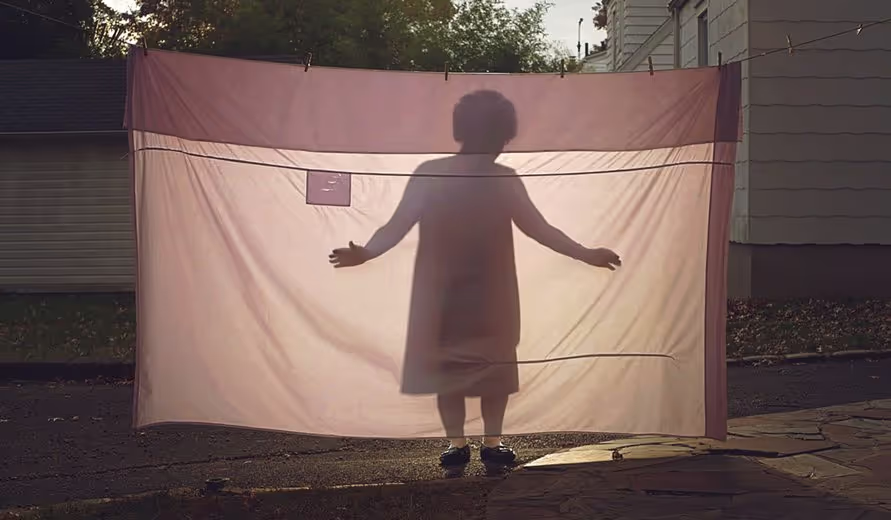
Reconstructing a Culture from Artifacts Left Behind
OVERVIEW
“Archaeology is the study of past cultures through the material (physical) remains people left behind.” (archaeological.org) Artifacts uncovered by archaeologists inform the narratives of history studied by every student in today’s schools. This lesson invites students to wonder about how scientists travel the path from a random item left behind to conclusions about how people lived or what they believed. Using the film 306 Hollywood as a model, students will be asked to create “catalogs” of “artifacts” representing their own lives or communities.
OBJECTIVES
In this lesson, students will:
- Explore how archaeologists make inferences about societies from the artifacts left behind
- Examine what the “artifacts” in our own homes say about our current society
- Create a representation of self by creating a catalog of personal artifacts
GRADE LEVELS: 10-12
SUBJECT AREAS
Archaeology
Art
History
Research Skills
U.S. History (post-WWII)
English/Language Arts
MATERIALS:
Film clips from 306 Hollywood and a way to screen them
[Optional]: Screen grabs of the catalogs (for use in class only)
ESTIMATED TIME NEEDED:
2 full class periods with homework in between
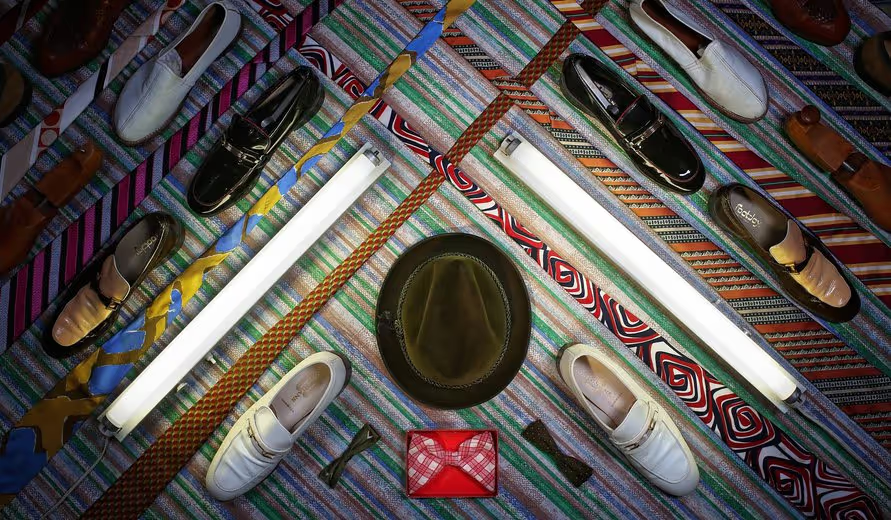
306 Hollywood: Discussion Guide
We are siblings who for years have aspired to make feature documentaries that reveal the myths and magic of everyday life. Towards this end, we set off to create 306 Hollywood, using humor, fantasy, and drama to transform the story of an old lady into an epic tale of what remains after life ends.
Before our grandmother Annette died, our intention was to make a candid and humorous film from the perspective of old age (“Getting old isn’t for sissies!” she always said). This project was based on 10 years of interviews we filmed with her. However, when we returned to Annette’s house after her funeral, we were faced with the grim reality of having to sell the house and throw out all of her possessions. That is when another, more complex, story emerged.
It is easy to take a house for granted. Domestic space is often overlooked, underestimated and left out of the mainstream record. Yet here was a space where our family had lived for 70 years. The thousands of objects that remained revealed layers of history—personal, social, and cultural. “A house is a universe,” physicist Alan Lightman declares in one interview. We believe this wholeheartedly, that our sense of time, identity and relationships are all connected to the home.
We are interested in rethinking the documentary form and are inspired by fairy tales, myths and magical realism. Fairy tales have been used for thousands of years to articulate our deepest fears and ease life transitions. We also believe that real life stories should be as entertaining and accessible as narrative films. Our cinematic language springs from this tradition and uses a technique called “normalized magic” where the day-to-day is collapsed with the wondrous. 306 Hollywood uses magical interventions to open the story to greater possibilities, to express the film’s themes of the visceral experience of grief and the psychological nature of memory, and to plumb the psychological truths that escape our everyday language.
We aim to transform the ordinary into the extraordinary. Our background is in the visual arts and we apply this sensibility to every one of our images. We crafted dozens of installations from Annette’s possessions; built a scale model of the house; turned our grandfather’s office into a mythical kingdom; and the last scene shows the entire house covered in the clothing of everyone who lived at 306 Hollywood.
— Elan and Jonathan Bogarín
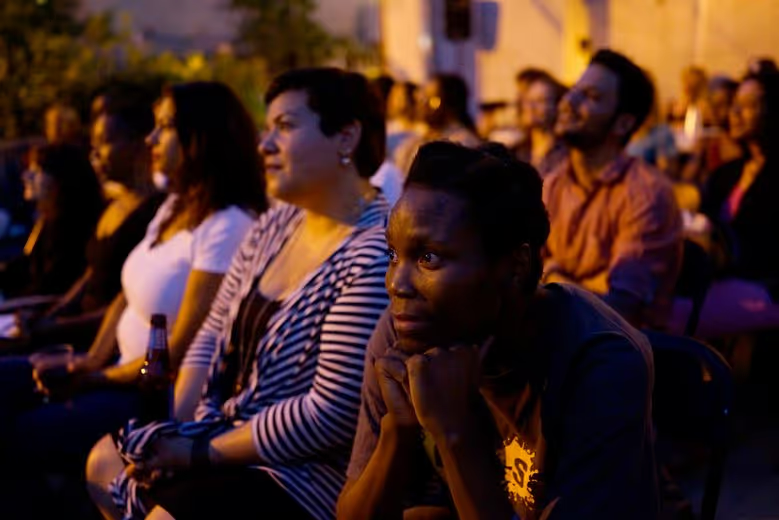
Step-by-Step Guide to Hosting a POV Screening
POV films showcase documentary film as an art form and can also be used to present information, get people interested in taking action on an issue, provide opportunities for people from different groups or perspectives to exchange views and create space for reflection. Refer to the event planning tips below to help you create a meaningful, high-impact event.
Step 1:
Determine your objectives.
POV film screenings can be tailored to your organization’s specific goals. Ask yourself:
Have I defined my goals?
Set realistic objectives with your partners by thinking about some basic questions: What do you want to happen as a result of your event? Who is your target audience? Keep in mind that some goals are easier to accomplish than others. For example, expanding a person’s knowledge is easier than changing his or her beliefs and behaviors. Establishing clear objectives will make it easier to decide how to structure the event (whether as a single meeting or an ongoing project, for example), target publicity and evaluate results.
Does the way I am planning to structure the event fit my objectives?
Do you need an outside facilitator, translator or sign language interpreter? If your objective is to share information, are there local experts on the topic who should participate in a panel discussion? How large an audience do you want? Large groups are appropriate for information exchanges, while small groups allow for more intensive dialogue.
Have I arranged to involve all stakeholders?
Think about contacting other community organizations, public officials or experts who might be good speakers. If your group is planning to take action that will affect people other than those present, it is especially important to give voice to those not in the room and ensure that people are allowed to speak for themselves. Ask stakeholders to identify their objectives and determine to what extent they can be involved.
Step 2:
Decide on a date, time and location.
Start planning your event at least one month in advance of the scheduled screening to ensure timely delivery of the film and adequate time for event promotion.
Your location should:
Be reserved for the duration of the film, if not longer
Be large enough to accommodate all attendees
Have proper A/V equipment: POV provides a copy of the film on DVD.
Possible event goals include:
Raising awareness of important issues that affect your community and the world
Encouraging dialogue around these issues forming new organizational alliances and partnerships
Making new contacts with the media and becoming a resource to be consulted
Recruiting new members through increased visibility
Enhancing your educational curriculum for students, staff and/or volunteers
Studying the art of documentary
Please note that goals may not include specific calls to action around legislation unless both sides are represented.
Step 3:
Sign up to host an event.
Join the POV Community Network:
- Check your inbox for a link to confirm your email address. A member of our team will approve your registration within 1 business day.
- Activate your account: Check your inbox for an activation link and temporary password. • Request: Once approved, log in to your account and click "My Events" to register a screening.
Let us know if you have trouble registering or change any of your event plans by contacting us at events@pov.org
Ask Yourself:
If the group is large, are there plans to break into smaller groups? Or should attendance be limited?
Is the event being held in a space where all participants will feel comfortable?
Is the space wheelchair accessible? Is it in a part of town that’s easy to reach by various kinds of transportation? If you are bringing together different constituencies, is the space in neutral territory? Does the physical configuration allow for the kind of discussion you hope to have?
Will the way that the room is set up help you meet your goals?
Is the room comfortable? Will everyone be able to see the screen easily and hear the film? If you intend to have a discussion, will people be able to see one another? Are there spaces appropriate for small breakout groups?
Have I scheduled time to plan for action?
Planning next steps can help people leave the room feeling energized and optimistic, even if the discussion has been difficult. Action steps are especially important for people who already have a good deal of experience talking about the issues on the table. For those who are new to the issues, just engaging in public discussion serves as an action step.