
Grit Delve Deeper Reading List
Drake, Phillip. Indonesia and the Politics of Disaster: Power and Representation in Indonesia’s Mud Volcano.Routledge, 2016.
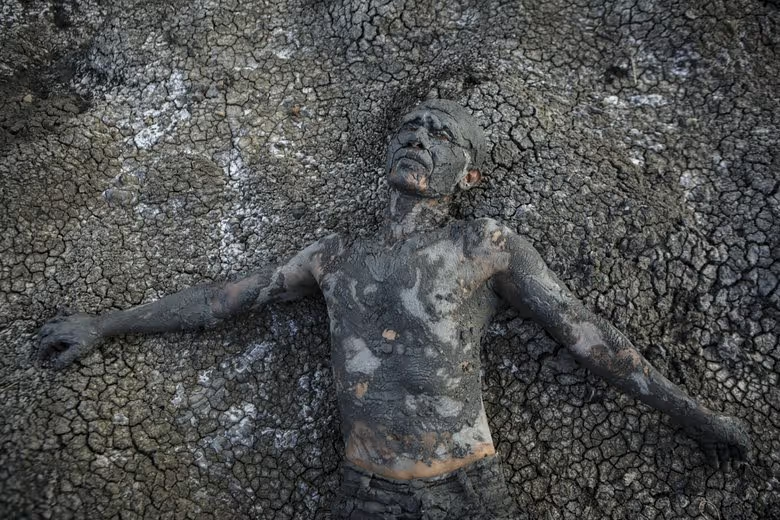
Named after Lapindo Brantas, a gas exploration company that was drilling at the eruption site, the Lapindo mudflow initially burst in 2006 and continues to flow today, becoming the most expensive disaster in Indonesia’s history. Using this environmental incident in Indonesia as a case study, this book explores representations of disaster in scientific reports, public discourse, literature, and other cultural forms, observing the impact of these portrayals on the ways people both understand and respond to complicated environmental disasters.
Gold, Russell. The Boom: How Fracking Ignited the American Energy Revolution and Changed the World. Simon and Schuster, 2014.
A narrative history, The Boom follows the dramatic development and adoption of fracking technology. It is a thrilling journey filled with colorful characters: the Texas oilman who created the first modern frack; a bare-knuckled Oklahoman natural gas empire-builder who gave the world an enormous new supply of energy and was brought down by his own success and excesses; an environmental leader whose embrace of fracking brought an end to his public career; and an aging fracking pioneer who is now trying to save the industry from itself.
Pisani, Elizabeth. Indonesia, Etc.: Exploring the Improbable Nation. W.W. Norton & Company, 2015.
Declaring Independence in 1945, Indonesia said it would “work out the details of the transfer of power etc. as soon as possible.” With over 300 ethnic groups spread across over 13,500 islands, the world’s fourth most populous nation has been working on that “etc.” ever since. Author Elizabeth Pisani traveled 26,000 miles in search of the links that bind this disparate nation.
Parry, Richard Lloyd. In the Time of Madness: Indonesia on the Edge of Chaos.Grove Press, 2005.
In the last years of the twentieth century, longtime journalist Richard Lloyd Parry found himself in the vast island nation of Indonesia, one of the most alluring, mysterious, and violent countries in the world. For thirty-two years, it had been paralyzed by the grip of the dictator and mystic General Suharto, but now the age of Suharto was coming to an end.
Gilio-Whitaker, Dina. As Long as Grass Grows: the Indigenous Fight for Environmental Justice, from Colonization to Standing Rock. Beacon Press, 2019.
The story of Native peoples’ resistance to environmental injustice and land incursions, and a call for environmentalists to learn from the Indigenous community’s rich history of activism. Through the unique lens of “Indigenized environmental justice,” Indigenous researcher and activist Dina Gilio-Whitaker explores the fraught history of treaty violations, struggles for food and water security, and protection of sacred sites, while highlighting the important leadership of Indigenous women in this centuries-long struggle. As Long As Grass Grows gives readers an accessible history of Indigenous resistance to government and corporate incursions on their lands and offers new approaches to environmental justice activism and policy.
Honest Truths: Ethics in Documentary Film
The Distant Barking of Dogs by Simon Lereng Wilmont
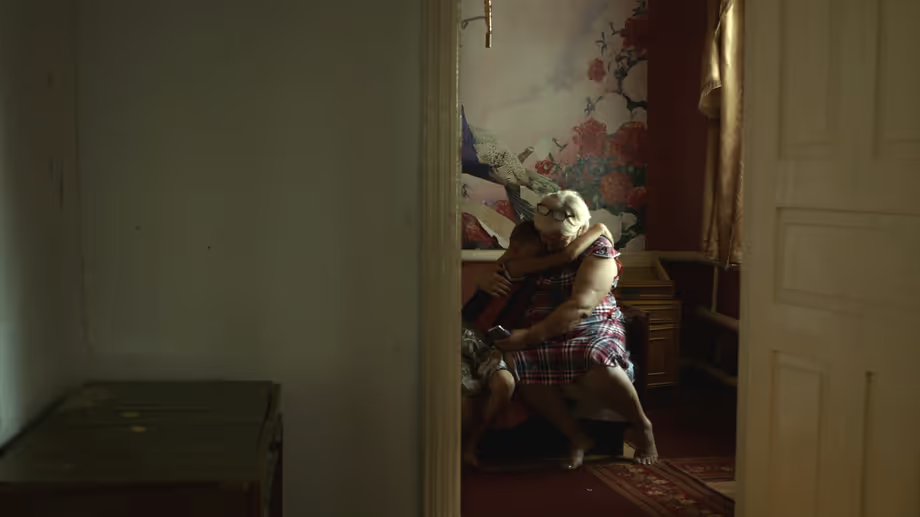
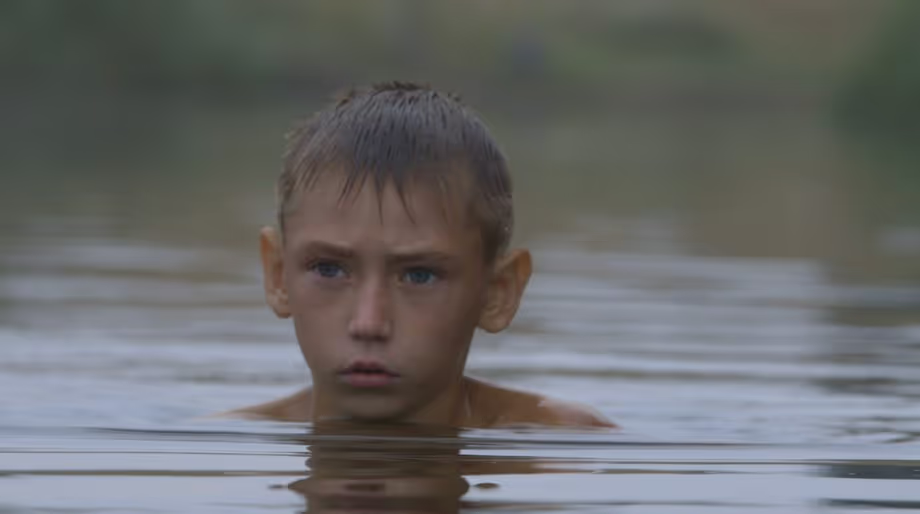
Filmmaker Simon Lereng Wilmont’s documentary follows 10-year-old Oleg over a year, witnessing the gradual erosion of his innocence beneath the pressures of the ongoing war in eastern Ukraine.
Oleg lives with his beloved grandmother Alexandra in the small village of Hnutove. Having no other place to go, Oleg and Alexandra stay as others leave the village. Life becomes increasingly difficult with each passing day, and there is no end to the war in sight.
In the now half-deserted village, Oleg and Alexandra are the only true constants in each other’s lives, and the film shows both how fragile such close relationships are and how crucial they are for survival. Through Oleg’s perspective, the film examines what it means to grow up in a war zone. It portrays how a child’s struggle to discover the world is intertwined with all the dangers and challenges the war presents.
The Distant Barking of Dogs unveils the consequences of war bearing down on the children in eastern Ukraine and, by natural extension, the scars and life lessons this generation will carry with them into the future.
The Act of Killing by Joshua Oppenheimer
When the Indonesian government was overthrown by the military in 1965, small-time gangster Anwar Congo and his friends helped the army kill more than one million alleged communists, ethnic Chinese and intellectuals. Some nations with histories of similar crimes against humanity have created truth and reconciliation initiatives and even jailed perpetrators. In Indonesia, the perpetrators are still in power, and death squad members are honored for their patriotism.
In a mind-bending twist, filmmaker Joshua Oppenheimer and his Indonesian co-director (who remains anonymous for his own safety) offer Anwar and his “crew” a chance to tell their story in any way they choose. Their choice: to dramatize their brutal deeds in the style of the American westerns, musicals and gangster movies they love—with themselves as the stars. The result is a nightmarish vision of a banal culture of impunity in which killers joke about crimes against humanity on television chat shows.
For more information on the film and additional background on the 1965 Indonesian genocide, download the Discussion Guide for The Act of Killing.
On Her Shoulders by Alexandria Bombach
Twenty-three-year-old Nadia Murad’s life is a dizzying array of exhausting undertakings—from giving testimony before the United Nations to visiting refugee camps to bearing her soul in media interviews and one-on-one meetings with top government officials. Repeating her traumatic story to the world, this ordinary young woman finds herself thrust onto the international stage as the voice of her people.
In On Her Shoulders, filmmaker Alexandria Bombach follows this strong-willed young woman, who survived the 2014 genocide of the Yazidis in Northern Iraq and escaped the hands of ISIS to become a relentless beacon of hope for her people, even though at times she longs to set aside this monumental burden and simply lead an ordinary life.
For more information on the film and additional background on the 2014 Yazidi genocide, download the Discussion Guide for On Her Shoulders.
The Distant Barking of Dogs: Discussion Guide
In my two previous films, I followed children who lived in very safe worlds. Their lives got knocked out of balance temporarily, and in the films we followed them in their individual struggles to get back on their feet again, growing wiser from the experience. That made me think about what it would be like if the situation was completely turned upside down: How does a child find safety and security in a chaotic world?
In The Distant Barking of Dogs, I follow 10-year-old Oleg, who lives with his grandma in a warzone in the eastern part of Ukraine, less than one mile from the frontline. I spent time in the area researching, and I remember the first time I met Oleg. He immediately stood out. I asked if he could describe how it felt to be scared. He looked at me and without hesitation said, “It feels like a hand reaching in and grabbing my heart. When the first explosions sound, after the cannons have fired, the hand starts squeezing my heart. Then it gets all little and cold, too.” It was then I knew I had found my main subject.
Soon afterward, I met his grandmother, Alexandra, an amazing, loving and strong woman. It was obvious how close and special the bond between the two of them was. Their house still showed signs of shelling and desperately needed repairs, but it was filled with warmth and laughter. A lot of the people in the village had been displaced, including many close friends and relatives, leaving behind a vacuum of activity where time did not exist. But there was always a warm meal ready and a good story waiting to be shared in their house. Life was calm and beautiful, as it should be. For a second, you almost forgot about the war. Staying there long enough, though, I soon realized that this bubble of safety was just an illusion. A brittle illusion that could shatter violently and often unexpectedly to reveal the very real and dangerous world that Oleg and Alexandra really live in.
The film is about how people deal with the cracks in that illusion and about the human drive we have to survive no matter what. How, even amidst the most impossible circumstances, we build illusory worlds for ourselves in which we can find comfort and warmth, because we can't exist for long in chaos. Even when the illusion is demolished over and over again, we still keep building it back up again. That kind of tenacity is incredibly beautiful to me.
I am also reminded of the importance of the people who surround us by the mutual dependency that Oleg and his grandmother have developed. They share a love for each other. Without one, the other would collapse. They live in two different worlds. His world is immediate: he reacts to what happens and quickly suppresses the bad things. She, on the other hand, knows that the things yet to come can have terrible consequences for them. In the film, Alexandra shelters Oleg from the big, bad world around him for as long as she can. That's what makes it possible for him to be a child long enough to give her the joy and strength that she needs to survive and keep up hope.
—Simon Lereng Wilmont
Director, The Distant Barking of Dogs
The Changing Same Delve Deeper Reading List
Blackmon, Douglas A.Slavery By Another Name: The Re-Enslavement of Black Americans from the Civil War to World War II.Random House, 2008.
In this groundbreaking historical expose, Douglas A. Blackmon brings to light one of the most shameful chapters in American history—an “Age of Neoslavery” that thrived from the aftermath of the Civil War through the dawn of World War II. Using a vast record of original documents and personal narratives, Douglas A. Blackmon unearths the lost stories of slaves and their descendants who journeyed into freedom after the Emancipation Proclamation and then back into the shadow of involuntary servitude shortly thereafter.
Feimster, Crystal.Southern Horrors: Women and The Politics of Rape and Lynching. Harvard University Press, 2011.
Pairing the lives of two Southern women—Ida B. Wells, who fearlessly branded lynching a white tool of political terror against southern blacks, and Rebecca Latimer Felton, who urged white men to prove their manhood by lynching black men accused of raping white women—Feimster makes visible the ways in which black and white women sought protection and political power in the New South. While Wells was black and Felton was white, both were journalists, temperance women, suffragists, and anti-rape activists. By placing their concerns at the center of southern politics, Feimster illuminates a critical and novel aspect of southern racial and sexual dynamics. Despite being on opposite sides of the lynching question, both Wells and Felton sought protection from sexual violence and political empowerment for women.
Giddings, Paula.Ida: A Sword Among Lions. Amistad, 2009.
Heralded as a landmark achievement upon publication, Ida: A Sword Among Lions is a sweeping narrative about a country and a crusader embroiled in the struggle against lynching—a practice that imperiled not only the lives of black men and women, but also a nation based on law and riven by race. At the center of the national drama is Ida B. Wells (1862-1931). Born to slaves in Mississippi, Wells began her activist career by refusing to leave a first-class ladies' car on a Memphis railway and rose to lead the nation's first campaign against lynching. For Wells, the key to the rise in violence was embedded in attitudes not only about black men, but also about women and sexuality. Her independent perspective and percussive personality gained her encomiums as a hero—as well as aspersions on her character and threats of death.
Goldsby, Jacqueline.A Spectacular Secret: Lynching in American Life and Literature.The University of Chicago Press, 2006.
This incisive study takes on one of the grimmest secrets in America’s national life—the history of lynching and, more generally, the public punishment of African Americans. Jacqueline Goldsby shows that lynching cannot be explained away as a phenomenon peculiar to the South or as the perverse culmination of racist politics. Rather, lynching—a highly visible form of social violence that has historically been shrouded in secrecy—was in fact a fundamental part of the national consciousness whose cultural logic played a pivotal role in the making of American modernity.
Ifill, Sherrilyn A.On the Courthouse Lawn: Confronting the Legacy of Lynching in the Twenty-first Century.Rev ed. with foreword by Bryan Stevenson, Beacon Press, 2018.
Nearly 5,000 black Americans were lynched between 1890 and 1960. Over forty years later, Sherrilyn Ifill’s On the Courthouse Lawn examines the numerous ways that this racial trauma still resounds across the United States. While the lynchings and their immediate aftermath were devastating, the little-known contemporary consequences, such as the marginalization of political and economic development for black Americans, are equally pernicious.
Leamer, Laurence.The Lynching: The Epic Courtroom Battle That Brought Down the Klan. William Morrow, 2016.
Based on numerous interviews and extensive archival research, The Lynching brings to life two dramatic trials, during which the Alabama Klan’s motives and philosophy were exposed for the evil they represent. In addition to telling a gripping and consequential story, Laurence Leamer chronicles the KKK and its activities in the second half of the twentieth century, and illuminates its lingering effect on race relations in America today.
Lynching in America: Confronting the Legacy of Racial Terror.3rd ed., Equal Justice Initiative, 2015.
Lynching in America makes the case that lynching of African Americans was terrorism, a widely supported phenomenon used to enforce racial subordination and segregation. Lynchings were violent and public events that traumatized black people throughout the country and were largely tolerated by state and federal officials. This was not “frontier justice” carried out by a few marginalized vigilantes or extremists. Instead, many African Americans who were never accused of any crime were tortured and murdered in front of picnicking spectators (including elected officials and prominent citizens) for bumping into a white person, or wearing their military uniforms after World War I, or not using the appropriate title when addressing a white person. People who participated in lynchings were celebrated and acted with impunity.
McGovern, James R.Anatomy of a Lynching: the Killing of Claude Neal. Rev. ed. with foreword by Manfred Berg, Louisiana State University Press, 2014.
First published in 1982, James R. McGovern’s Anatomy of a Lynching unflinchingly reconstructs the grim events surrounding the death of Claude Neal, one of the estimated three thousand blacks who died at the hands of southern lynch mobs in the six decades between the 1880s and the outbreak of World War II.
Metress, Christopher.The Lynching of Emmett Till: A Documentary Narrative. University of Virginia Press, 2002.
With a collection of more than one hundred documents spanning almost half a century, Christopher Metress retells Till’s story in a unique and daring way. Juxtaposing news accounts and investigative journalism with memoirs, poetry, and fiction, this documentary narrative not only includes material by such prominent figures as Hodding Carter, Chester Himes, Eleanor Roosevelt, James Baldwin, Gwendolyn Brooks, Eldridge Cleaver, Bob Dylan, John Edgar Wideman, Lewis Nordan, and Michael Eric Dyson, but it also contains several previously unpublished works—among them a newly discovered Langston Hughes poem—and a generous selection of hard-to-find documents never before collected.
Mitchell, Koritha.Living with Lynching: African American Lynching Plays, Performance, and Citizenship, 1890-1930. University of Illinois Press, 2012.
Often available in periodicals, lynching plays were read aloud or acted out by black church members, schoolchildren, and families. Koritha Mitchell shows that African Americans performed and read the scripts in community settings to certify to each other that lynching victims were not the isolated brutes that dominant discourses made them out to be. Instead, the play scripts often described victims as honorable heads of households being torn from model domestic units by white violence. In closely analyzing the political and spiritual uses of black theatre during the Progressive Era, Mitchell demonstrates that audiences were shown affective ties in black families, a subject often erased in mainstream images of African Americans.
Stevenson, Bryan.Just Mercy: A Story of Justice and Redemption.Spiegel & Grau, 2014.
Bryan Stevenson was a young lawyer when he founded the Equal Justice Initiative, a legal practice dedicated to defending those most desperate and in need: the poor, the wrongly condemned, and women and children trapped in the farthest reaches of our criminal justice system. One of his first cases was that of Walter McMillian, a young man who was sentenced to die for a notorious murder he insisted he didn’t commit. The case drew Bryan into a tangle of conspiracy, political machination, and legal brinksmanship—and transformed his understanding of mercy and justice forever. Just Mercy is at once an unforgettable account of an idealistic, gifted young lawyer’s coming of age, a moving window into the lives of those he has defended, and an inspiring argument for compassion in the pursuit of true justice.
Ore, Ersula J. Lynching:Violence, Rhetoric, and American Identity.University Press of Mississippi, 2019.
Ersula J. Ore investigates lynching as a racialized practice of civic engagement, in effect an argument against black inclusion within the changing nation. Ore scrutinizes the civic roots of lynching, the relationship between lynching and white constitutionalism, and contemporary manifestations of lynching discourse and logic today. From the 1880s onward, lynchings, she finds, manifested a violent form of symbolic action that called a national public into existence, denoted citizenship, and upheld political community.
Shin, Sun Yung, ed.A Good Time for Truth: Race in Minnesota.Minnesota Historical Society Press, 2016.
In this provocative book, sixteen of Minnesota’s best writers provide a range of perspectives on what it is like to live as a person of color in Minnesota. They give readers a splendid gift: the gift of touching another human being’s inner reality, behind masks and veils and politeness. They bring us generously into experiences that we must understand if we are to come together in real relationships. Minnesota communities struggle with some of the nation’s worst racial disparities. As its authors confront and consider the realities that lie beneath the numbers, this book provides an important tool to those who want to be part of closing those gaps.
Wideman, John Edgar.Writing to Save a Life. 1st ed., Scribner, 2016.
In 1955, Emmett Till, aged fourteen, traveled from his home in Chicago to visit family in Mississippi. Several weeks later, he returned, dead; allegedly, he whistled at a white woman. His mother, Mamie, wanted the world to see what had been done to her son. She chose to leave his casket open. Images of her brutalized boy were published widely. While Emmett’s story is known, there’s a dark side note that’s rarely mentioned. Ten years earlier, Emmett’s father was executed by the Army for rape and murder. In Writing to Save a Life, John Edgar Wideman searches for Louis Till, a silent victim of American injustice.
Wilkerson, Isabel.The Warmth of Other Suns: The Epic Story of America’s Great Migration. Random House, 2010.
In this epic, beautifully written masterwork, Pulitzer Prize–winning author Isabel Wilkerson chronicles one of the great-untold stories of American history: the decades-long migration of black citizens who fled the South for northern and western cities, in search of a better life. From 1915 to 1970, this exodus of almost six million people changed the face of America. Wilkerson compares this epic migration to the migrations of other peoples in history. She interviewed more than a thousand people, and gained access to new data and official records, to write this definitive and vividly dramatic account of how these American journeys unfolded, altering our cities, our country, and ourselves.
Coates, Ta-Nehisi.Between the World and Me. Penguin Random House, 2015.
In a profound work that pivots from the biggest questions about American history and ideals to the most intimate concerns of a father for his son, Ta-Nehisi Coates offers a powerful new framework for understanding our nation’s history and current crisis. Americans have built an empire on the idea of “race,” a falsehood that damages us all but falls most heavily on the bodies of black women and men—bodies exploited through slavery and segregation, and, today, threatened, locked up, and murdered out of all proportion. What is it like to inhabit a black body and find a way to live within it? And how can we all honestly reckon with this fraught history and free ourselves from its burden? Between the World and Me is Ta-Nehisi Coates’s attempt to answer these questions in a letter to his adolescent son.
Nadia Murad in the Public Eye: Analyzing the Moral Responsibility of the Media
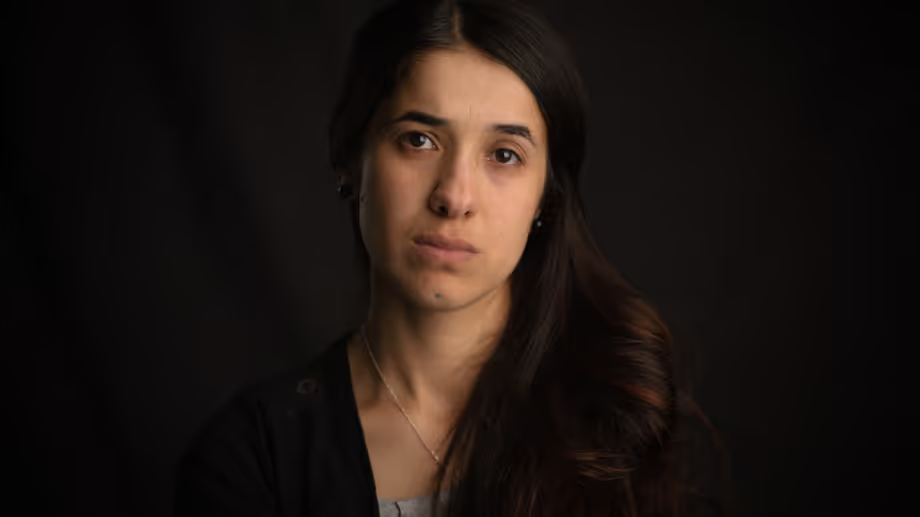
In 2018 Nadia Murad was awarded the Nobel Peace Prize alongside Denis Mukwege, according to the prize committee, “for their efforts to end the use of sexual violence as a weapon of war and armed conflict.” Four years earlier, Nadia Murad was a young woman living peacefully in her small Yazidi village of Kocho in northwest Iraq. Not only had she never heard of the Nobel Peace Prize, but she could not have imagined that one day she would be an international activist speaking on behalf of her community in front of the United Nations.
This dizzying rise to international attention is as worthy of study and attention as the events that brought Murad to the world stage of humanitarian and human rights work. Today we see Murad as a source of strength and resilience. She is a survivor, even called a hero by many for telling her story of survival again and again on behalf of her Yazidi people. But at what cost does Murad tell her story, and for whose benefit?
In this lesson, students will have the opportunity to consider this question and broaden their media literacy skills by identifying the moral and ethical parameters journalists follow when interacting with and reporting on survivors of genocide. By viewing excerpts of On Her Shoulders—a documentary portrait of Nadia Murad, who survived the 2014 Yazidi genocide—students will evaluate the balance between the media’s desire for survivors to tell their stories, the public’s need for stories of strength and heroism and the survivors’ pursuit of justice for their community.
Important Note to Educators
On Her Shoulders is a film about a war, collective violence, rape and trauma as a weapon of war. Regardless of whether you or someone you know has ever been affected by war or sexual violence, the story of Nadia Murad’s torture and survival is emotional and difficult. Bringing these elements into a classroom requires care, context and a strong culture of respect and trust in one another in order to share and process this information.
To prepare yourself and your students for this lesson:
Watch all the film clips from On Her Shoulders prior to screening them in your classroom. Watching the full feature film is highly recommended.
Review the On Her Shoulders website and learn more about Nadia’s Initiative.
Read through all the handouts and review the Resources for Further Learning section of this lesson to learn more about the history and culture of the Yazidi people and Nadia Murad’s work and international recognition since 2014.
The Distant Barking of Dogs Delve Deeper Reading List
Pieniazek, Pawel. Translated by Malgorzata Markoff and John Markoff. Greetings from Novorossiya: Eyewitness to the War in Ukraine. University of Pittsburgh Press, 2017.
Polish journalist Pawel Pieniazek was among the first journalists to enter the war-torn region of eastern Ukraine and Greetings from Novorossiya is his vivid firsthand account of the conflict. He was the first reporter to reach the scene when Russian troops in Ukraine accidentally shot down a civilian airliner, killing all 298 people aboard. Unlike Western journalists, his fluency in both Ukrainian and Russian granted him access and the ability to move among all sides in the conflict. With powerful color photos, telling interviews from the local population, and brilliant reportage, Pieniazek’s account documents these dramatic events as they transpired.
Kuzio, Taras. Putin's War Against Ukraine: Revolution, Nationalism, and Crime. CreateSpace Independent Publishing Platform, 2017.
Putin’s war against Ukraine has killed over 30,000 civilians, Ukrainian and Russian soldiers and Russian proxies, forced a third of the population of the Donbas to flee, illegally nationalized Ukrainian state and private entities in the Crimea and the Donbas, destroyed huge areas of the infrastructure and economy of the Donbas, and created a black hole of crime and soft security threats to Europe. Putin's War Against Ukraine is the first book to focus on national identity as the root of the crisis through Russia's long-term refusal to view Ukrainians as a separate people and an unwillingness to recognize the sovereignty and borders of independent Ukraine.
De Toledo, Sylvie, and Deborah Edler Brown. Grandparents as Parents, Second Edition: A Survival Guide for Raising a Second Family. Guilford Press, 2013.
If you're among the millions of grandparents raising grandchildren today, you need information, support, and practical guidance you can count on to keep your family strong. This is the book for you. Learn effective strategies to help you cope with the stresses of parenting the second time around, care for vulnerable grand kids and set boundaries with their often-troubled parents, and navigate the maze of government aid, court proceedings, and special education. Wise, honest, moving stories show how numerous other grandparents are surviving and thriving in their new roles.
Scheeringa, Michael S. They'll Never Be the Same: A Parent's Guide to PTSD in Youth. Las Vegas Central Recovery Press, 2018.
A compassionate and accessible guide for parents whose children have experienced traumatic or life-threatening events written by one of the foremost authorities on post-traumatic stress disorder (PTSD) in children and adolescents. Dr. Scheeringa understands the desperation many parents feel and explains the impact of trauma, simplifies the science into layman’s terms, debunks the myths, and provides direction on navigating the confusing maze of the mental health world to find appropriate care.
Shore, Marci. The Ukrainian Night: An Intimate History of Revolution. Yale University Press, 2018.
In this lyrical and intimate book, Marci Shore evokes the human face of the Ukrainian Revolution. Grounded in the true stories of activists and soldiers, parents and children, Shore’s book blends a narrative of suspenseful choices with a historian’s reflections on what revolution is and what it means. She gently sets her portraits of individual revolutionaries against the past as they understand it—and the future as they hope to make it. In so doing, she provides a lesson about human solidarity in a world, our world, where the boundary between reality and fiction is ever more effaced.
Toal, Gerard. Near Abroad: Putin, the West and the Contest over Ukraine and the Caucasus. Oxford University Press, 2017.
In Near Abroad, Gerard Toal moves beyond the polemical rhetoric that surrounds Russia's interventions in Georgia and Ukraine to study the underlying territorial conflicts and geopolitical struggles. Central to understanding are legacies of the Soviet Union collapse: unresolved territorial issues, weak states and a conflicted geopolitical culture in Russia over the new territorial order. Toal explains the road to invasion and war in Georgia and Ukraine, thereafter, and provides an account of real life geopolitics, one that emphasizes changing spatial relationships, geopolitical cultures and the power of media images. Not only a penetrating analysis of Russia's relationships with its regional neighbors, Near Abroad also offers an analysis of how US geopolitical culture frequently fails to fully understand Russia and the geopolitical archipelago of dependencies in its near abroad.
On Her Shoulders Delve Deeper Reading List
Mikhail, Dunya. The Beekeeper: Rescuing the Stolen Women of Iraq. New Directions Publishing, 2018.
Since 2014, Daesh (ISIS) has been brutalizing the Yazidi people of northern Iraq: sowing destruction, killing those who won’t convert to Islam, and enslaving young girls and women. The Beekeeper, by the acclaimed poet and journalist Dunya Mikhail, tells the harrowing stories of several women who managed to escape the clutches of Daesh. Mikhail extensively interviews these women—who’ve lost their families and loved ones, who’ve been repeatedly sold, raped, psychologically tortured, and forced to manufacture chemical weapons—and as their tales unfold, an unlikely hero emerges: a beekeeper, who uses his knowledge of the local terrain, along with a wide network of transporters, helpers, and former cigarette smugglers, to bring these women, one by one, through the war-torn landscapes of Iraq, Syria, and Turkey, back into safety.
Simpson, Roger and Cote, William. Covering Violence: A Guide to Ethical Reporting About Victims & Trauma.Columbia University Press, 2006.
Reporting on violence is one of the most problematic features of journalistic practice: the area most frequently criticized by the public and those on the receiving end of that coverage. Now in its second edition, Covering Violence remains a crucial guide for becoming a sensitive and responsible reporter. Discussing such topics as rape and the ethics of interviewing children, the book gives students and journalists a detailed understanding of what is happening "on the scene" of a violent event, including where a reporter can go safely and legally, how to obtain the most useful information, and how best to interview and photograph victims and witnesses.
Goodnow, Katherine, Loham, Jack, and Marfleet, Philip. Museums, the Media, and Refugees.Berghahn Books, 2008.
Across countries and time, asylum-seekers and refugees have been represented in a variety of ways. In some representations they appear negatively, as dangers threatening to ‘over-run’ a country or a region with ‘floods’ of incompatible strangers. In others, the same people are portrayed positively, with compassion, and pictured as desperately in need of assistance. How these competing perceptions are received has significant consequences for determining public policy, human rights, international agreements, and the realization of cultural diversity, and so it is imperative to understand how these images are perpetuated. To this end, this volume reflects on museum practice and the contexts, stories, and images of asylum seekers and refugees prevalent in our mass media.
Murad, Nadia. The Last Girl: My Story of Captivity, and My Fight Against the Islamic State. Tim Duggan Books, 2017.
Nadia Murad was born and raised in Kocho, a small village of farmers and shepherds in northern Iraq. A member of the Yazidi community, she and her brothers and sisters lived a quiet life. Nadia had dreams of becoming a history teacher or opening her own beauty salon. On August 15th, 2014, when Nadia was just twenty-one years old, this life ended. Islamic State militants massacred the people of her village, executing men who refused to convert to Islam and women too old to become sex slaves. Six of Nadia’s brothers were killed, and her mother soon after, their bodies swept into mass graves. Nadia was taken to Mosul and forced, along with thousands of other Yazidi girls, into the ISIS slave trade. Nadia would be held captive by several militants and repeatedly raped and beaten. Finally, she managed a narrow escape through the streets of Mosul, finding shelter in the home of a Sunni Muslim family whose eldest son risked his life to smuggle her to safety. Today, Nadia’s story—as a witness to the Islamic State’s brutality, a survivor of rape, a refugee, a Yazidi—has forced the world to pay attention to an ongoing genocide.
Hisham, Marwan (Author) & Molly Crabapple (Illustrator). Brothers of the Gun: A Memoir of the Syrian War. Penguin Random House, 2018.
Illustrated with more than eighty ink drawings by Molly Crabapple that bring to life the beauty and chaos, Brothers of the Gun offers a ground-level reflection on the Syrian revolution—and how it bled into international catastrophe and global war. This is a story of pragmatism and idealism, impossible violence and repression, and, even in the midst of war, profound acts of courage, creativity, and hope.
Heineman, Elizabeth D. Sexual Violence in Conflict Zones From the Ancient World to the Era of Human Rights. University of Pennsylvania Press, 2013.
Since the 1990s, sexual violence in conflict zones has received much media attention. In large part as a result of grassroots feminist organizing in the 1970s and 1980s, mass rapes in the wars in the former Yugoslavia and during the Rwandan genocide received widespread coverage, and international organizations—from courts to NGOs to the UN—have engaged in systematic efforts to hold perpetrators accountable and to ameliorate the effects of wartime sexual violence.
Bradley, Megan. Forced Migration, Reconciliation, and Justice. McGill-Queen's University Press, 2015.
At the start of 2014, more people were displaced globally by conflict and human rights violations than at any time since the Second World War. Although many of those displaced, from countries such as Syria, Iraq, Colombia, Kenya, and Sudan, have survived grave human rights abuses that demand redress, the links between forced migration, justice, and reconciliation have historically received little attention. This collection addresses the roles of various actors including governments, UN agencies, NGOs, and displaced persons themselves, raising complex questions about accountability for past injustices and how to support reconciliation in communities shaped by exile.
Inventing Tomorrow Delve Deeper Reading List
Colopy, Cheryl.Dirty, Sacred Rivers. Oxford University Press, 2012.
Dirty, Sacred Riversexplores South Asia’s increasingly urgent water crisis, taking readers on a journey through North India, Nepal, and Bangladesh, from the Himalaya to the Bay of Bengal. The book shows how rivers, traditionally revered by the people of the Indian subcontinent, have in recent decades deteriorated dramatically due to economic progress and gross mismanagement.
Eriksen, Marcus.Junk Raft: An Ocean Voyage and a Rising Tide of Activism to Fight Plastic Pollution.Beacon Press, 2017.
A scientist, activist, and inveterate adventurer, Eriksen is drawn to the sea by a desire to right an environmental injustice. Against long odds and common sense, he and his co-navigator, Joel Paschal, construct a “junk raft” made of plastic trash and set themselves adrift from Los Angeles to Hawaii, with no motor or support vessel, confronting perilous cyclones, food shortages, and a fast decaying raft. As Erikson recounts his struggles to keep afloat, he immerses readers in the deep history of the plastic pollution crisis and the movement that has arisen to combat it.
Greene, Ronnie.Night Fire: Big Oil, Poison Air, and Margie Richard’s Fight to Save Her Town.HarperCollins Publishers, 2008.
Margie Eugene Richard was raised in the shadow of a giant chemical plant operated by Shell, and witnessed her neighbors fall ill amid the toxic waste the plant emitted year after year. Her own sister, Naomi, eventually succumbed to a rare lung disease linked to environmental hazards. Determined to see Shell take responsibility for its actions, Margie and her neighbors— largely poor and with few obvious resources—educated themselves not only on the consequences of environmental poison but also how to fight back.
Jacobs, Chip and Kelly, William J.Smogtown: The Lung-Burning History of Pollution in Los Angeles.Overlook Press, 2008.
Smogtownis the story of pollution, progress, and how an optimistic people confronted the epic struggle against airborne poisons barraging their hometowns. With wit, verve, and a fresh look at history, California based journalists Chip Jacobs and William J. Kelly highlight the bold personalities involved, the corporate-tainted science, the terrifying health costs, the attempts at cleanup, and how the smog battle helped mold the modern-day culture of Los Angeles.
Klein, Naomi. This Changes Everything: Capitalism vs. the Climate. Simon & Schuster, 2014.
Klein exposes the myths that are clouding the climate debate. We have been told the market will save us, when in fact the addiction to profit and growth is digging us in deeper every day. We have been told it’s impossible to get off fossil fuels when in fact we know exactly how to do it—it just requires breaking every rule in the “free-market” playbook: reining in corporate power, rebuilding local economies, and reclaiming our democracies.We have also been told that humanity is too greedy and selfish to rise to this challenge. In fact, all around the world, the fight for the next economy and against reckless extraction is already succeeding in ways both surprising and inspiring. Climate change, Klein argues, is a civilizational wake-up call, a powerful message delivered in the language of fires, floods, storms, and droughts. Confronting it is no longer about changing the light bulbs. It’s about changing the world—before the world changes so drastically that no one is safe. Either we leap—or we sink.
Bisbee '17: Discussion Guide
I’ve been going to Bisbee, Arizona since 2003, when my mother-in-law bought an old cabin in the eccentric former mining town near the border. I immediately fell in love with the place. My partner was born in Tucson and we have roots in the area, but nothing prepared me for this strange, magical, truly haunted enclave – and the secret history buried there. Since then, I’ve been dreaming of making a film that captures the unique and troubled spirit of Bisbee. The centennial of the Bisbee deportation – a tragedy where 1200 striking miners, many of them immigrants, were marched out of town at gunpoint and loaded unto cattle cars – gave us the opportunity. Maybe it was just a matter of time before I made the Bisbee film – my first ever feature film idea back when I initially came to town was to “re-stage the deportation with the locals.” So after five feature documentaries, many of which use performance to try to create new ways of seeing and understanding, it was finally time to make the movie I’d been dreaming of.
The Bisbee deportation is one of countless untold tales of radicalism and oppression in American history and I knew I wanted to tell the story when I first heard it in 2003. But we had relatively little idea when we started pre-production in the summer of 2016 just how relevant the story would become. As the calendar turned to the summer of 2017, with the centennial approaching, labor rights under unprecedented attack and a humanitarian crisis gathering on the U.S.-Mexico border, a sense of urgency began to set in for all of us. The desire for the community to tell this story was palpable and we filmmakers were providing the stage. They knew what we knew: the images that we were creating together would matter. Bisbee, in many ways, is a microcosm of the country and understanding the depth of what happened in the old company town is a way to grasp where we are today as nation, how deeply ingrained American mythologies are used to divide us, and what calamities await if we don’t heed the lessons of our history.
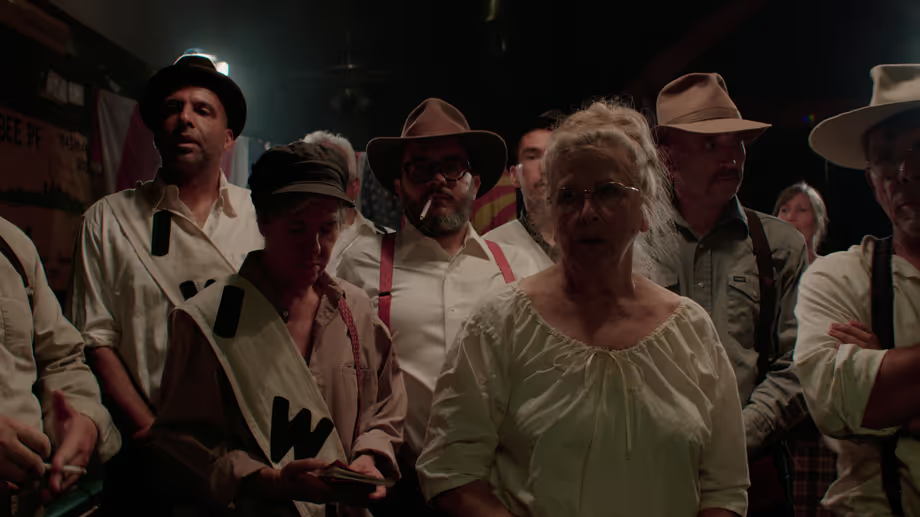
Our first mission, then, was to document the emotional awakening the town was experiencing as the centennial of the deportation approached. Then we began working with everyone from descendants of deportees to company families to create scenes that helped facilitate a kind of truth and reconciliation by way of layered performance. In my last several films, I’ve pushed further and further into the possibilities of collaborative, performative documentary filmmaking, where subjects and filmmakers work together to stage semiconstructed scenes that help the viewer imagine the internal lives of real people. With Bisbee '17, we’ve pushed this idea significantly forward. What we see is a working through of story and history and mythology as non-actors engage in “roles” that relate to their real lives and this collective trauma. The historical, the political, and the personal all become entwined as locals play dress up, portraying ghosts of a buried past. It all leads to a surprisingly cathartic and emotional place, where the collective performance of a town playing itself reveals both divisions and connections between people. Should we bury the past forever or should we work together to exorcise our demons? One white guy who played one of the vigilantes declares at the end of the large-scale recreation, “this is like the largest group therapy session ever.” A Mexican- American man who had played a deportee saw things a little differently. “You guys were good,” he said to a friend playing a deporter, “maybe too good.”
—Robert Greene, Director/Editor, Bisbee '17
Collaborating with History: Re-examining the Past through Research and Reenactment
Combining the genres of documentary, musical theater, and western film, Robert Greene’s experimental film Bisbee ’17 follows members of an Arizona community as they reckon with a dark episode in their town’s history.
In 1917, over one thousand Arizona miners—on strike for better wages and safer working conditions—were violently rounded up by their armed neighbors, herded onto cattle cars, and deposited 180 miles away in the New Mexican desert. Most of the workers expelled from Bisbee were immigrants. This event came to be known as the Bisbee deportation, and was discussed only in hushed tones during the following century. Bisbee ’17 documents Bisbee locals as they plan a centennial commemoration. They stage dramatic scenes from 1917, culminating in a large-scale recreation of the deportation itself on its 100th anniversary. These scenes are based on historical research but also convey the actors’ interpretations of their characters’ motivations, underscoring the complexity of collective historical memory. The reenactment raises difficult questions about contemporary issues of immigration, labor rights, corporate power and state-backed violence with haunting scenes created by people who are reckoning with history in real time.
In this lesson for Bisbee ‘17, students will explore the concept of historical memory and consider the social and cultural factors that influence how the Bisbee deportation has been remembered by the town’s residents. Students will then research and reenact an event from their own community’s past and analyze cultural factors that shape modern interpretations of the event.
Important Note to Educators
Viewing and discussing sensitive material: This lesson and the accompanying film address sensitive social issues and teachers should screen the film clips and review all of the related materials prior to the lesson. It would also be helpful to connect with a school social worker for resources specific to your school community’s needs and guidelines.
Remind the class that this is a supportive environment and review your classroom’s tools for creating a safe space, including class agreements. These might include guidelines like “no name-calling,” “no interrupting,” “listen without judgment,” “use respectful language,” “share to your level of comfort,” “you have the right to pass,” etc. And remind students that when they talk about groups of people, they should be careful to use the word “some,” not “all.”
Visit Teaching Tolerance for additional resources and strategies for tackling challenging topics in the classroom:
Inventing Tomorrow Lesson Plans
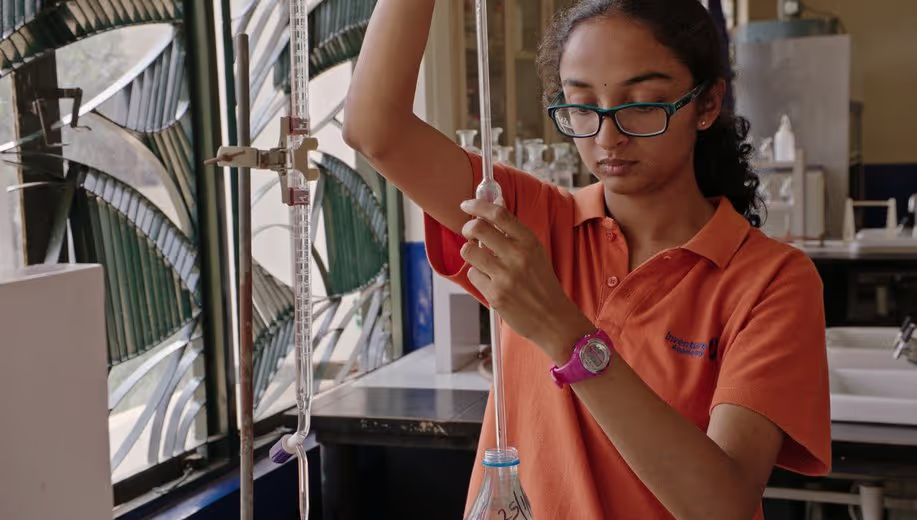
The Teaching Curriculum for Inventing Tomorrow offers educators the opportunity to make science, technology, engineering, and math come alive by pairing screenings of the documentary with classroom learning. Each student story in the documentary lays the groundwork for one of the lessons in the curriculum.
An individual lesson, or the complete curriculum, can easily be incorporated into existing coursework in middle school Science and high school Biology and Life Sciences, Chemistry, Marine Biology/Oceanography, Earth and Environmental Science, Geography, Geology or supplement units on Sustainability, Media Literacy, Global Studies, Current Events, and more.
Inventing Tomorrow: Discussion Guide
Q & A with Laura Nix, Director and Producer of Inventing Tomorrow
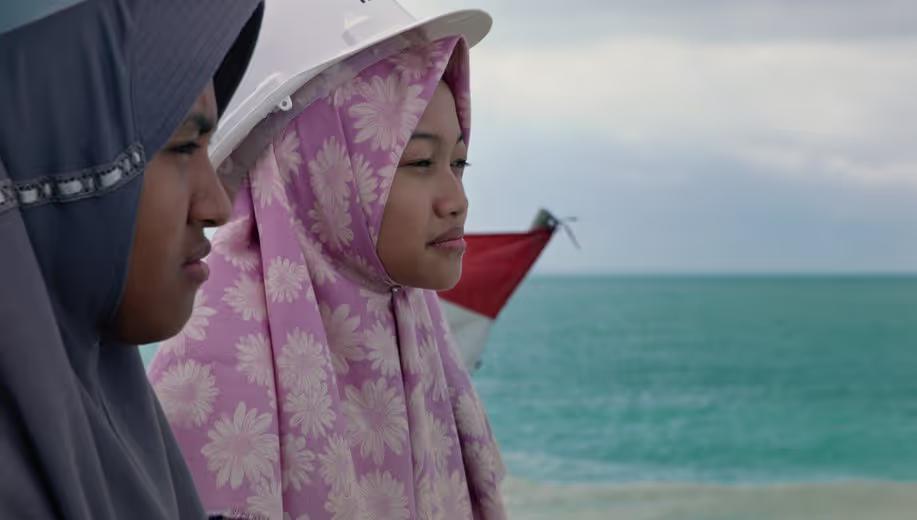
“Our student scientists are observing the damaged planet they’ve inherited, asking the right questions, and inventing solutions to create a path forward. Their commitment to action and their clarity of purpose offers a model for how we should all proceed.”
- Laura Nix, Producer and Director
What made you decide to do a film based around a high school science fair?
I was approached by my producers Diane Becker and Melanie Miller to make a doc about the science fair ISEF, so I attended the fair in Phoenix in 2016 to both film and scout and immediately realized there was a great story to tell there as most people don’t know about the fair outside of the educational and science communities. The sense of hopefulness and optimism there was infectious. I found I was the most struck however by kids I met who were doing research because of issues they were confronting at home – whether it was lack of clean drinking water, or air pollution, or some other type of environmental challenge. They weren’t doing research because it would be cool on their college application, but because they were deeply and personally motivated to change where they lived.
How did you find and decide on the students you followed?
We started by reaching out to science teachers and fair directors all over the world, and asked them to identify students who were working on projects with an environmental theme. We then spent months interviewing hundreds of kids from all over the world. We were looking for kids who were doing science with a sense of purpose and who were addressing a range of environmental issues that were local, personal and that dealt with air, water, and earth. I was specifically looking for issues that were visual, and for students who could clearly describe their project to an audience. We purposefully went beyond the scope of just climate change, so we could tell a larger story of kids engaged in environmental stewardship. It was really important to me to create an emotional and character-based film, so I was also looking for kids who had a personal story or an obstacle that was compelling, so I could show how they were working to overcome it. We wanted diversity of region, race, and religion, and a balance of girls and boys. I traveled all over the world to meet the kids we eventually decided to film, and I followed them without having any idea of what would happen once they arrived at the fair. I spent time with all of them because I believed in them as people, and because I was fascinated by their ability to pay attention and ask the right questions about the world around them.
The film emphasizes the need for ingenuity and originality. After making it, how do you feel about the potential for ingenuity and originality to save humanity from itself?
I think each of our young scientists shows us a potential path forward, and it’s really up to us to decide to empower those young people. I’m hopeful that the film will show the absolute value of STEM (Science, Technology, Engineering, Math) education in our culture. The key to creating innovative solutions for the future is access to high-quality STEM education. In the United States, we are not competitive with the rest of the world in that regard, and there are states where STEM education is coming under political fire. This stands in direct opposition to empowering the next generation to confront the future. We are not blocked by a lack of technological solutions; we’re blocked by political obstacles. Another thing that struck me about the kids was that they didn’t approach their work from a political standpoint at all. I find that hopeful, because they don’t see why politics should be an issue in addressing the environment. And they’re right; it’s not a political issue, it’s a moral issue.
The film documents some pretty intense environmental destruction, all within heavily populated areas, as people are continuing to go about their daily lives. What was that experience like for you and your crew?
The reality is that if you take a closer look at where you live, most places are facing environmental degradation. In some areas, you’re affected by it in a daily way. In others it might not be as visible, but dig a little deeper and you’ll find something in your own neighborhood. I was impressed by these students’ ability to observe where they were living, and identify what needed to be fixed. Whether or not they’re able to invent a solution today, their willingness to tackle the issue is what matters.
We do have options for how we as a culture can address these issues. But what really struck me about the kids was that they weren’t saying, “We need to stop this industry.” They were saying, “Industry is what gives people jobs where we live, so we need to engage in industrial remediation. There’s a way we could support our economy that doesn’t have to be so damaging.” It was interesting to me that all of the kids were invested in working within the systems that were already there. They wanted to come up with common-sense ways of making things better.