
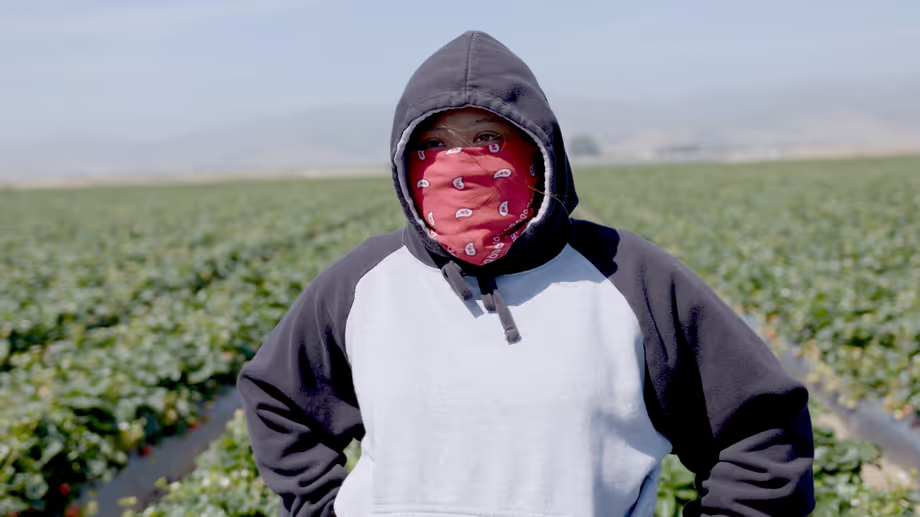
Fruits of Labor Discussion Guide
Ashley, a Mexican-American teenager living in an agricultural town in the central coast of California, dreams of graduating high school and going to college. But when ICE raids threaten her family, Ashley is forced to become the breadwinner, working days in the strawberry fields and nights at a food processing company.
USING THIS GUIDE
This guide is an invitation to dialogue. It is based on a belief in the power of human connection and designed for people who want to use Fruits of Labor to engage family, friends, classmates, colleagues, and communities in dialogue after viewing. In contrast to initiatives that foster debates in which participants try to convince others that they are right, this document envisions conversations undertaken in a spirit of openness in which people try to understand one another and expand their thinking by sharing viewpoints and listening actively.
The discussion prompts are intentionally crafted to help a wide range of audiences think more deeply about the issues in the film. Rather than attempting to address them all, choose one or two that best meet your needs and interests. And be sure to leave time to consider taking action. Planning next steps can help people leave the room feeling energized and optimistic, even in instances when conversations have been difficult.
For more detailed event planning and facilitation tips, visit communitynetwork.amdoc.org.
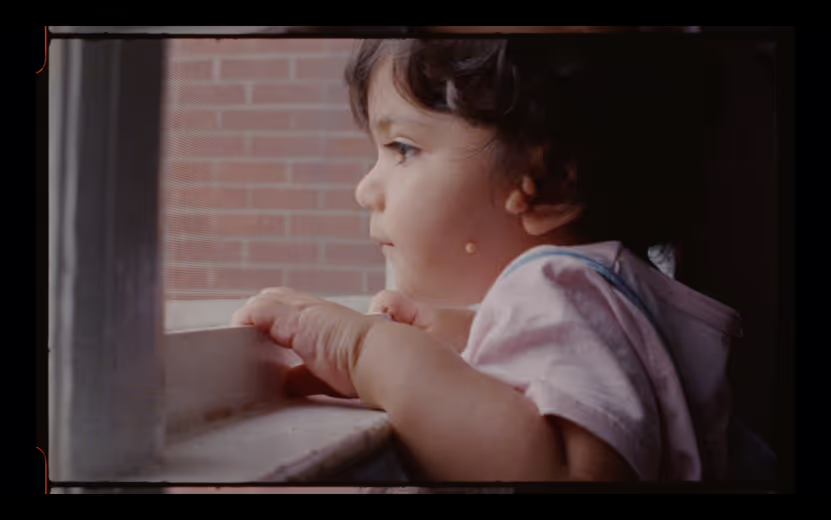
A Broken House Discussion Guide
FILM SUMMARY
Mohamad Hafez received a one-way ticket to the United States. Missing his homeland, he decided to create a stand-in. A story of love, loss and creating pathways home.
USING THIS GUIDE
This guide is an invitation to dialogue. It is based on a belief in the power of human connection and designed for people who want to use A Broken House to engage family, friends, classmates, colleagues, and communities in conversation and understanding. In contrast to initiatives that foster debates in which participants try to convince others that they are right, this document envisions conversations undertaken in a spirit of openness in which people try to understand one another and expand their thinking by sharing viewpoints and actively listening.
The discussion prompts are intentionally crafted to help a wide range of audiences think more deeply about the issues in the film. Rather than attempting to address them all, choose one or two that best meet your needs and interests. And be sure to leave time to consider taking action. Planning next steps can help people leave the room feeling energized and optimistic, even in instances when conversations have been difficult.
For more detailed event planning and facilitation tips, visit https://communitynetwork.amdoc.org/.
To screen the film ahead of conversation you can stream it here.
A Letter from the Filmmaker, Jimmy Goldblum
I originally wanted to tell a story about refugees that my wife could watch. I had noticed a disturbing trend in this genre of films: documentarians were increasingly relying on graphic violence as a way to build empathy for the victims of conflict. These images are devastating and re-traumatizing to viewers like my wife, who developed c-PTSD while reporting on drone attack survivors in her home country of Pakistan. I wondered, for her and immigrant audiences like her, who deserved to see their stories told on-screen, what would it look like to create a film about the aftermath of war with neither blood nor bodies in it; to instead focus on the other things lost in conflict: our connection to our families, our culture, our ways of being in the world?
Then I met the architect Mohamad Hafez. I saw so much of myself in him. We’re both art and movie lovers, our parents shared similar professions; and we both grew up running around our neighborhoods with sketchbooks, living in the world of our doodles. The major difference between us is that Mohamad was born—according to George W. Bush and his NSEERS program —in the wrong type of country: Syria. For that reason, he was issued a single-entry visa to the United States and could no longer return home. He missed weddings, funerals, and births. He started to make miniatures as a way to soothe his homesickness; art therapy that he didn’t know was art therapy.
Mohamad’s lonely nostalgia turned to rage when the Syrian war broke out. He watched the thousand-year-old minarets, arches and porticoes that inspired him to become an architect— ancient doorways with their Hellenic, Roman, Byzantine, and Islamic influences—come crashing down. His world came crashing down with them: his family became refugees, fleeing to five countries amongst the six of them; and his parents eventually separated, unable to reconcile their competing attachments to Syria. And yet, Mohamad was one of the lucky ones: that, even as he endured the dissolution of the country he loved, he, along with his loved ones, survived.
I finished “A Broken House” a few months before the global pandemic forced us all inside for 18-months. As quarantine continued and we all missed weddings, funerals, and births, we experienced the slightest taste of Mohamad’s tragedy. But unlike Mohamad, travel bans have never prevented me from returning home; and I still have a home to which I can return.
This film asks, for those who survive war and arrive on our shores, what gets left behind? For Mohamad, all he has left of Syria and his family are memories. Damascus is irreparably changed, and our immigration laws have made it so, in the nearly two decades since Mohamad arrived in the United States, his once close-knit family has not been together under a single roof.
Even though they survived war and the life of a refugee without becoming another casualty or bloody statistic, this reality is agonizing, untenable, and yes, violent, enough.
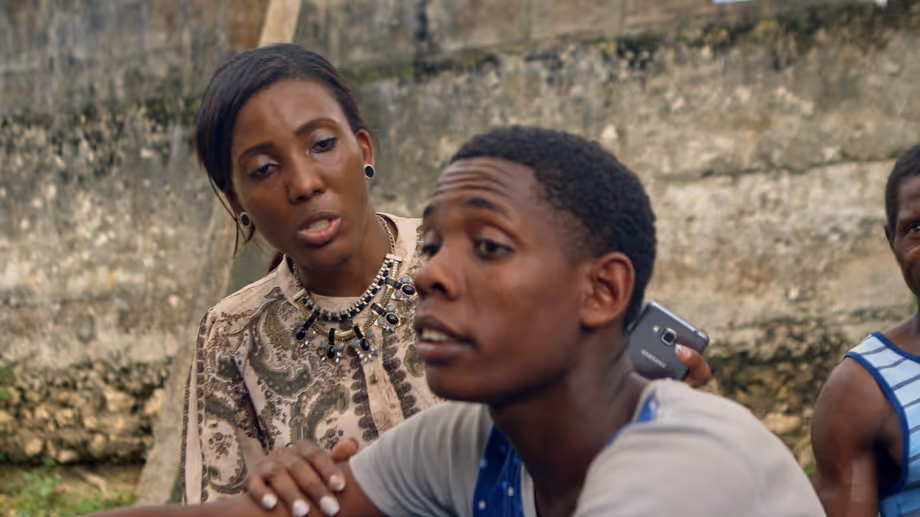
Stateless Healing Guide
STATELESS
Michèle Stephenson’s documentary Statelesscenters grassroots organizer and attorney Rosa Iris as she works with Dominican families of Haitian descent who have been stripped of their citizenship. In 2013 Domininca Republic. From Rosa’s encounters with these families and individuals, the tense and complex history between Haiti and the Dominican Republic unearths tensions of politics, identity, race, humanity and belonging - a complex history that impacts present day politics and the safety and privilege of people in both Dominican Republic and Haiti. As the Dominican Nationalist Movement works tirelessly to protect the borders into Dominican Republic to keep Haitians out, those with Haitian ancestry work even harder to legitimize their existence and value in a system and a political structure that keeps to limit their possibilities and humanity.
This guide was created as an offering to support community approaches to collective processing, and a direction towards healing after screening Stateless. This guide offers you the opportunities to engage with your audience once during the screening and also the opportunity to create experiential workshops following to deepen the work.
THIS GUIDE CAN BE USED TO EXPLORE THE FOLLOWING THEMES:
- White supremacy, ultra Nationalism, & racial capitalism on a global scale: “These expressions of hate can lead to physical violence” Rosa Iris
- Anti Haitianism: “Someone called me Haitian because of my skin color. They called me Haitian as an insult. I answered, “Why would that upset me?” Elias
- Anti Blackness: “Or a plan to whiten the population. Their problem is with blacks not whites.” Juan Teofilo
- Xenophobia: “The Haitians have a plan that the Dominican Republic take care of their citizens.” Gladys
- Mental wellness: “Maybe nothing was physically missing...But they stole my peace of mind, how do they pay for that?” Juan Teofilo
- Fatherhood: “They say mothers feel the deep connection with her children. But I have a special connection with my children. I can feel when something happens to them.” Juan Teofilo
- Duty: “I decided to run for congress. As a mother I have to leave my son, But the conservatives want to limit the freedom of Dominicans of Haitian descent.” Rosa Iris
- Voting: “I could give you 50, 100 pesos to go vote, but if you vote for someone who serves the community, you’ll get so much more!” Rosa Iris
- Government: “Who will help me feel safe? The State? When the State is the one persecuting me?” Juan Teofilo
Download the full resource here.

Pier Kids Delve Deeper
On the Christopher Street Pier in New York City, homeless queer and trans youth of color forge friendships and chosen families, withstanding tremendous amounts of abuse while working to carve out autonomy and security in their lives. With intimate access to three fearless young persons -- Krystal, Desean and Casper -- Pier Kids highlights the resilience of a community many choose to ignore.
Beam, Cris. Transparent: Love, Family, and Living the T with Transgender Teens. Mariner Books, 2008.
When Beam moved to Los Angeles, she was drawn deeply into the pained and powerful group of transgirls she discovered. This work shows readers their world--a dizzying mix of familiar teenage cliques and crushes with far less familiar challenges like how to morph one's body on a few dollars a day.
Berg, Ryan. No House To Call My Home: Love, Family and Other Transgressions. Nation Books, 2016.
A deep and intimate look at the lives of LGBTQ youth in foster care, vividly chronicling their struggles, fears and hardships, and revealing the force that allows them to carry on: the irrepressible power of hope.
Davis, Heath Fogg. Beyond Trans: Does Gender Matter?NYU Press, 2017.
Beyond Trans pushes the conversation on gender identity to its limits: questioning the need for gender categories in the first place. Whether on birth certificates or college admissions applications or on bathroom doors, why do we need to mark people and places with sex categories? Do they serve a real purpose or are these places and forms just mechanisms of exclusion? Heath Fogg Davis offers an impassioned call to rethink the usefulness of dividing the world into not just Male and Female categories but even additional categories of Transgender and gender fluid. Davis, himself a transgender man, explores the underlying gender-enforcing policies and customs in American life that have led to transgender bathroom bills, college admissions controversies, and more, arguing that it is necessary for our society to take real steps to challenge the assumption that gender matters.
Eichinger, Marilynne. Over the Peanut Fence: Scaling Barriers for Runaway and Homeless Youths. MEZR Press, 2019.
When a 20-year-old street youth came to live with the author, it initiated a five-year struggle to help the youth scale a wall of hopelessness to attain a future of possibilities. His journey along with others' illustrate what it takes to overcome early trauma. Part memoir, storybook, and analysis, the book provides a path forward.
Ho, Vivian. Those Who Wander: America’s Lost Street Kids. Little A, 2019.
In 2015, the senseless Bay Area murders of twenty-three-year-old Audrey Carey and sixty-seven-year-old Steve Carter were personal tragedies for the victims' families. But they also shed light on a more complex issue. The killers were three drifters scrounging for a living among a burgeoning counterculture population. Soon this community of runaways and transients became vulnerable scapegoats of a modern witch hunt. The supposedly progressive residents of San Francisco's Haight-Ashbury, only two generations removed from the Summer of Love, now feared all of society's outcasts as threats. In Those Who Wander, Vivian Ho delves deep into a rising subculture that's changing the very fabric of her city and all of urban America. Moving beyond the disheartening statistics, she gives voices to these young people--victims of abuse, failed foster care, mental illness, and drug addiction. She also doesn't ignore the threat they pose to themselves and to others as a dangerous dark side emerges. With alarming urgency, she asks what can be done to save the next generation of America's vagabond youth.
Lowrey, Sassafras; Burke, Jennifer Clare; Shepard, Judy Peck. Kicked Out. Homofactus Press, 2010.
This volume is collection of essays written by young people who were kicked out of their homes as minors for identifying as lesbian, gay, bisexual, transgender (LGBT), as well as a few policy essays from service providers. Diverse contributors ranging in age, experience, and current living situation share stories of perseverance and abuse with poignant accounts of survival. The editors point out that very few urban areas have recognized the need to serve dispossessed LGBT youth by establishing shelters or safe houses; money is tight and public support is often hard to muster. They feel that homelessness of these kids is but a symptom of a larger and more pervasive cultural problem: we are a society that does not value all people, and somehow there seems to be a tacit belief that parents of LGBT youth are entitled to abdicate their responsibility to love and protect the children they have created. They feel that such a mindset is due to a homophobic and transphobic culture. This anthology intends to present the points-of-view of the voiceless and also to challenge the stereotypical face of homelessness.
Robinson, Brandon Andrew. Coming Out to the Streets: The Lives of LGBTQ Youth Experiencing Homelessness. University of California Press, 2020.
Lesbian, gay, bisexual, transgender, and queer (LGBTQ) youth are disproportionately represented in the U.S. youth homelessness population. In Coming Out to the Streets, Brandon Andrew Robinson examines their lives. Based on interviews and ethnographic fieldwork in central Texas, Coming Out to the Streets maps the LGBTQ youth's lives prior to experiencing homelessness-within their families, schools, and other institutions-and while they live on the streets, deal with police, and navigate shelters and services for people experiencing homelessness. Through this documentation, Robinson shows how poverty and racial inequality shape how LGBTQ youth experiencing homelessness negotiate their gender and sexuality. Robinson contends that solutions to addressing LGBTQ youth homelessness need to move beyond blaming families for rejecting their child. By highlighting youth's voices, Robinson calls for queer and trans liberation through systemic change.
Smith, Martin J. Going to Trinidad : a Doctor, a Colorado Town, and Stories from an Unlikely Gender Crossroads. Bower House, 2021.
For more than four decades, between 1969 and 2010, the remote former mining town of Trinidad, Colorado was the unlikely crossroads for approximately six thousand medical pilgrims who came looking for relief from the pain of gender dysphoria. The surgical skill and nonjudgmental compassion of surgeons Stanley Biber and his transgender protege Marci Bowers not only made the phrase "Going to Trinidad" a euphemism for gender confirmation surgery in the worldwide transgender community, but also turned the small outpost near the New Mexico border into what The New York Times once called "the sex-change capital of the world.” More than six thousand transgender men and women left Trinidad hoping that hormone therapy and surgical relief was the right prescription for their pain. For most it was, but not for all, and their experiences offer important and timely insights for those struggling to understand this sometimes confounding human condition.

Pier Kids Lesson Plan: Reimagining Our Power and Identities Through Speculative Fiction
Directed and Written by Elegance Bratton, Pier Kids zooms in on the lives of homeless queer and trans young adults who convene at Christoper Street Pier in New York City. By creating their own chosen families they found themselves, their community, safety and a level of acknowledgement that they have been lacking. The film follows the survival strategies, bursts of joy, and the complex family lives of Krystal, DeSean, and Jusheem as they are pushed to the margins of New York City while being simultaneously hypervisible and invisibilized. This lesson is just one part in a longer journey for students to work through and explore the relationship between: 1) power 2) identity 3) storytelling 4) naming your identity on your own terms and 5) exploring the bounds and limitations of labels and limited visions of identities.
For many, like we see in the film there are feelings of not belonging, seeking community and the desire to walk towards the identity you create for yourself...the version of “you” you feel in your body, mind, and heart. Unfortunately for some individuals, their identities continue to be ignored, marginalized, and/or not acknowledged on their terms. Speculative fiction has allowed people who have been othered to dream and imagine something more. In this lesson plan, students will have the opportunity to deviate from the heteronormative and dominant narratives of people and their trajectory by exploring a different story of what could be and what is possible.
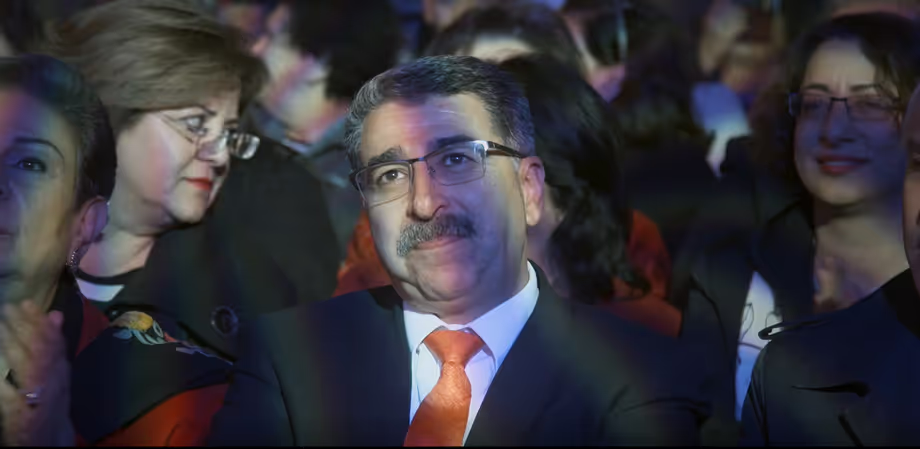
Mayor Lesson Plan: A Lesson on Palestinian Culture & Resistance
“Make space for joy until we get freedom and independence.” Mayor Musa tells the crowd gathered in the city of Ramallah to watch the lighting of the Christmas tree.
These words standout amidst the backdrop of resistance and violence as Palestinians from Ramallah push back against the occupation of their land and the annexation of Jerusalem as Israel’s capital. Thus the crux of David Osit’s film highlights and decimates a variety of juxtapositions created by Western media. Palestinians are shown as multifaceted full beings within a modern city. Yet, the occupation still looms large and soon enough, though we think we’re watching a film about how difficult it is to be a civil servant, what we get is so much more. The film maker beautifully captures how hard it is for Mayor Musa to run a city while under occupation. More importantly, the viewer comes to understand that though Palestinians must and do resist, there’s also a place for joy and hope. And perhaps, it’s actually that joy and hope that keeps them going another day. This lesson will help students develop an understanding of the history of Palestine, its culture, and religions through critical analysis of the occupation from the view of the Mayor of Ramallah and its people.
In these series of lessons, students learn new vocabulary terms relating to Israeli occupation of Palestine. They’re asked to build upon prior knowledge of the occupation of Palestine utilizing a K-W-L chart. In addition, they will engage in various methods of learning like Venn Diagrams as they compare and contrast Christmas lighting events in Palestine and the U.S. as well as Palesitinian and Black Lives Matter protests. Throughout the lessons, there is robust space for student voice as they grapple with in-text and higher order thinking questions. Students will also participate in a debate around the issue of resistance and what it looks like. Learning will be tracked with the use of pre and post knowledge checks utilizing google forms. The lessons can be easily modified and adapted depending on your student needs. However, the use of multimodal activities within these lessons addresses some of the learning challenges that some students may face. Students should walk away from this lesson with a more nuanced view of the occupation of Palestine while building analysis, comprehension, and debate skills.

Stateless: Lesson Plan
“And I refuse to feel like A foreigner in my own country.” Juan Teofilo Murat
How would you feel if the nation where you were born and raised stripped you of your citizenship? Stripped you of the political identity you had known since your birth? What would you do? That is the premise of the moving observational documentary Stateless by the renown filmmaker Michèle Stephenson that follows Rosa Iris and Juan Teofilo, two black Dominicans of Haitian descent who struggle to reclaim Dominican citizenship, and a non-Haitian light-skinned Dominican xenophobic nationalist female who protests Haitian immigration to her country. This lesson provides a humanistic framework in understanding the role and impact of the 168-13 Constitutional Tribunal ruling/policy in the Dominican Republic which deprived thousands of Dominicans of Haitian descent of their nationality essentially rendering them stateless.
KEYWORDS: humanization, bureaucracy, borders, foreigners, walls, racism

Landfall Lesson Plan: Disaster Colonialism in Puerto Rico
Mirroring the underside of a unique moment in history, LANDFALL Film asks us to remember the long-standing legacies of U.S. colonialism in Puerto Rico. Through a series of intimate interviews and slow-moving, haunting shots that reveal major differences in everyday life, LANDFALL carefully calls into question the complexity of competing narratives regarding the recovery and future of post-disaster Puerto Rico. Directed by Cecilia Aldaronado, this film intentionally holds space for the people of Puerto Rico to uplift their community-led mutual aid efforts and amplify their voices and visions for self-determination and sovereignty.
Using the framework of disaster colonialism, this lesson will provide a historical context of LANDFALL film to allow students to critically examine the ongoing crises in Puerto Rico. It will offer an opportunity for students to consider the competing narratives of characters in the film, and how these personal narratives underlie and influence rebuilding policies and approaches to recovery. Students will also have an opportunity to reflect on their own knowledge and understanding of colonialism and coloniality, and how their own personal narratives may be informed by these concepts.
The Neutral Ground Lesson Plan: Confederate Monuments: They're Not Neutral
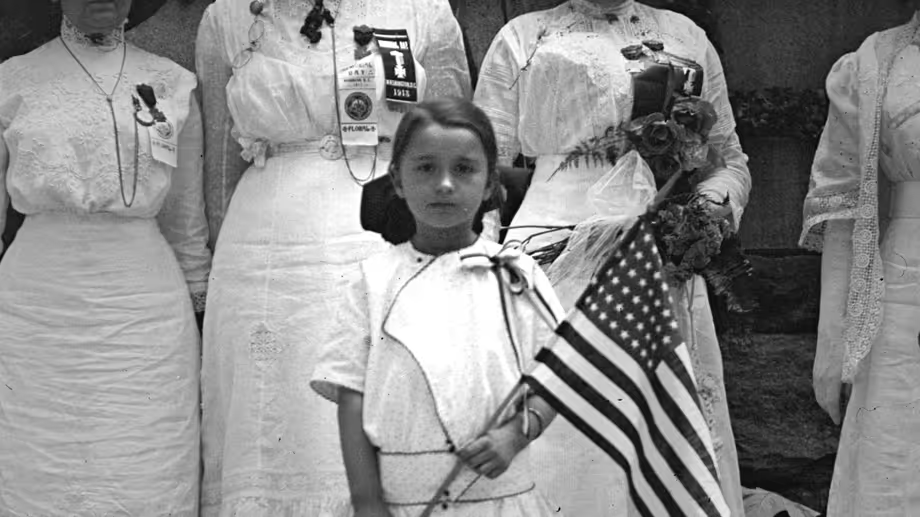
The Neutral Ground documents New Orleans’ fight over monuments and America’s troubled romance with the Lost Cause. In 2015, director CJ Hunt was filming the New Orleans City Council’s vote to remove four confederate monuments. But when that removal is halted by death threats, CJ sets out to understand why a losing army from 1865 still holds so much power in America.
This lesson plan is designed to help students gain a more critical understanding of the controversies surrounding contemporary movements to remove confederate monuments. The goal is to foster healthy conversations and cultivate a deeper understanding of the subject matter while also promoting compassion and advocacy.
In this lesson, students will be presented with a choice board by which they may find the truth within the different narratives referenced in the film.
Mayor Discussion Guide
Mayor
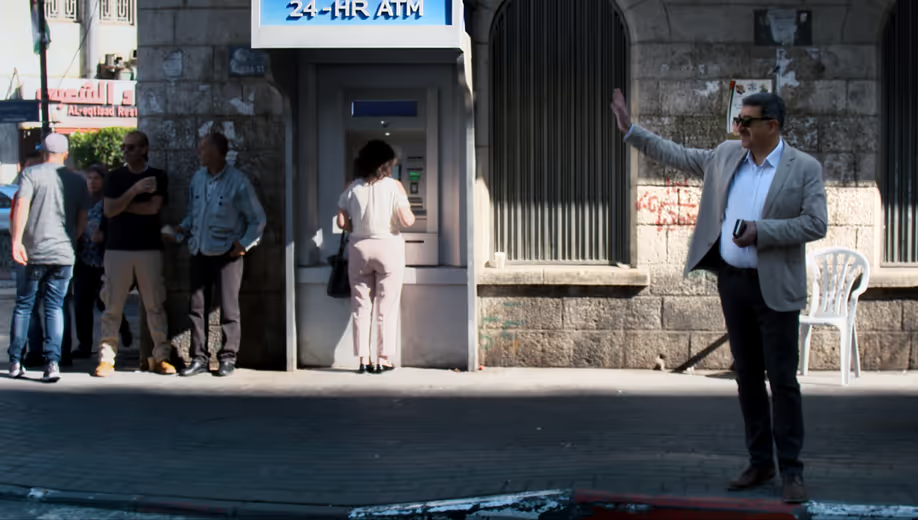
Musa Hadid is the Christian mayor of Ramallah, the de facto capital of the Palestinian Authority. As he tries to keep his city running while paving sidewalks, planning holidays and building a new fountain, his job is made increasingly difficult by the Israeli occupation of his home. Mayor asks with humor and quiet outrage: how do you run a city if you don’t have a country?
Mayor Delve Deeper
This list of resources, compiled by Matt Pettit and the staff of the Topeka & Shawnee County Public Library, provides a range of perspectives on the issues raised by the POV documentary Mayor.
Musa Hadid is the Christian mayor of Ramallah, the de facto capital of the Palestinian Authority. As he tries to keep his city running while paving sidewalks, planning holidays and building a new fountain, his job is made increasingly difficult by the Israeli occupation of his home. Mayor asks with humor and quiet outrage: how do you run a city if you don’t have a country?
ADULT NON-FICTION
Chomsky, Noam & Pappé, Ilan. Gaza in Crisis: Reflections on the US-Israeli War Against the Palestinians. Chicago IL: Haymarket Books, 2003.
Israel's Operation Cast Lead thrust the humanitarian crisis in the Gaza Strip into the center of the
debate about the Israel/Palestine conflict. In this updated and expanded edition, Noam Chomsky and Ilan Pappé survey the fallout from Israel's conduct in Gaza, including their latest incursions, and place it in historical context.
Barghouti, Murid. I Saw Ramallah. New York: Anchor Books, 2003.
Barred from his homeland after 1967’s Six-Day War, poet Mourid Barghouti spent thirty years in exile—shuttling among the world’s cities, yet secure in none of them; separated from his family for years at a time; never certain whether he was a visitor, a refugee, a citizen, or a guest. As he returns home for the first time since the Israeli occupation [he] is unable to recognize the city of his youth. Sifting through memories… he discovers what it means to be deprived not only of a homeland but of “the habitual place and status of a person.” Winner of the Naguib Mahfouz Medal for Literature.
Bregman, Ahron. Cursed Victory: Israel and the Occupied Territories: A History. New York: Pegasus Books, 2015.
In a move that would forever alter the map of the Middle East, Israel captured the West Bank, Golan Heights, Gaza Strip and Sinai Peninsula in 1967's brief but pivotal Six Day War. Cursed Victory is the first complete history of the war's troubled aftermath—a military occupation of the Palestinian territories that is now well into its fifth decade. Drawing on unprecedented access to high-level sources, top-secret memos and never-before-published letters, the book provides a gripping chronicle of how what Israel promised would be an 'enlightened occupation' quickly turned sour, and the anguished diplomatic attempts to bring it to an end.
Davis, Angela. Freedom is a Constant Struggle: Ferguson, Palestine, and the Foundations of a Movement. Chicago, IL: Haymarket Books, 2015.
In these newly collected essays, interviews, and speeches, world-renowned activist and scholar Angela Y. Davis illuminates the connections between struggles against state violence and oppression throughout history and around the world. Reflecting on the importance of black feminism, intersectionality, and prison abolitionism for today's struggles, Davis discusses the legacies of previous liberation struggles, from the Black Freedom Movement to the South African anti-Apartheid movement. She highlights connections and analyzes today's struggles against state terror, from Ferguson to Palestine.
Feldman, Keith P. A Shadow over Palestine: The Imperial Life of Race in America. Minneapolis, MN: University of Minnesota Press, 2017.
This book brings a transnational perspective to the cultural forces that have shaped sharply differing ideas of Israel’s standing with the United States—right up to the violent divisions of today. Focusing on the period from 1960 to 1985, author Keith P. Feldman reveals the centrality of Israel and Palestine in postwar U.S. imperial culture.
Halper, Jeff. Decolonizing Israel, Liberating Palestine: Zionism, Settler Colonialism, and the Case for One Democratic State.Pluto Press, 2021.
This book explores how the concept of settler colonialism provides a clearer understanding of the Zionist movement's project to establish a Jewish state in Palestine, displacing the Palestinian Arab population and marginalizing its cultural presence. Jeff Halper argues that the only way out of a colonial situation is decolonization: the dismantling of Zionist structures of domination and control and their replacement by a single democratic state, in which Palestinians and Israeli Jews forge a new civil society and a shared political community.
Hill, Marc Lamont & Plitnick, Mitchell. Except for Palestine: The Limits of Progressive Politics. New York, NY: 2021.
In this major work of daring criticism and analysis, scholar and political commentator Marc Lamont Hill and Israel-Palestine expert Mitchell Plitnick spotlight how holding fast to one-sided and unwaveringly pro-Israel policies reflects the truth-bending grip of authoritarianism on both Israel and the United States. Except for Palestine deftly argues that progressives and liberals who oppose regressive policies on immigration, racial justice, gender equality, LGBTQ rights, and other issues must extend these core principles to the oppression of Palestinians. In doing so, the authors take seriously the political concerns and well-being of both Israelis and Palestinians, demonstrating the extent to which U.S. policy has made peace harder to attain. They also unravel the conflation of advocacy for Palestinian rights with anti-Semitism and hatred of Israel.
Khatib, Sulaiman and Eilberg-Schwartz, Penina. In This Place Together: A Palestinian's Journey to Collective Liberation. Boston, Massachusetts: Beacon Press, 2021.
In language that is poetic and unflinchingly honest, Eilberg-Schwartz and Khatib chronicle what led him to dedicate his life to joint nonviolence. In his journey, he encountered the deep injustice of torture, witnessed the power of hunger strikes, and studied Jewish history. Ultimately, he came to realize mutual recognition, alongside a transformation of the systems that governed their lives, was necessary for both Palestinians and Israelis to move forward
Klein Halevi, Yossi. Letters to My Palestinian Neighbor. New York: HarperCollins, 2018.
Attempting to break the agonizing impasse between Israelis and Palestinians, the Israeli commentator and award-winning author of Like Dreamers directly addresses his Palestinian neighbors in this taut and provocative book, empathizing with Palestinian suffering and longing for reconciliation as he explores how the conflict looks through Israeli eyes. And now, in a brand-new Epilogue, Palestinian readers have been given a chance to respond through their own powerful letters. Letters to My Palestinian Neighbor is one Israeli’s powerful attempt to reach beyond the wall that separates Israelis and Palestinians and into the hearts of "the enemy."
Oren Michael B. Six Days of War: June 1967 and the Making of the Modern Middle East. New York: Ballantine Books, 2003.
Historian Michael B. Oren reconstructs both the lightning-fast action on the battlefields and the political shocks that electrified the world. Extraordinary personalities—Moshe Dayan and Gamal Abdul Nasser, Lyndon Johnson and Alexei Kosygin—rose and toppled from power as a result of this war; borders were redrawn; daring strategies brilliantly succeeded or disastrously failed in a matter of hours. And the balance of power changed—in the Middle East and in the world. A towering work of history and an enthralling human narrative, Six Days of War is the most important book on the Middle East conflict to appear in a generation.
Regan, Bernard. The Balfour Declaration: Empire, the Mandate and Resistance in Palestine. Brooklyn, NY: Verso Books, 2018.
The true history of the imperial deal that transformed the Middle East and sealed the fate of Palestine. On 2 November 1917, the British government, represented by Foreign Minister Arthur Balfour, declared it was in favour of “the establishment in Palestine of a national home for the Jewish people.” This short note would become one of the most controversial documents of modern history. Offering new insights into the imperial rivalries between Britain, Germany and the Ottomans, Regan exposes British policy in the region as part of a larger geopolitical game. He charts the debates within the British government, the Zionist movement, and the Palestinian groups struggling for selfdetermination. The after-effects of these events are still felt today.
Robinson, Daniel, et al. Israel & the Palestinian Territories. Dublin: Lonely Planet Publications Pty Ltd, 2018.
Israel & the Palestinian Territories is a Lonely Planet guidebook to the area, useful for the non-traveler as it immerses readers in the history, people, music, landscapes, wildlife, cuisine and politics of the region from a non-political tourist perspective. The volume is replete with color maps and vivid photography for readers to get a sense of the region beyond media depictions of unceasing conflict and strife.
Shehadeh Rajeh. Going Home: A Walk Through Fifty Years of Occupation. London: Profile Books, 2020.
Orwell Prize-winning author of Palestinian Walks: Notes on a Vanishing Landscape, Raja Shehadeh travels to Ramallah and records the changing face of the city. Walking along the streets he grew up in, he tells the stories of the people, the relationships, the houses, and the businesses that were and now are cornerstones of the city and his community. Green spaces - gardens and hills crowned with olive trees - have been replaced by tower blocks and concrete lots; the occupation and the settlements have further entrenched themselves in every aspect of movement-from the roads that can and cannot be used to the bureaucratic barriers that prevent people leaving the West Bank. The culture of the city has also shifted with Islam taking a more prominent role in people's everyday and political lives and the geography of the city.
Landfall Discussion Guide
Landfall
When Hurricane María made landfall in Puerto Rico in 2017 the US territory was already 72 billion dollars in debt. Two years later, record numbers of Puerto Ricans took to the streets to demand the resignation of Gov Ricardo Rossell. This is a portrait of what happened in between.
Through shard-like glimpses of everyday life in post-Hurricane María Puerto Rico, Landfall is a cautionary tale for our times. Set against the backdrop of protests that toppled the US colony’s governor in 2019, the film offers a prismatic portrait of collective trauma and resistance. While the devastation of María attracted a great deal of media coverage, the world has paid far less attention to the storm that preceded it: a 72-billion-dollar debt crisis crippling Puerto Rico well before the winds and waters hit. Landfall examines the kinship of these two storms—one environmental, the other economic—juxtaposing competing utopian visions of recovery. Featuring intimate encounters with Puerto Ricans as well as the newcomers flooding the island, Landfall reflects on a question of contemporary global relevance: when the world falls apart, who do we become?