
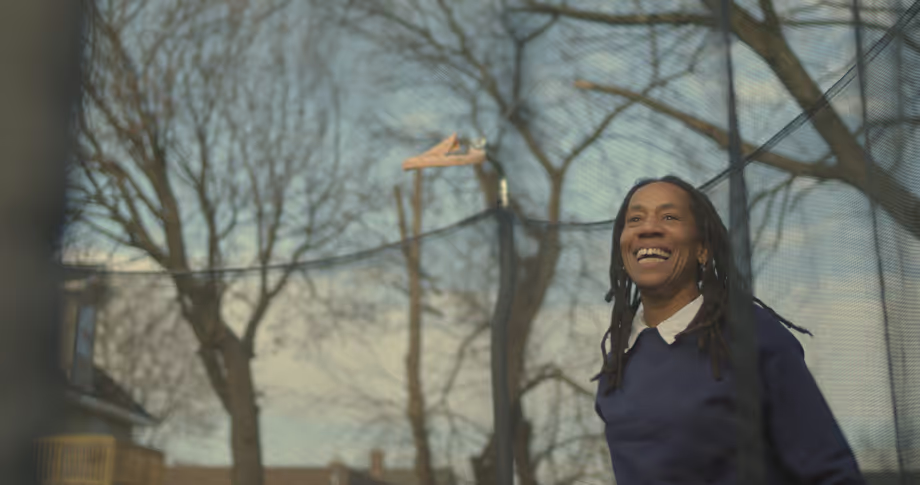
I'm Free, Now You Are Free Discussion Guide
FILM SUMMARY
A story about the reunion and repair between Mike Africa Jr and his mother Debbie Davis — a formerly incarcerated political prisoner of the MOVE 9.
USING THIS GUIDE
This guide is an invitation to dialogue. It is based on a belief in the power of human connection and designed for people who want to use I’m Free, Now You Are Free to engage family, friends, classmates, colleagues, and communities. In contrast to initiatives that foster debates in which participants try to convince others that they are right, this resource envisions conversations undertaken in a spirit of openness in which people try to understand one another and expand their thinking by sharing viewpoints and actively listening to one another.
The discussion prompts are intentionally crafted to help a wide range of audiences think more deeply about the issues in the film. Rather than attempting to address them all, choose one or two that best meet your needs and interests. And be sure to leave time to consider taking action. Planning next steps can help people leave the room feeling energized and optimistic, even in instances when conversations have been difficult.
For more detailed event planning and facilitation tips, visit https://communitynetwork.amdoc.org/.
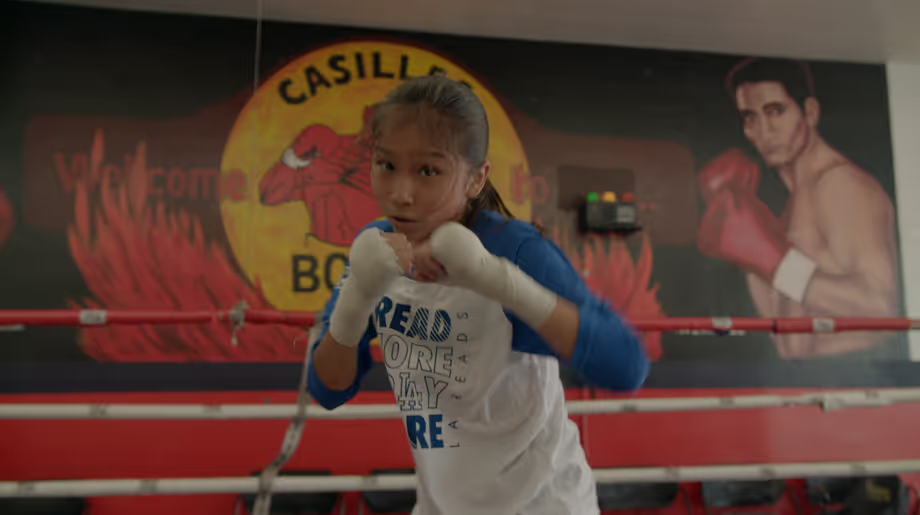
Team Meryland Discussion Guide
FILM SUMMARY
In the projects of Watts, Meryland Gonzales, a twelve-year-old female boxer trains to be crowned the 2019 Junior Olympics champion after losing at the 2018 competition all while reliving a past medical trauma that forces her to fight for her life. Meanwhile, her parents, immigrants from Michoacán, Mexico work tirelessly to give their miracle child a shot at achieving her dreams
USING THIS GUIDE
This guide is an invitation to dialogue. It is based on a belief in the power of human connection and designed for people who want to use Team Meryland to engage family, friends, classmates, colleagues, and communities. In contrast to initiatives that foster debates in which participants try to convince others that they are right, this document envisions conversations undertaken in a spirit of openness in which people try to understand one another and expand their thinking by sharing viewpoints and listening actively.
The discussion prompts are intentionally crafted to help a wide range of audiences think more deeply about the issues in the film. Rather than attempting to address them all, choose one or two that best meet your needs and interests. And be sure to leave time to consider taking action. Planning next steps can help people leave the room feeling energized and optimistic, even in instances when conversations have been difficult.
For more detailed event planning and facilitation tips, visit communitynetwork.amdoc.org.
LETTER FROM THE FILMMAKER
I made Team Meryland because I truly believe in the power of family and the miracle of second chances. I grew up the youngest of seven kids in a tight-knit Filipino family raised by a single mom. Throughout my own journey, I’ve learned the strength of my siblings, the sacrifices my mom made for us, and our teamwork as a family to get a miraculous second chance. When I met the Gonzalez family and learned of their story, I knew immediately that this was a narrative I needed to champion. It’s a story I wish my family and I had seen when we were looking for hope.
The family’s ability to fight together through hardship spoke to my core. Team Merylandis a portrait of a young girl from Watts, South LA with a second chance to achieve greatness through boxing. Despite suffering from a severe medical trauma, growing up in a tough area of South LA, and being a first generation American, Meryland never gives up on her dreams, truly embodying the image of a “rose emerging from the concrete” as her father so eloquently describes her.
After a year-and-a-half of filming and another year of post-production, it is a privilege that my team and I share this film with you today. Living through the hardships of 2020 and 2021 which have broken many of us, I now realize that this goes beyond a film for my family. It’s a story the world needs to hear. We hope the Gonzalez family shows us how to heal, find joy, and get back in the ring with loved ones in your corner. There isn’t a better time like today to fight for your dreams.
Gabriel Gaurano, Director Cinematographer & Editor, Team Meryland

Unapologetic Delve Deeper
This list of fiction and nonfiction books, compiled by kYmberly Keeton of ART | library deco of Austin, Texas provides a range of perspectives on the issues raised by the POV documentaryUnapologetic.
About Film: After two police killings, Black millennial organizers challenge a Chicago administration complicit in state violence against its Black residents. Told through the lens of Janaé and Bella, two fierce abolitionist leaders, Unapologetic is a deep look into the Movement for Black Lives, from the police murder of Rekia Boyd to the election of mayor Lori Lightfoot.
Adult Non-Fiction
Alexander, Michelle.The New Jim Crow: Mass Incarceration in the Age of Colorblindness. New York, New Press, 2010.
This powerful text highlights the racial dimensions of the "War on Drugs." The author argues that federal drug policy unfairly targets communities of color, keeping millions of young, Black men in a cycle of poverty and behind bars.The New Jim Crow is a stunning account of the rebirth of a caste-like system in the United States, one that has resulted in millions of African Americans locked behind bars and then relegated to a permanent second-class status—denied the very rights supposedly won in the Civil Rights Movement.
Bennett, Michael, and Dave Zirin.Things That Make White People Uncomfortable. Chicago, Haymarket Books, 2019.
Bennett adds his unmistakable voice to discussions of racism and police violence, Black athletes and their relationship to powerful institutions like the NCAA and the NFL, the role of protest in history, and the responsibilities of athletes as role models to speak out against injustice. Following in the footsteps of activist-athletes from Muhammad Ali to Colin Kaepernick, Bennett demonstrates his outspoken leadership both on and off the field. Written with award-winning sportswriter and author Dave Zirin, Things that Make White People Uncomfortable is a sports book for our turbulent times, a memoir, and a manifesto as hilarious and engaging as it is illuminating.
Coates, Ta-Nehisi.Between the World and Me. New York, Spiegel & Grau, 2015.
Between the World and Me unfolds as a six-chapter letter from Coates to his 15-year-old son Samori, prompted by his son’s stunned and heartbroken reaction to the announcement that no charges would be brought against Ferguson police officer Darren Wilson in the killing of unarmed teenager Michael Brown.Between the World and Me is Ta-Nehisi Coates’s attempt to answer questions in a letter to his adolescent son. Coates shares with his son—and readers—the story of his awakening to the truth about his place in the world through a series of revelatory experiences, from Howard University to Civil War battlefields, from the South Side of Chicago to Paris, from his childhood home to the living rooms of mothers whose children’s lives were taken as American plunder.
Collins, Patricia Hill.Fighting Words: Black Women and the Search for Justice (Contradictions of Modernity). 1st ed. vol. 7, University of Minnesota Press, 1998.
In Fighting Words, Collins investigates how effectively Black feminist thought confronts the injustices African American women currently face. The book examines poverty, mothering, white supremacy and Afrocentrism, the resegregation of American society by race and class, and the ideas of Sojourner Truth and how they can serve as a springboard for more liberating social theory.
Day, Susie.Brother You Choose: Panthers, Politics, and Revolution. 2020.
Paul Coates and Eddie Conway met as young men in Baltimore in the Black Panther Party for Self Defense. When Conway went to prison in 1970 based on flimsy evidence, Coates advocated for him. Coates (father of Ta-Nehisi) founded Black Classic Press and maintained his friendship with Conway despite the 44 years the latter spent in prison. Day has compiled and edited their wide-ranging conversations.
Haga, Kazu.Healing Resistance: A Radically Different Response to Harm.Parallax Press, 2020.
Activists and social change agents, restorative justice practitioners, faith leaders, and anybody engaged in social progress and shifting society will find this mindful approach to nonviolent action indispensable. Nonviolence was once considered the highest form of activism and radical change. And yet its basic truth, its restorative power, has been forgotten. In Healing Resistance, leading Kingian Nonviolence trainer Kazu Haga blazingly reclaims the energy and assertiveness of nonviolent practice (utilized by the Women’s March and Black Lives Matter), and proves that nonviolent civil resistance remains the most effective strategy for social change in hostile times. With over 20 years of experience practicing and teaching Kingian Nonviolence, Haga offers us the practical approach to societal conflict first begun by Dr. Martin Luther King Jr. during the Civil Rights Movement, which has been developed into a fully workable, step-by-step training and deeply transformative philosophy. Kingian Nonviolence takes on the timely issues of endless protest and activist burnout, and presents tried-and-tested strategies for staying resilient, creating equity, and restoring peace.
hooks, bell.Teaching Community: A Pedagogy of Hope. 1st ed. Routledge, 2003.
In Teaching Community bell hooks seeks to theorize from the place of the positive, looking at what works. Writing about struggles to end racism and white supremacy, she makes the useful point that "No one is born a racist. Everyone makes a choice." Teaching Community tells us how we can choose to end racism and create a beloved community. hooks looks at many issues-among them, spirituality in the classroom, white people looking to end racism, and erotic relationships between professors and students. Spirit, struggle, service, love, the ideals of shared knowledge and shared learning - these values motivate progressive social change. Teachers of vision know that democratic education can never be confined to a classroom. Teaching - so often undervalued in our society -- can be a joyous and inclusive activity. bell hooks shows the way. "When teachers teach with love, combining care, commitment, knowledge, responsibility, respect, and trust, we are often able to enter the classroom and go straight to the heart of the matter, which is knowing what to do on any given day to create the best climate for learning."
Lorde, Audre.A Burst of Light. 2nd ed. Ixia Press, 2017.
Winner of the 1988 Before Columbus Foundation National Book Award, this path-breaking collection of essays is a clarion call to build communities that nurture our spirit. Lorde announces the need for a radical politics of intersectionality while struggling to maintain her own faith as she wages a battle against liver cancer. From reflections on her struggle with the disease to thoughts on lesbian sexuality and African-American identity in a straight white man's world, Lorde's voice remains enduringly relevant in today's political landscape.
Lorde, Audre.Sister Outsider. 1984. Reprint, Penguin Random House, 2007.
In this charged collection of fifteen essays and speeches, Lorde takes on sexism, racism, ageism, homophobia, and class, and propounds social difference as a vehicle for action and change. Her prose is incisive, unflinching, and lyrical, reflecting struggle but ultimately offering messages of hope. This commemorative edition includes a new foreword by Lorde-scholar and poet Cheryl Clarke, who celebrates the ways in which Lorde’s philosophies resonate more than twenty years after they were first published. These landmark writings are, in Lorde’s own words, a call to “never close our eyes to the terror, to the chaos which is Black which is creative which is female which is dark which is rejected which is messy which is . . . ”
Moraga, Cherríe and Gloria Anzaldúa, eds.This Bridge Called My Back: Writings by Radical Women of Color. 4th ed. State University of New York Press, 1981.
Through personal essays, criticism, interviews, testimonials, poetry, and visual art, the collection explores, as coeditor Cherríe Moraga writes, "the complex confluence of identities--race, class, gender, and sexuality--systemic to women of color oppression and liberation." Reissued here, nearly thirty-five years after its inception, the fourth edition contains an extensive new introduction by Moraga, along with a previously unpublished statement by Gloria Anzaldúa.
Parenti, Christian.Lockdown America: Police and Prisons in the Age of Crisis. New York, Verso, 2001.
In this important book, Parenti surveys the rise of the prison industrial complex from the Nixon through Reagan eras and into the present. Why does the United States currently have one of the highest rates of incarceration in the world, with over 1.8 million Americans living behind bars? Why are only 29 percent of all prisoners violent offenders? Parenti, a former radio journalist and now a professor at the New College of California, argues that capitalism implies and demands a certain amount of poverty; the powers that be then respond by incarcerating drug users, the underclass, and other relatively powerless persons.
Rankine, Claudia. Citizen :An American Lyric. Graywolf Press, 2014.
Claudia Rankine's bold new book recounts mounting racial aggressions in ongoing encounters in twenty-first-century daily life and in the media. Some of these encounters are slights, seeming slips of the tongue, and some are intentional offensives in the classroom, at the supermarket, at home, on the tennis court with Serena Williams and the soccer field with Zinedine Zidane, online, on TV-everywhere, all the time. Including personal stories about the weight of racism, Hurricane Katrina, the denigration of Serena Williams, police killings and more, “Citizen” plunges readers into a world of pain, but softens the blow with writing so beautiful that my breath caught in my throat.
Reagan, Michale Beyea.Intersectional Class Struggle.AK Press, 2021.
This innovative study, explores the relevance of class as a theoretical category in our world today, arguing that leading traditions of class analysis have missed major elements of what class is and how it operates. It combines instersectional theory and materialism to show that culture, economics, ideology, and consciousness are all factors that go into making “class” meaningful. Using a historical lens, it studies the experiences of working class peoples, from migrant farm workers in California’s central valley, to the “factory girls” of New England, and black workers in the South to explore the variety of working-class experiences. It investigates how the concepts of racial capitalism and black feminist thought, when applied to class studies and popular movements, allow us to walk and chew gum at the same time—to recognize that our movements can be diverse and particularistic as well as have elements of the universal experience shared by all workers. Ultimately, it argues that class is made up of all of us, it is of ourselves, in all our contradiction and complexity.
Saeed Jones.How We Fight for Our Lives: A Memoir. Cengage Gale, 2020.
As a teenager growing up in Texas, Jones had wrestled with the feelings provoked by other men’s bodies. The murders of James Byrd, Jr. and Matthew Shepard taught him that “[b]eing a black gay boy is a death wish.” Yet Jones endured and embraced his sexuality. His relationship with his Buddhist mother forms the backbone of this affecting story.
Samaran, Nora.Turn this World Inside Out: The Emergence of Nurturance Culture.AK Press, 2019.
As Nora Samaran writes, “violence is nurturance turned backwards.” In its place, she proposes “nurturance culture” as the opposite of rape culture, suggesting that models of care and accountability—different from “call-outs” rooted in the politics of guilt—can move toward dismantling systems of dominance and oppression.
When communities identify and interrupt systemic violence, prioritize the needs of those harmed, and hold a circle of belonging that humanizes everyone, they create a foundation that can begin to resist and repair the harms inflicted by patriarchy, white supremacy, and capitalism. Emerging from insights in gender studies, race theory, and psychology, and influenced by contemporary social movements, Turn This World Inside Out engages today's crucial questions, helping move us beyond seemingly intractable barriers to collective change.
Smith, Clint.How the World is Passed: A Reckoning with the History of Slavery Across America.Little, Brown, and Company, 2021.
Beginning in his hometown of New Orleans, Clint Smith leads the reader on an unforgettable tour of monuments and landmarks—those that are honest about the past and those that are not—that offer an intergenerational story of how slavery has been central in shaping our nation’s collective history, and ourselves.
It is the story of the Monticello Plantation in Virginia, the estate where Thomas Jefferson wrote letters espousing the urgent need for liberty while enslaving more than four hundred people. It is the story of the Whitney Plantation, one of the only former plantations devoted to preserving the experience of the enslaved people whose lives and work sustained it. It is the story of Angola, a former plantation–turned–maximum-security prison in Louisiana that is filled with Black men who work across the 18,000-acre land for virtually no pay. And it is the story of Blandford Cemetery, the final resting place of tens of thousands of Confederate soldiers.
Smith, Mychal Denzel.Invisible Man, Got the Whole World Watching : A Young Black Man’s Education. New York, Bold Type Books, 2017.
How do you learn to be a Black man in America? For young Black men today, it means coming of age during the presidency of Barack Obama. It means witnessing the deaths of Oscar Grant, Trayvon Martin, Michael Brown, Akai Gurley, and too many more. It means celebrating powerful moments of Black self-determination for LeBron James, Dave Chappelle, and Frank Ocean. Mychal Denzel Smith chronicles his own personal and political education during these tumultuous years, describing his efforts to come into his own in a world that denied his humanity
Taylor, Keeanga-Yamahtta, editor.How We Get Free: Black Feminism and the Combahee River Collective. Haymarket, 2017.
The Combahee River Collective, a path-breaking group of radical black feminists, was one of the most important organizations to develop out of the antiracist and women’s liberation movements of the 1960s and 70s. In this collection of essays and interviews edited by activist-scholar Keeanga-Yamahtta Taylor, founding members of the organization and contemporary activists reflect on the legacy of its contributions to Black feminism and its impact on today’s struggles.
Taylor, Renee Sonya.The Body Is Not An Apology: The Power Of Radical Self-Love.Berrett-Koehler Publishers, 2018.
Humans are a varied and divergent bunch with all manner of beliefs, morals, and bodies. Systems of oppression thrive off our inability to make peace with difference and injure the relationship we have with our own bodies.
The Body Is Not an Apology offers radical self-love as the balm to heal the wounds inflicted by these violent systems. World-renowned activist and poet Sonya Renee Taylor invites us to reconnect with the radical origins of our minds and bodies and celebrate our collective, enduring strength. As we awaken to our own indoctrinated body shame, we feel inspired to awaken others and to interrupt the systems that perpetuate body shame and oppression against all bodies. When we act from this truth on a global scale, we usher in the transformative opportunity of radical self-love, which is the opportunity for a more just, equitable, and compassionate world—for us all.
Ward, Jesmyn.Men We Reaped : A Memoir. London, Bloomsbury, 2018.
Jesmyn's memoir shines a light on the community she comes from, in the small town of DeLisle, Mississippi, a place of quiet beauty and fierce attachment. Here, in the space of four years, she lost five young men dear to her, including her beloved brother-lost to drugs, accidents, murder, and suicide. Their deaths were seemingly unconnected, yet their lives had been connected, by identity and place, and as Jesmyn dealt with these losses, she came to a staggering truth: These young men died because of who they were and the place they were from, because certain disadvantages breed a certain kind of bad luck. Because they lived with a history of racism and economic struggle.

North By Current Delve Deeper
This list of reading resources to accompany North By Current was compiled by Veronda Pitchford of Califa Group, a non-profit library consortium, in San Francisco, California.
ADULT NON-FICTION
Anderson, Seth. LGBT Salt Lake. Charleston, South Carolina, Arcadia Publishing, 2017
LGBT Salt Lake recounts the history and survival of the LGBT community in Salt Lake City, Utah. From the early 1970s when a discernible "gay community" had emerged in Salt Lake City, laying the groundwork for future activism and institutions through the 1980s, amidst the devastation from the HIV/AIDS epidemic, marginalized communities valiantly worked to fight the disease and support each other. By the 1990s, LGBT Utahns had gained traction legally and politically with the formation of the first gay straight alliance at East High School and the election of the first openly gay person to the Utah legislature in 1998. In 2008, Salt Lake City’s transgender community became more visible in this new century that also included the community’s battle to gain marriage equality.
Bakker, Alex, et al. Others of My Kind: Transatlantic Transgender Histories. Calgary, Alberta Canada, University of Calgary Press, 2020
From the turn of the twentieth century to the 1950s, a group of transgender people on both sides of the Atlantic created communities that profoundly shaped the history and study of gender identity. By exchanging letters and pictures among themselves they established private networks of affirmation and trust, and by submitting their stories and photographs to medical journals and popular magazines they sought to educate both doctors and the public. The book draws on archives in Europe and North America to tell the story of this remarkable transatlantic transgender community. This book uncovers threads of connection between Germany, the United States, and the Netherlands to discover the people who influenced the work of authorities like Magnus Hirschfeld, Harry Benjamin, and Alfred Kinsey not only with their clinical presentations, but also with their personal relationships. Others of My Kind celebrates the faces, lives, and personal networks of those who drove twentieth-century transgender history.
Campbell Naidoo, Jamie, editor. Rainbow Family Collections: Selecting and Using Children’s Books with Lesbian, Gay, Bisexual, Transgender, and Queer Content (Children’s and Young Adult Literature Reference) by Naidoo, Jamie Campbell (2012) Hardcover. Santa Barbara, CA, ABC-CLIO, 2012
Research shows that an estimated 2 million children are being raised in lesbian, gay, bisexual, and transgender (LGBT) families in the United States; that the number of same-sex couples adopting children is at an all-time high; and that lesbian, gay, bisexual, transgender, and queer/questioning (LGBTQ) couples raising children live in 96 percent of all counties in the United States. Today's educators and youth librarians therefore need guidance in choosing, evaluating, and selecting high-quality children's books with LGBTQ content.
Gray, Mary, et al. Queering the Countryside. Amsterdam, Netherlands, Amsterdam University Press, 2016
The rural queer experience is often hidden or ignored, and presumed to be alienating, lacking, and incomplete without connections to a gay culture that exists in urban communities elsewhere. Queering the Countryside offers the first comprehensive look at queer desires found in rural America from a genuinely multi-disciplinary perspective. This collection of original essays confronts the assumption that queer desires depend upon urban life for meaning.
Kolk, Van Bessel der, MD. The Body Keeps the Score: Brain, Mind, and Body in the Healing of Trauma. Reprint, New York, NY, Penguin Publishing Group, 2015
Trauma is a fact of life. Veterans and their families deal with the painful aftermath of combat; one in five Americans has been molested; one in four grew up with alcoholics; one in three couples have engaged in physical violence. In The Body Keeps the Score, he uses recent scientific advances to show how trauma literally reshapes both body and brain, compromising sufferers’ capacities for pleasure, engagement, self-control, and trust. He explores numerous treatments—from neurofeedback and meditation to sports, drama, and yoga—that offer paths to recovery by activating the brain’s natural neuroplasticity. The Body Keeps the Score exposes the tremendous power of our relationships both to hurt and to heal—and offers new hope for reclaiming lives.
Ostler, Blaire. Queer Mormon Theology: An Introduction. Newburgh, IN Common Consent Press, 2021
For most members of the Church of Jesus Christ of Latter-day Saints, its theology is only ever viewed through the authorized lens of Church Correlation. The book looks at the basic tenets of the religion through the eyes of a queer church member and starts with the premise that Mormon theology is inherently queer and always has been and, therefore, better suited than most religious traditions to embrace and celebrate the queerness of the individuals who, collectively, constitute the Kingdom of God.
Winfrey, Oprah, and Bruce Perry. What Happened to You?: Conversations on Trauma, Resilience, and Healing. 1st ed., New York, New York, Flatiron Books: An Oprah Book, 2021
The book offers a groundbreaking and profound shift from asking “What’s wrong with you?” to “What happened to you?” to those who are experiencing trauma. In conversation throughout the book, Oprah Winfrey and renowned brain and trauma expert Dr. Bruce Perry focus on understanding people and behavior to create a subtle but profound shift in approach to trauma, to understand the past in order to clear a path to the future—opening the door to resilience and healing in a proven, powerful way.
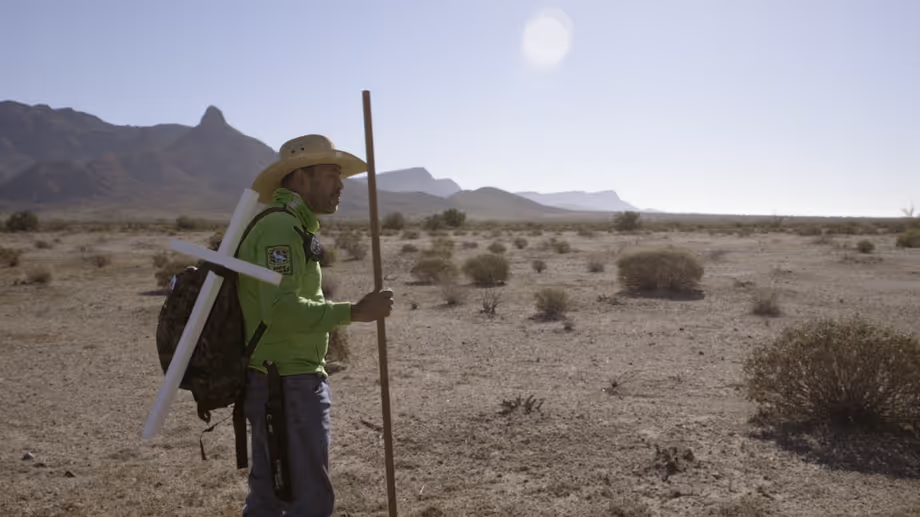
Águilas Discussion Guide
FILM SUMMARY
Along the scorching southern border in Arizona, only an estimated one out of every five missing migrants is ever found. Águilas is the story of one group of searchers, the Águilas del Desierto, composed largely of immigrant Latinos. Once a month this group of volunteers—construction workers, gardeners, and domestic laborers by day—sets out to recover the missing, often reported to them by loved ones thousands of miles away.
USING THIS GUIDE
This guide is an invitation to dialogue. It is based on a belief in the power of human connection and designed for people who want to use Águilas to engage family, friends, classmates, colleagues, and communities. In contrast to initiatives that foster debates in which participants try to convince others that they are right, this resource envisions conversations undertaken in a spirit of openness in which people try to understand one another and expand their thinking by sharing viewpoints and actively listening to one another.
The discussion prompts are intentionally crafted to help a wide range of audiences think more deeply about the issues in the film. Rather than attempting to address them all, choose one or two that best meet your needs and interests. And be sure to leave time to consider taking action. Planning next steps can help people leave the room feeling energized and optimistic, even in instances when conversations have been difficult.
For more detailed event planning and facilitation tips, visit communitynetwork.amdoc.org.

North By Current Discussion Guide
FILM SUMMARY
Filmmaker and artist Angelo Madsen Minax returns to his rural Michigan hometown after the death of his young niece. Decades of home movies and ethereal narration reflect on struggles with grief and addiction as Madsen examines family, faith, and transgender identity.
USING THIS GUIDE
This guide is an invitation to dialogue and requires preparation before you and your community dive in. This guide is designed for people who want to use North By Current to engage family friends, classmates, colleagues, and communities in honest, though challenging, conversations that will require all participants remain committed to being fully present. Conversations that center gender identity; feelings of belonging; addiction; abuse and safety; loss and grief can be difficult to begin and facilitate, but this guide is meant to support you in sustaining conversations in community. In contrast to initiatives that foster debates in which participants try to convince others that they are right, this document envisions conversations undertaken in a spirit of openness in which people listen actively and share different experiences and viewpoints with care and respect.
This discussion guide is meant to inspire people with varying degrees of knowledge, as well as dynamic and different experiences, in relation to these topics to enter the conversation, and stay present in the conversation, in order to impact change and awareness.
The discussion prompts are intentionally crafted to help a wide range of audiences think more deeply about the topics in the film. Rather than attempting to address them all, choose the questions that best meet your needs and interests.And be sure to leave time to consider taking action. Planning next steps can help people leave the room feeling energized and transformed, even in instances when conversations have been difficult and/or uncomfortable. Please also consider using the closing activity that gives participants an opportunity to collectively reflect before closing.

Song of the Butterflies Discussion Guide
FILM SUMMARY
Rember Yahuarcani is an Indigenous painter and one of the last surviving members of the White Heron clan of the Uitoto Nation in Peru. He left his Amazonian community to pursue a successful career in Lima, but when he finds himself in a creative rut, he returns home to visit his father, a painter, and his mother, a sculptor, and discovers why the stories of his ancestors cannot be forgotten.
USING THIS GUIDE
This guide is an invitation to dialogue. It is based on a belief in the power of human connection and designed for people who want to use The Song of the Butterfliesto engage family, friends, classmates, colleagues, and communities. In contrast to initiatives that foster debates in which participants try to convince others that they are right, this document envisions conversations undertaken in a spirit of openness in which people try to understand one another and expand their thinking by sharing viewpoints and listening actively.
The discussion prompts are intentionally crafted to help a wide range of audiences think more deeply about the issues in the film. Rather than attempting to address them all, choose one or two that best meet your needs and interests. And be sure to leave time to consider taking action. Planning next steps can help people leave the room feeling energized and optimistic, even in instances when conversations have been difficult.
For more detailed event planning and facilitation tips, visit communitynetwork.amdoc.org.

Things We Dare Not Do Discussion Guide
FILM SUMMARY
In the small Mexican coastal village of El Roblito, 16-year-old Ñoño lives what seems to be an idyllic existence with his loving family. But he holds a secret. Defying gender norms, Ñoño works up the courage to tell his family he wants to live his life as a woman. Yet when violence interrupts a community celebration, he must face the reality of a country shrouded in machismo and transphobia.
USING THIS GUIDE
This guide is an invitation to dialogue. It is based on a belief in the power of human connection and designed for people who want to use Things We Dare Not Do to engage family, friends, classmates, colleagues, and communities. In contrast to initiatives that foster debates in which participants try to convince others that they are right, this document envisions conversations undertaken in a spirit of openness in which people try to understand one another and expand their thinking by sharing viewpoints and listening actively.
The discussion prompts are intentionally crafted to help a wide range of audiences think more deeply about the issues in the film. Rather than attempting to address them all, choose one or two that best meet your needs and interests. And be sure to leave time to consider taking action. Planning next steps can help people leave the room feeling energized and optimistic, even in instances when conversations have been difficult.
For more detailed event planning and facilitation tips, visit communitynetwork.amdoc.org.
LETTER FROM THE FILMMAKER
I had a secret in my life and I wanted to go in search of a place where I could talk about it. I thought that talking about the secrets would make me grow up, become more mature or that maybe it would be the other way around, that maturing and growing up would make me talk about the secrets.
The film just came to be, it wrote itself while making the film. At first, I only knew I wanted to film something that would feel like a process of growing up. I thought that filming with kids in a space where you could get to feel first-hand the violence we live in Mexico would allow me to be close to the transformation process of a coming of age.
I got to Roblito, and after almost four years of being close to those who wake up, work and sleep there, I began to feel and understand that the waves of violence in that town are awful, painful and traumatizing but everyone around is keeping up with their daily random routine.
Ñoño grabbed our attention. She was the oldest of the pack of kids, and I felt particular empathy towards her, maybe because we both rejected the masculinity of the adults from the town. She’s the only teenager that hasn’t gotten out of that place, the only adolescent that keeps hanging out with the kids.
We developed a friendship, and thanks to that I noticed that she was also keeping a secret: she dresses as a woman when nobody’s watching. I think that the fact that we both were keeping a secret from our parents brought us closer despite our different ages and issues. It made us want to listen to each other. I talked to her about the contradiction of not being able to talk publicly about my boyfriend, and she talked to me about his dream of dressing as a woman. That was the beginning of a long journey of talks, moments, and dreams shared between us that got captured by the camera, and therefore, the film.
All the time I had ethical conflicts during the process of making the film. I worked with children and tried to be clear with them and also with their parents, all the time. That was the only way I found myself comfortable doing this movie. To me, it was important not to only be fair as a filmmaker, but also to be fair as a human being. For example, there is a sequence where I am in the middle of an intimate family confession and I was filming at the time. Suddenly the situation became so intimate that I was feeling out of place and I asked the family for permission to go out and leave them alone talking without a camera. It was they who decided for me to stay. Because they know me, they knew my inner conflicts. I was trying to find out how to be brave enough to find acceptance in the authority structure (family in this case). And Ñoño was doing so by asking her parents for permission to dress as a woman. And they knew how important it was for me to not only be there but also to film as well.
Things we dare not do is the outcome of this journey of dreams, accidents, and experiences. It’s a film that seeks to make people feel more compassionate towards the complicated process of coming of age.
—Bruno Santamaria Razo
Things We Dare Not Do Delver Deeper
In the small Mexican coastal village of El Roblito, 16-year-old Ñoño lives what seems to be an idyllic existence with his loving family. But he holds a secret. Defying gender norms, Ñoño works up the courage to tell his family he wants to live his life as a woman, a fraught decision in a country shrouded in machismo and transphobia.
Boylan, Jennifer Finney. She's Not There: A Life in Two Genders. New York : Penguin Random House, 2013.
She’s Not There was one of the first works to present trans experience from the perspective of a literary novelist, opening a door to new understanding of love, sex, gender, and identity. Boylan inspired readers to ask the same questions she asked herself: What is it that makes us---ourselves? What does it mean to be a man, or a woman? How much could my husband, or wife, change—and still be recognizable as the one I love?
Hoffman-Fox, Dara. You and Your Gender Identity: A Guide to Discovery. New York : Skyhorse Publishing, 2017.
In this groundbreaking guide, Dara Hoffman-Fox, LPC, accomplished gender therapist and thought leader whose articles, blogs, and videos have empowered thousands worldwide, helps you navigate your journey of self-discovery in three approachable stages: preparation, reflection, and exploration.
Krieger, Irwin. Helping Your Transgender Teen: A guide for parents. Berlin : Imprint, Springer, 2014.
If you are the parent of a transgender teen, this book will help you understand what your child is feeling and experiencing. Irwin Krieger is a clinical social worker with many years of experience helping transgender teens. This book brings you the insights gained from his work with these teenagers and their families. According to the author, “Today’s teens have access to a wealth of information on the internet. Teenagers who are wondering about gender identity soon find out what it means to be transgender or transsexual. Parents, on the other hand, know little about this topic. When a teenager declares he or she is transgender, parents fear that their child is confused and is choosing a life fraught with danger. I wrote this book to help parents of transgender teens gain an understanding of this complex subject.” "Helping Your Transgender Teen" begins with the basic information you and your family need. The central chapters of the book address the fears and concerns most parents of transgender teens share. The final chapters guide you through the steps you can take to discover what is best for your child. Although written for parents, this book is also useful for pediatricians, therapists, educators and others who work with teenagers and young adults. "Helping Your Transgender Teen" provides answers to many of your questions about adolescent gender identity.
Meadow, Tey. Trans Kids: Being Gendered in the Twenty-First Century. Berkley : University of California Press, 2018.
Trans Kids is a trenchant ethnographic and interview-based study of the first generation of families affirming and facilitating gender nonconformity in children. Whereas previous generations of parents sent such children for psychiatric treatment aimed at a cure, these parents agree to call their children new names, allow them to wear whatever clothing they choose, and approach the state to alter the gender designation on their passports and birth certificates. Sociologist Tey Meadow argues that these parents are negotiating gender in new and significant ways, with everyone and everything, from intimates to institutions.
Snorton, Reily. Black on Both Sides: A Racial History of Trans Identity. Minn. : University of Minnesota Press, 2017.
The story of Christine Jorgensen, America’s first prominent transsexual, famously narrated trans embodiment in the postwar era. Her celebrity, however, has obscured other mid-century trans narratives—ones lived by African Americans such as Lucy Hicks Anderson and James McHarris. Their erasure from trans history masks the profound ways race has figured prominently in the construction and representation of transgender subjects. In Black on Both Sides, C. Riley Snorton identifies multiple intersections between blackness and transness from the mid-nineteenth century to present-day anti-black and anti-trans legislation and violence.

Pier Kids Discussion Guide
Pier KidsDiscussion Guide
View the trailer here and sign up to receive updates here.
Film Summary
On the Christopher Street Pier in New York City, homeless queer and trans youth of color forge friendships and chosen families, withstanding tremendous amounts of abuse while working to carve out autonomy in their lives. With intimate, immersive access to these fearless young people, Pier Kidshighlights the precarity and resilience of a community many choose to ignore.
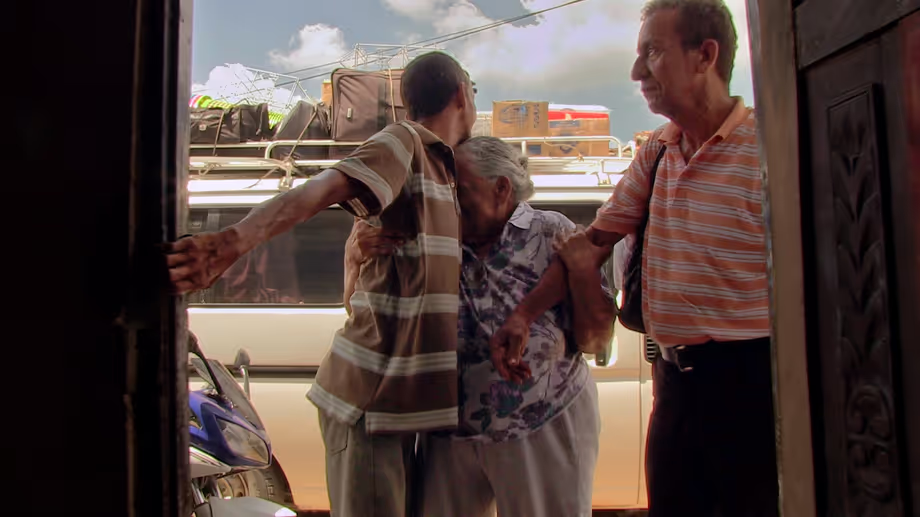
La Casa De Mama Icha Discussion Guide
La Casa de Mama Icha offers a profound meditation on notions of home and the inescapable pull of one’s motherland. The documentary follows María Dionisia Navarro, otherwise known as Mama Icha, on a physical and spiritual journey that draws on the complexities inherent to many migrant experiences: distance, the loved ones left behind, and the problem of aging in a country that doesn’t feel like your own.
At ninety-three, Mama Icha feels that the end of her life is near. Despite protests from her family, she spends her days focusing on just one thing: returning to her native village of Mompox in northern Colombia. Mama Icha dreams of passing her final years taking comfort in the landscapes of her youth, walking along the Magdalena River at dusk, surrounded by her relatives and neighbors in the courtyard of the house that she painstakingly had built during her years of absence, with the money she sent from abroad.
Thirty years prior, Mama Icha had emigrated to the United States to help her daughter with the care of her children, Mama Icha’s grandchildren, and remained ever since. Now, against the best wishes of her family in the U.S. who feel that she’s built an admirable life in Philadelphia complete with Social Security, a community that supports her, and access to important senior resources, Mama Icha boards a plane and flies back to Colombia where she meets her sons, Gustavo and Alberto, who have been in charge of her house while she’s been gone.
But upon returning, the idyllic world of her memories is put up against a harsh reality of deteriorating family relationships and broken expectations. The confrontation is disappointing and forces Mama Icha to consider exactly how much she’s willing to sacrifice for the notion of home that she’s longed for so long.

La Casa De Mama Icha Delve Deeper
These suggested readings provide a range of perspectives on issues raised by the POV documentary La Casa de Mama Icha and allow for deeper engagement. Compiled by Sarah Burris from Bay County Public Library.
Adult Non-Fiction
Cathey, Kate. Colombia: Culture Smart! The Essential Guide to Customs & Culture. (Second Edition) Kuperard. 2019.
Colombia has a spectacular and variant landscape, embracing tropical beaches, highland plateaus, the rugged, snow-capped peaks of the Andes, arid deserts, and dense Amazonian jungle. Colombian society is equally diverse. Stylish, cosmopolitan cities coexist with poverty in the beautiful countryside. As a result of the 16th-century Spanish conquest, modern Colombia’s multiethnic society is a synthesis of Spanish, indigenous, and African traditions—evident in the music, in the food, and in Barranquilla’s famous Carnival. The Colombian people are emerging from decades of crushing civil war and lawlessness with their spirits unbroken. Animated, lighthearted, and ever ready to enjoy the moment, they are looking to the future with hope and are eager to share their rich and beautiful country with the outside world.
Fajardo, Anika. Magical Realism for Non-Believers: A Memoir of Finding Family.University of Minnesota Press. 2019.
He loved Colombia too much to leave it. The explanation from her Minnesotan mother was enough to satisfy a child’s curiosity about her missing father. But at twenty-one, Anika Fajardo wanted more. She wanted to know her father better and to know what kind of country could have such a hold on him. And so, in 1995, Fajardo boarded a plane and flew to Colombia to discover a birthplace that was foreign to her and a father who was a stranger. There she learns that sometimes, no matter how many pieces you find, fitting together a family history isn’t easy.
Feiling, Tom. Short Walks from Bogotá: Journeys in the new Colombia. Penguin Random House, 2012.
For decades, Colombia was the 'narcostate'. Now travel to Colombia and South America is on the rise, and it's seen as one of the rising stars of the global economy. Where does the truth lie?
Writer and journalist Tom Feiling, author of the acclaimed study of cocaine The Candy Machine, has journeyed throughout Colombia, down roads that were until recently too dangerous to travel, to paint a fresh picture of one of the world's most notorious and least-understood countries. He talks to former guerrilla fighters and their ex-captives; women whose sons were 'disappeared' by paramilitaries; the nomadic tribe who once thought they were the only people on earth and now charge $10 for a photo; the Japanese 'emerald cowboy' who made a fortune from mining; and revels in the stories that countless ordinary Colombians tell.
Gawande, Atul. Being Mortal: Medicine and What Matters in the End.Metropolitan Books; 2014.
Medicine has triumphed in modern times, transforming birth, injury, and infectious disease from harrowing to manageable. But in the inevitable condition of aging and death, the goals of medicine seem too frequently to run counter to the interest of the human spirit. Nursing homes, preoccupied with safety, pin patients into railed beds and wheelchairs. Hospitals isolate the dying, checking for vital signs long after the goals of cure have become moot. Doctors, committed to extending life, continue to carry out devastating procedures that in the end extend suffering. Gawande, a practicing surgeon, addresses his profession's ultimate limitation, arguing that quality of life is the desired goal for patients and families. Gawande offers examples of freer, more socially fulfilling models for assisting the infirm and dependent elderly, and he explores the varieties of hospice care to demonstrate that a person's last weeks or months may be rich and dignified.
Rodrigo, Garcia. A Farewell to Gabo and Mercedes: a Son’s Memoir of Gabriel García Márquez and Mercedes Barcha.HarperVia, 2021.
In March 2014, Gabriel García Márquez, one of the most acclaimed writers of the twentieth century, came down with a cold. The woman who had been beside him for more than fifty years, his wife Mercedes Barcha, was not hopeful; her husband, affectionately known as “Gabo,” was then nearly 87 and battling dementia. I don't think we'll get out of this one, she told their son Rodrigo. Hearing his mother’s words, Rodrigo wondered, “Is this how the end begins?” To make sense of events as they unfolded, he began to write the story of García Márquez’s final days. The result is this intimate and honest account that not only contemplates his father’s mortality but reveals his remarkable humanity.
Velásquez, Mariana. Colombiana: A Rediscovery of Recipes and Rituals from the Soul of Columbia. Harper Wave, 2021.
To Mariana Velásquez, a native of Bogotá, the diverse mix of heritages, cultures, and regions that comprise Colombian food can be summed up in one simple concept: More is more. No matter what rung of society, Colombians feed their guests well, and leave them feeling nourished in body and soul. In Colombiana, the award-winning recipe developer and food stylist draws on the rich culinary traditions of her native land and puts her own modern twist on dishes beloved by generations of Colombians.
Warnick, Melody. This is Where You Belong: the Art and Science of Loving the Place You Live. Penguin Random House, 2016.
The average restless American will move 11.7 times in a lifetime. For Melody Warnick, it was move #6, from Austin, Texas, to Blacksburg, Virginia, that threatened to unhinge her. In the lonely aftermath of unpacking, she wondered: Aren’t we supposed to put down roots at some point? How does the place we live become the place we want to stay? This time, she had an epiphany. Rather than hold her breath and hope this new town would be her family’s perfect fit, she would figure out how to fall in love with it no matter what.