
Love Child: Asylum Policy and U.S. Law
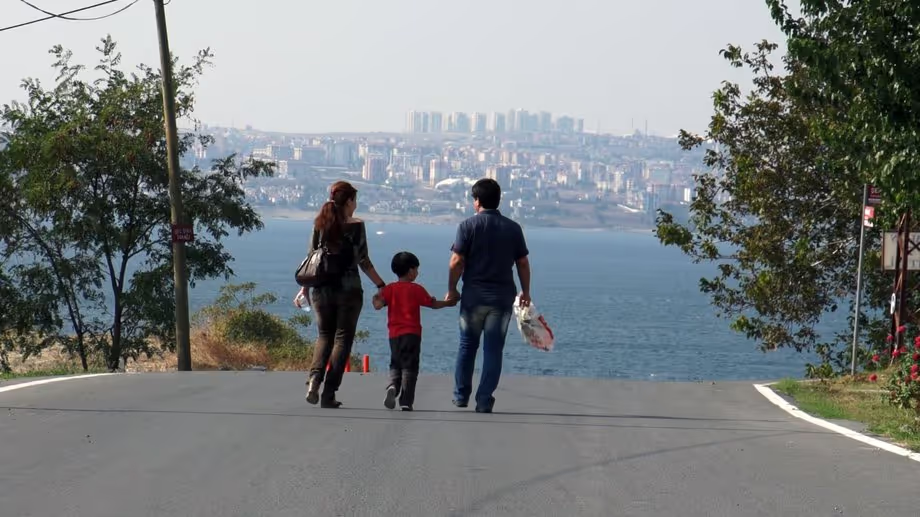
Iranian teachers, Sahand and Leila, are university educated and economically secure. They speak English – not well, but enough to get by. Theirs is not the stereotypical refugee story. Nevertheless, they have been refugees since 2012.
When Mani was born, his parents were both legally married to other people. Mani is evidence of their adultery, a sin which is also a capital crime in Iran. Afraid for their lives, they flee to seek asylum in Turkey, and a more permanent home someplace in the West, beyond the reach of Iranian intelligence.
Because Danish filmmaker, Eva Mulvad, documented their complicated and frustrating journey for six years, Love Child provides a case study that students can examine. In this lesson, students will consider American immigration practices and policies and take on the role of the immigration judge, studying relevant ethics and laws, and then providing a written “verdict” on whether Leila, Sahand, and Mani should be permitted to resettle in the U.S.
A Note from Curriculum Creator, Dr. Faith Rogow
Adolescents commonly experience feelings conjured by stories and these feelings can be difficult to understand; for some, that can lead to feelings of disconnection, isolation, and even alienation. Finding the universal themes in their own life stories can help them understand that they are, indeed, unique, but also connected. At a time when many people are pulling away from those who are different (racially, religiously, ethnically), finding the themes that are common to humanity can provide common ground, helping people better understand those they define as “other.” As an added benefit, recognizing the universal themes in their own stories can help students identify (and perhaps even connect with) themes in the literature they are assigned to read. Pay close attention to the learners in your care as you engage in this lesson - check-in with them, create community rules to ensure that no harm is fostered in your classroom.
Subject Areas
- Global Studies
- Civics
- Research Skills
- Ethics
- Law
Grade Levels: [9-10]
Objectives:
In this lesson, students will:
- Learn the definitions of: refugee, asylum, statelessness, well-founded fear
- Use research skills to find current U.S. policy on granting asylum
- Hear and read “testimony” from a family applying for asylum
- Apply what they learn about U.S. policy to the situation of the family in Love Child, taking into account ethical responsibilities, as well as the law
- Issue a written “verdict” based
Materials:
- Film Clips from Love Child and a way to screen them; also ongoing access to the clips for students to review as needed
- “Testimony” Handout – This is a document compiled from scenes in Love Child that cannot be screened as part of this lesson. It fills in important parts of the story. If you are in a position to screen the entire film with students, you do not need this handout.
- Internet access for research purposes
Time Needed:
One 45-minute class period, preceded and followed by homework. Optional follow-up class for students to share and discuss their verdicts.
Love Child Discussion Guide
View the trailer hereand sign up to receive updates here.
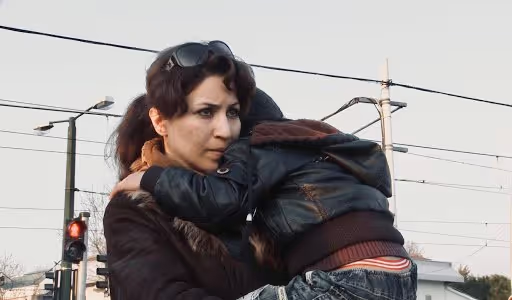
With adultery punishable by death in Iran, a young couple make the fateful decision to flee the country with their son. Love Child follows the trio on their life-threatening journey to plead asylum and witnesses a mother’s heartbreaking fight to keep her family together and secure a future for her son.
Love Child Delve Deeper List
With adultery being punishable by death in Iran, a young couple makes the fateful decision to flee the country with their son Mani. Love Child, is the intimate love story about an illicit family on a journey to seek asylum in Turkey and start a new life.
ADULT NONFICTION
Boochani, Behrouz. No Friend But the Mountains: Writing from Manus Prison. Toronto, Canada: House of Anansi Press Inc, 2019.
Winner of the Victorian Prize for Literature, “No Friend but the Mountains” was written, text message by message, by Behrouz Boochani, as he documented his experience in Manus Island, a refugee detention center off the coast of Australia.
Bui, Thi. The Best We Could Do: An Illustrated Memoir. New York: Abrams Comicarts, 2018.
The past and future clash for one family after the fall of Saigon in Thi Bui’s debut graphic memoir. Bui recounts her family’s journey from South Vietnam to a Malaysian refugee camp and finally the Bay Area. The sacrifices she must make as an immigrant and new mother are uncovered in this family tale that questions what makes a family, especially in times of crisis.
Luiselli, Valerie. Tell Me How It Ends: An Essay in Forty Questions. Minneapolis, Minnesota: Coffee House Press, 2017.
In “Tell Me How It Ends” Valeria Luiselli describes what happens to the tens of thousands of unaccompanied minors arriving in the US without papers, through the construct of the 40 questions they are asked in the court forms.
Nayeri, Dina, The Ungrateful Refugee: What Immigrants Never Tell You. New York, New York: Catapult, 2019.
In “The Ungrateful Refugee” Nayeri confronts notions like ‘the swarm.’ and, on the other hand, ‘good’ immigrants. She calls attention to the harmful way in which Western governments privilege certain dangers over others. With surprising and provocative questions, this book challenges the reader to rethink how they consider the refugee crisis.
Nguyen, Viet Thanh. The Displaced: Refugee Writers on Refugee Lives. New York: Harry N. Abrams, 2018.
Edited by Viet Thanh Nguyen, “The Displaced” features essays about exile and dislocation by 17 refugee writers from around the world.
Shukla, Nikesh. The Good Immigrant: 26 Writers Reflect on America. New York, New York: Little Brown and Company, 2019.
In this book, editors Nikesh Shukla and Chimene Suleyman hand the microphone to an incredible range of writers to share their powerful personal stories of living between cultures and languages while struggling to figure out who they are and where they belong.
Wamariya, Clemantine. The Girl Who Smiled Beads: A Story of War and What Comes After. New York, New York: The Crown Publishing Group, 2018.
Clemantine Wamariya was six years old when her mother and father began to speak in whispers, when neighbors began to disappear, and when she heard the loud, ugly sounds her brother said were thunder. In 1994, Clemantine Wamariya and her Claire, fled the Rwandan massacre and spent the next six years migrating through seven African countries, searching for safety -- perpetually hungry, imprisoned, and abused, enduring and escaping refugee camps, finding unexpected kindness, and witnessing inhuman cruelty.
Portraits and Dreams Discussion Guide
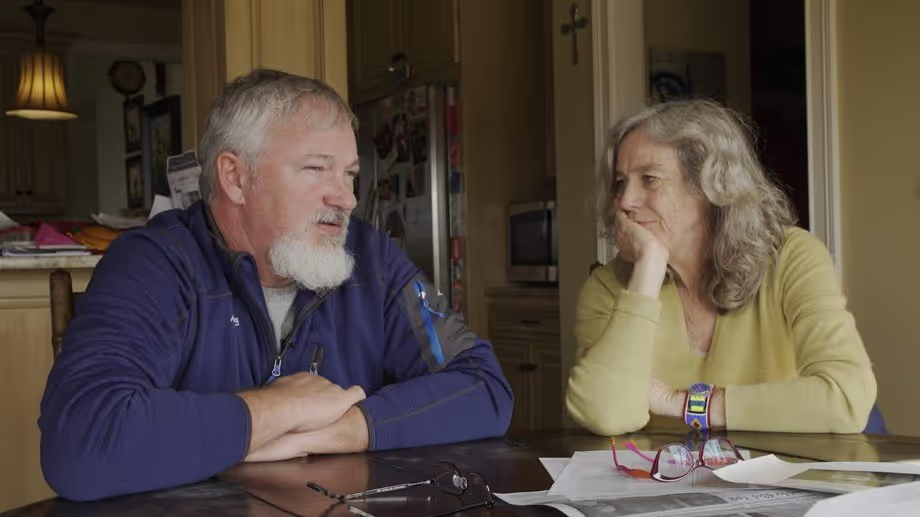
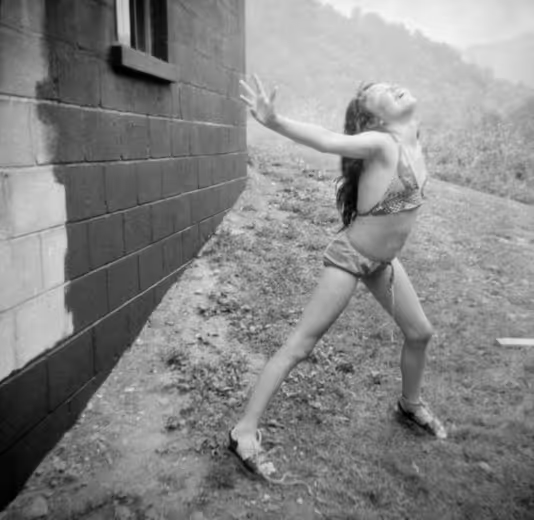
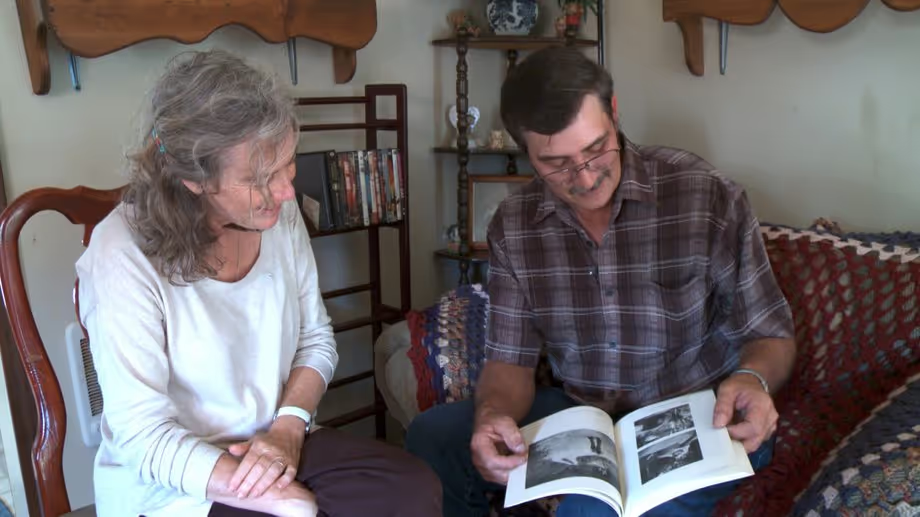
Portraits and Dreams revisits photographs created by Kentucky schoolchildren in the 1970s and the place where the photos were made. The film is about the students, their work as visionary photographers and the lives they have led since then, as well as the linkage of personal memory to the passage of time.
Portraits and Dreams: Framing and Point of View in Self and Community Portraits
Celebrated photographer Wendy Ewald has spent her life teaching students in communities around the world to record their own family histories on camera. Her seminal 1985 work, Portraits and Dreams: Photographs and Stories By Children of The Appalachians, was the result of a unique creative collaboration between Ewald and the students she taught at three elementary schools in Letcher County, Kentucky, in the 1970s. Tasked with finding authentic ways of representing the lives of these children, she gave each of them a camera and interviewed them about their childhood in the mountains. The photographs represented a rare opportunity for children living in rural Appalachia to reflect on their families, dreams, fears and release their vibrant imaginations. In the documentary Portraits and Dreams, co-directed by Ewald and Elizabeth Barret, the photographer returns to Kentucky and visits with students she taught in Appalachia whose work formed the book, who are now adults with families of their own.
This lesson acknowledges that students have insight into themselves and their communities and that such insight is worthy of deliberate self-expression. Throughout the lesson, students will learn about a rural Appalachian community, and a group of middle school students who engaged in a long term photographic project with Wendy Ewald. Clips of the young photographers discussing their work--and their lives since then-- will help students explore and discuss tensions between insider and outsider perspectives of community, with a particular focus on depictions and experiences of poverty. Students will have the opportunity to learn about photographic elements and then apply these elements in their own portraits. The selected clips, and related assignments, are designed to help students slow down and interpret and make meaningful artistic decisions and to pay attention to how communities are framed in the media.
Teaching Philosophies
Wendy Ewald
As an artist, when I first began to teach, I used my intuitive teaching skills to help my students create the photographs I sensed they were capable of making. I felt my job was to recognize the uniqueness of each child’s vision and nurture it. I could see the students gaining self-confidence as they became fluent in this new medium. They often made discoveries about themselves while examining their surroundings. And at times the students’ photographs helped their teachers understand how they saw their communities and home lives.
Sarah Bausell
As a former high school English teacher and current teacher educator, my approach to teaching emerges from a strong belief in the power of storytelling and, relatedly, a commitment to pedagogies that honor student rights to self-expression. For educators, this film serves as a dual reminder: students are uniquely suited to describe their lives and we must reimagine our work as teachers to make such deliberate self-expression central to our curriculum. This lesson is designed to guide students through self-expression and also deepen their awareness of and push-back on dominant and oftentimes misanthropic portrayals of communities.
A Note to Teachers
The photographers featured in this film share significant socio-cultural and economic insight into their Appalachian communities. For many students and teachers alike, the intimate portrayals of generational poverty and some of the personal revelations about childhood physical abuse and hunger illuminated in this documentary may be triggering. Pay close attention to the learners in your care, and in particular pay attention to the ways that they interact with one another, their photographs, and the stories shared through this film.
Subject Areas:
- English Language Arts
- Art (Photography, Film Studies)
- Social Studies
- Social Emotional Learning
Grade Levels: 7-12
Objectives:
In this lesson, students will:
- English Language Arts (ELA): Assess and write about how point of view, framing, and symbol shapes the content and style of a photograph;
- Social Studies: Describe the connections between the physical environment of a place and the economic activities found there; examine structural factors of poverty and conflicts between representations of community and community members’ various experiences;
- Art: Understand and analyze key photographic concepts, such as point of view, framing, and symbol; make photographs and explain aesthetic choices using written text;
- Social Emotional Learning: engage diverse perspectives and empathize with others, including those from diverse backgrounds and cultures.
Materials:
- Student journals or writing materials
- Cameras-Many students have access to cell phones with cameras. Something to keep in mind are that these cameras vary in quality and, oftentimes, have a host of lenses/add ons. If students are asked to use their own phone as a camera, then teachers should ask students to think about the various affordances and limitations of that particular tool as they plan for and take their own portrait.
- “The War on Poverty” Life Magazine, 1964
- Reading Photographs Handout
Time Needed:
Four 45 minute class periods, with optional homework in between
Portraits and Dreams Delve Deeper Reading List
Portraits and Dreams revisits photographs created by Kentucky schoolchildren in the 1970s and the place where their photos were made. Photographer and artist Wendy Ewald, who guided the students in making their visionary photographs, returns to Kentucky and learns how the lives and visions of her former students have changed. The film combines the new narratives and insights of the now adult students.
Film maker, Wendy Ewald, has published extensively on topics illuminated in Portraits and Dreams You can explore her full bibliography on her website: www.wendyewald.com/books. Select titles are highlighted below:
Ewald, Wendy and Alexandra Lightfoot. I Wanna Take Me a Picture: Teaching Photography and Writing to Children. New York, New York: Beacon Press, 2002
Written for parents and teachers, I Wanna Take Me a Picture is an accessible and practical guide to getting children involved in photography. Through a series of lessons from self-portraiture to representing their dreams- it teaches everything a beginner needs to know: how to compose a picture, set up a darkroom and develop film.
Ewald, Wendy. Portraits and Dreams. MACK
This collection of photographs and essays was born out of Wendy Ewald's experiences teaching young children in Eastern Kentucky. The photographs included reflect the work of these young children and include self-portraits, family portraits, and photographs meant to capture the childrens' dreams.
Ewald, Wendy and Katherine Hyde, et al.. Literacy and Justice Through Photography: A Classroom Guide. New York, New York: Teachers College Press, 2011.
This practical guide will help teachers to use the acclaimed “Literacy Through Photography” method developed by Wendy Ewald to promote critical thinking, self-expression, and respect in the classroom.
About Love Delve Deeper Reading List
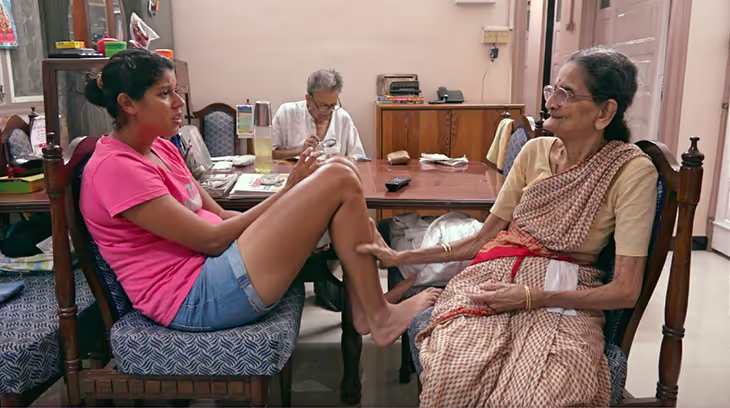
Three generations of the Phadke family live together in their home in Mumbai. When the youngest daughter turns the camera toward her family, the personal becomes political as power structures within the family become visible—and eventually unravel. Cruel and comic in equal measure, the film examines the vagaries of affection across generations, tied together by something stranger than love.
Gidia, Sujatha. Ants Among Elephants: An Untouchable Family and the Making of Modern India. New York, New York: Farrar, Straus, and Giroux, 2018.
Like one in six people in India, Sujatha Gidia was born an untouchable. In this biography, Gidia explores how her family history was at once extraordinary and typical. A moving portrait of love, hardship, and struggle, Ants Among Elephants is a personal history of modern India told from the bottom up.
Mehta, Suketu. Maximum City: Bombay Lost and Found. New York, New York: Penguin Books, 2004.
Suketu Mehta gives an insider’s view of Mumbai approaching the city from unexpected angles, and different points of view. As each individual story unfolds, Mehta also recounts his own efforts to make a home in Mumbai, after more than 20 years abroad, Candid, impassioned, funny, and heartrending, Maximum City is a revelation of an ancient and ever-changing world.
Patel, Sujata. Bombay and Mumbai: The City in Transition. Uttar Pradesh, India: Oxford India Paperbacks, 2005.
This volume looks at contemporary Mumbai. The papers in this volume explore and explain what Bombay has become in its shape and patterns of living at the beginning of the 21st century. It looks at the implications of change in Mumbai and the ways in which it has affected its people.
Phadke, Shilpa and Sameera Khan Why Loiter?: Women and Risk on Mumbai Streets. New York, New York: Penguin Books, 2011.
Why Loiter? maps the exclusions and negotiations that women from different classes and communities encounter in the nation’s urban public spaces. Based on more than three years of research, Phadke, Khan, and Ranade argue that through women’s access to urban spaces has increased they still do not have equal claim to public space in the city. Drawing on feminist theory, they argue that only by celebrating loitering as an radical act for most Indian women can a truly equal global city be created.
Rohatgi, Pauline Pheroza Gorrej, and Rahul Mehrotra. Bombay to Mumbai: Changing Perspectives. Mumbai, India. The Marg Foundation, 2008.
The history is told here of how, within three centuries, seven west-coast islands evolved into the Bombay peninsula, then into a flourishing center for trade. It ultimately became the cosmopolitan, high rise metropolis of Mumbai.
About Love: A Room of One's Own
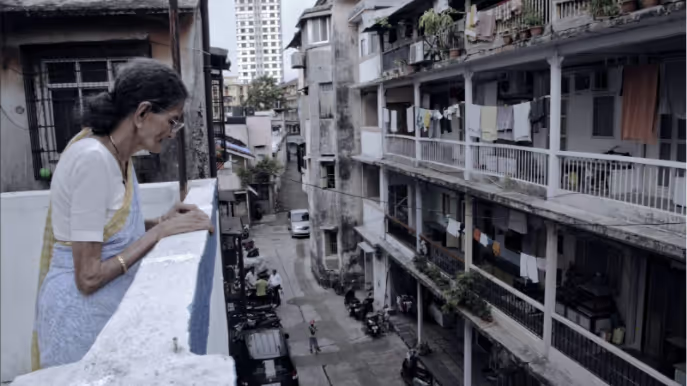
In About Love, filmmaker Archana Phadke offers a revealing portrait of her own family. Three generations of Phadkes live together in Mumbai, India’s financial center. A reasonably well-resourced family, they nevertheless are challenged by the contradictions of making a modern life within India’s Hindu and post-colonial nationalist structures that empower men while marginalizing women.
As Archana interviews her mother she is surprised to learn that the woman who raised her treasures time to be alone so that she can gather her thoughts and write. The writing gives her voice in a situation where she feels like no one listens to her.
This lesson offers students a chance to link and contrast Maneesha Phadke’s need to write with literary giant Virginia Woolf’s famous claim that in order to write, women need money and a room of one’s own (both of which have typically been denied by sexist cultures, laws, and customs). Teacher’s can guide students to explore as much or as little of the specific historical context for Woolf’s writing as suits curriculum needs. It will also be easy to add or skip research skills by assigning students to find information on Woolf or simply supplying the relevant background.
The point of introducing students to Woolf and Maneesha Phadke is to prime them for a metacognitive exercise in which they think about (and write about) their own writing. How do they carve out space and time to ponder their own thoughts, find their own voice, and express themselves? What can they learn from those who have gone before about the challenges, strategies, and rewards of finding ways to share their own voice?
A Note from Curriculum Creator, Dr. Faith Rogow
As educators, we often talk about the importance of students having voice—a chance to discover who they are and express themselves. But we rarely take time to guide them in practices that might help them do just that. Using the filmmaker’s mother, Maneesha, as both example and inspiration, this lesson gives students an opportunity to make an intentional plan that provides them time for reflection and creativity.
Subject Areas:
- English/Language Arts
- Modern Literature
- Women’s/Gender Studies
- Creative Writing
Grade Levels: 10-12
Objectives:
In this lesson, students will:
- Be introduced to the work of writer Virginia Woolf
- Understand Woolf’s comment that for women to write they need “money and a room of one’s own,” including how the comment applies to modern women
- Understand how carving out time to reflect is essential to having a public voice
- Make a plan for creating their own space to reflect and write
Materials
- Excerpt from Virginia Woolf’s A Room of One’s Own
- Film Clips from About Love and a way to screen them
Time Needed:
One 60-minute class period with homework and an option for students to share their writing.
About Love: Discussion Guide
In About Love, filmmaker Archana Phadke offers a revealing portrait of the banal, sometimes disturbing, ever enduring bonds of family. Three generations of the Phadke family live together in downtown Mumbai. Their lives, recorded over the span of three years (2015-2017), reveal the contradictions of a modern, well-educated family making a life within India’s traditional Hindu and post-colonial nationalist structures that empower men while marginalizing women.
As the family copes with caring for ailing elders and preparing for a son’s wedding, viewers are invited to think about the purposes of marriage, the impact of losing independence (either through marriage or infirmity), and what it means to be heard.
Chez Jolie Coiffure Delve Deeper Reading List
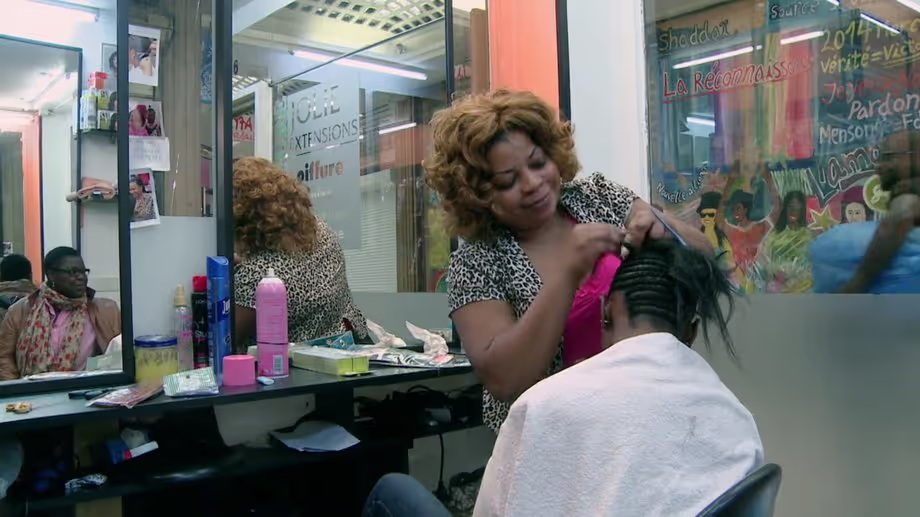
In this captivating documentary filmed in a single tiny room, viewers step inside an underground hair salon with its charismatic proprietor, a Cameroonian immigrant named Sabine. Here, she and her employees style extensions and glue on lashes while watching soaps, dishing romantic advice, sharing rumors about government programs to legalize migrants, and talking about life back home in Cameroon.
Adichie, Chimamanda Ngozi. Americanah. Anchor, 2013.
Ifemelu and Obinze are young and in love when they depart military-ruled Nigeria for the West. Beautiful, self-assured Ifemelu heads for America, where despite her academic success, she is forced to grapple with what it means to be black for the first time. Quiet, thoughtful Obinze had hoped to join her, but with post-9/11 America closed to him, he instead plunges into a dangerous, undocumented life in London. Fifteen years later, they reunite in a newly democratic Nigeria, and reignite their passion—for each other and for their homeland. The novel begins in a flashback when Ifemelu is having her hair braided—the imbued symbolism of hair is a key element in the book. And as a personal expression of identity it’s something every reader, and certainly every woman, can relate to personally.
Bulawayo, NoViolet. We Need New Names. Back Bay Books, 2014.
Darling is only ten years old, and yet she must navigate a fragile and violent world. In Zimbabwe, Darling and her friends steal guavas, try to get the baby out of young Chipo’s belly, and grasp at memories of Before. Before their homes were destroyed by paramilitary policemen, before the school closed, before the fathers left for dangerous jobs abroad. But Darling has a chance to escape: she has an aunt in America. She travels to this new land in search of America’s famous abundance only to find that her options as an immigrant are perilously few.
Busby, Margaret (Editor). New Daughters of Africa: An international anthology of writing by women of African descent.Amistad Press, 2019.
This follow-up to the original landmark anthology brings together fresh and vibrant voices that have emerged from across the globe in the past two decades, from Antigua to Zimbabwe and Angola to the United States. Key figures, including Margo Jefferson, Nawal El Saadawi, Edwidge Danticat, and Zadie Smith, join popular contemporaries such as Chimamanda Ngozi Adichie, Imbolo Mbue, Yrsa Daley-Ward, Taiye Selasi, and Chinelo Okparanta in celebrating the heritage that unites them. Each of the pieces in this remarkable collection demonstrates an uplifting sense of sisterhood, honors the strong links that endure from generation to generation, and addresses the common obstacles female writers of color face as they negotiate issues of race, gender, and class and address vital matters of independence, freedom, and oppression.
Gyasi, Yaa. Homegoing. Vintage, 2017.
Ghana, eighteenth century: two half-sisters are born into different villages, each unaware of the other. One will marry an Englishman and lead a life of comfort in the palatial rooms of the Cape Coast Castle. The other will be captured in a raid on her village, imprisoned in the very same castle, and sold into slavery. Homegoing follows the parallel paths of these sisters and their descendants through eight generations: from the Gold Coast to the plantations of Mississippi, from the American Civil War to Jazz Age Harlem. The novel casts light upon slavery’s troubled legacy both for those who were taken and those who stayed—and shows how the memory of captivity has been inscribed on the soul of our nation.Ghana, eighteenth century: two half sisters are born into different villages, each unaware of the other. One will marry an Englishman and lead a life of comfort in the palatial rooms of the Cape Coast Castle. The other will be captured in a raid on her village, imprisoned in the very same castle, and sold into slavery.
Selasi,Taiye. Ghana Must Go by.Penguin, 2014.
This novel takes readers from Accra to Lagos to London to New York, it is at once a portrait of a modern family and an exploration of the importance of where we come from to who we are.
A renowned surgeon and failed husband, Kweku Sai dies suddenly at dawn outside his home in suburban Accra. The news of his death sends a ripple around the world, bringing together the family he abandoned years before. Moving with great elegance through time and place, Ghana Must Go charts their circuitous journey to one another and, along the way, teaches us that the truths we speak can heal the wounds we hide.
Smith, Zadie. Swing Time: A NovelPenguin Books, 2017.
An ambitious, exuberant new novel moving from North West London to West Africa.
Two brown girls dream of being dancers—but only one, Tracey, has talent. The other has ideas: about rhythm and time, about black bodies and black music, what constitutes a tribe, or makes a person truly free. It’s a close but complicated childhood friendship that ends abruptly in their early twenties, never to be revisited, but never quite forgotten, either. The story moves from London to West Africa, where diaspora tourists travel back in time to find their roots, young men risk their lives to escape into a different future, the women dance just like Tracey—the same twists, the same shakes—and the origins of a profound inequality are not a matter of distant history, but a present dance to the music of time.
Chez Jolie Coiffure: Understanding the Push and Pull of International Migration
"She walked on roads, fields, deserts…”
Understanding the Push and Pull of International Migration
Overview
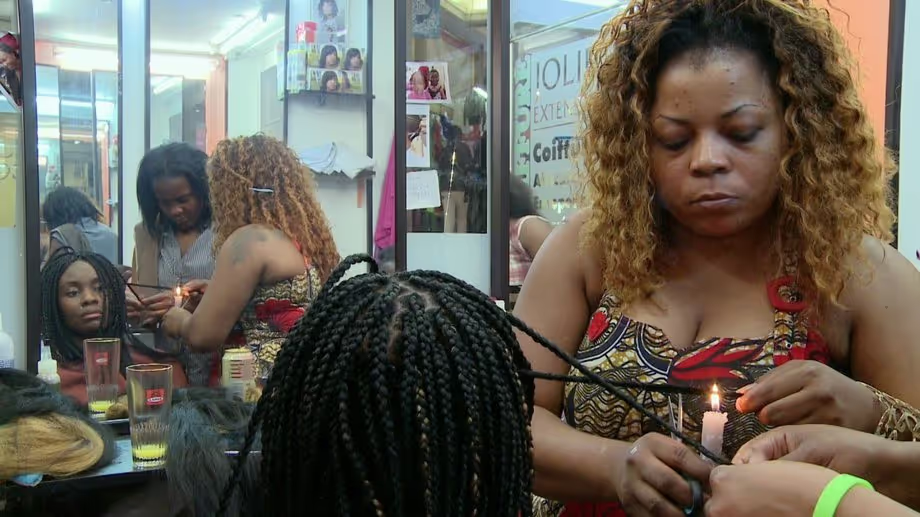
At Jolie Coiffure salon, the charismatic owner Sabine offers much more than the intricate hairstyles advertised in her window displays. Her small shop serves as a community hub where local West African immigrants like herself talk about their experiences, dish romantic advice, reminisce about home, and swap critical information on government policies and actions that impact their precarious lives as immigrants.
Years ago, Sabine left her home in Cameroon when recruited by a Lebanese maid service. As soon as she arrived in Lebanon, her passport was taken and she was trapped in domestic servitude with no rights or freedoms. After two years of abuse, Sabine escaped, travelling mostly on foot through Greece and Syria before seeking asylum in Belgium. She settled in Matonge, the city’s African quarter, where she manages her beauty salon Jolie Coiffure and waits to hear if she will finally be granted asylum or abruptly arrested and deported back to Cameroon.
Filmed entirely inside the tiny salon by director, Rosine Mbakam, Chez Jolie Coiffure captures an intimate look at a year in the lives of Sabine and her community as they navigate legal obstacles and confront personal traumas on their quest for a safe and lasting home in their new country.
In this lesson, students will share and examine their perceptions of and experience with immigration and sometimes vague language of international human migration. Through Sabine’s story and collaborative activities, students will identify “push/pull” factors that that lead individuals and families to leave their countries despite the complex hurdles and personal risks they face. They will then connect the factors that motivated each stage of Sabine’s journey to fundamental human rights as defined in the Universal Declaration of Human Rights. The lesson will culminate with students identifying current media stories of international migration and collaborate in small groups to develop multimedia presentations integrating their understanding of Push/Pull Factors, international human rights, and evaluating if/how these rights are applicable under U.S. policies.
A Note from Curriculum Creator, Allison Milewski
I have a confession to make: my love of teaching is deeply rooted in my own joy for learning. For the past 20 years, I’ve been incredibly privileged to work and live in both New York City and Southeast Asia where every day has presented an opportunity to learn about my students, my craft, our societies, and my own privileges and blind-spots. I have collaborated with diverse and inspiring communities of educators and students and taught across cultures, institutions, and age groups (from six to 60 -- sometimes in the same classroom!) Although every community, every classroom, and every student I’ve encountered is unique, the common thread that connects me to every person I’ve encountered, is the ability to learn from each other and the desire to expand our knowledge and experience by sharing our stories.
Director Rosine Mbakam’s documentary, Chez Jolie Coiffure, beautifully illustrates the revelatory power of storytelling - and the importance of considering who is telling the story about whom. Through the daily life and intimate stories of Cameroonian stylist, Sabine, Mbakam deftly brings into focus complex issues of mass migration, the global refugee crisis, worker exploitation, gender-based violence, and universal human rights as well as the ability of stories to build community and bear witness.
As an educator, I was especially drawn to the opportunity to introduce students to Sabine, an engaging, moving, and charismatic woman whose experiences demonstrate the human impact of academic concepts such as Push/Pull actors and the language of migration. Even as the lesson shifts to broader discussions of universal human rights and social responsibility, students’ activities and discussions can remain firmly grounded in Sabine’s personal story as a migrant, refugee, asylum seeker, and survivor.
A Note to Teachers
This lesson, and the accompanying film, address a range of challenging issues that may be sensitive for some students. I encourage teachers and facilitators to screen the film clips and review all of the related materials in advance of the lesson. Some (or many) of your students may have personal experience with issues such as immigration law, asylum seekers, migrant and refugee rights, labor exploitation, racism, xenophobia, and gender-based violence. Their perspectives and sensitivities should inform how the lesson is presented. It might also be helpful to connect with a school social worker for resources specific to your school’s guidelines and your students’ needs.
Before the lesson, remind the class that this is a supportive environment and make time to review your classroom’s tools for creating a safe-space, including class agreements. These might include guidelines like “no interrupting,” “listen without judgment,” “use respectful language,” “share to your level of comfort,” “you have the right to pass,” etc. And remind students that when they talk about groups of people, they should be careful to use the word “some,” not “all.”
Visit Teaching Tolerance for excellent resources and strategies for tackling challenging topics in the classroom:
- Teaching Tolerance: Let's Talk! Discussing Race, Racism and Other Difficult Topics with Students:
https://www.tolerance.org/magazine/publications/lets-talk - Social Justice Standards | The Teaching Tolerance Anti-bias Framework:
https://www.tolerance.org/professional-development/social-justice-standards-the-teaching-tolerance-antibias-framework - Teaching at the Intersections: Honor and teach about your students’ multiple identities:
https://www.tolerance.org/magazine/summer-2016/teaching-at-the-intersections
Subject Areas:
- Social Studies
- Political Science
- International Relations
- Global History/Global Studies
- Current Events
- Media Studies
- English Language Arts
Grade Levels: [9-12]
Objectives:
Students will
- Examine their perceptions of immigration and immigrants and interrogate implicit biases they may have
- Compare/contrast the different forms of international human migration and define key terms
- Identify “push/pull” factors that lead individuals like Sabine in Chez Jolie Coiffure to migrate to a new country
- Relate the factors that drive international migration to the protections in the Universal Declaration of Human Rights
- Create a multimedia presentation on a current immigration story that illustrates an understanding of migration push/pull factors and Universal Human Rights and assesses if/how the subjects of the story are protected under U.S. immigration, refugee and/or asylum policies
Materials:
- Chez Jolie Coiffure film clips and equipment on which to show them
- Student Handouts
- Student Handout A: The Push and Pull of Migration
- Student Handout B: Push/Pull Factors in Chez Jolie
- Student Handout C: Understanding Sabine’s Story
- Student Handout D: Migration and Universal Human Rights
- Teacher Handouts
- Teacher Handout A: Film Summary
- Teacher Handout B: Key Terms Cut-Outs
- Teacher Handout C: What are Universal Human Rights?
- White board/markers
- Large chart paper (2 sheets for each group of four students)
- Pens and writing paper
- Tape
Time Needed:
Two 50-minute class periods with homework
Chez Jolie Coiffure: Discussion Guide
View the trailer hereand sign up to receive updates here.
In this captivating documentary filmed in a single tiny room, viewers step inside an underground hair salon with its charismatic proprietor, a Cameroonian immigrant named Sabine. She and her employees style extensions and glue on lashes while watching soaps, dishing romantic advice, sharing rumors about government programs to legalize migrants and talking about life back home in Cameroon.